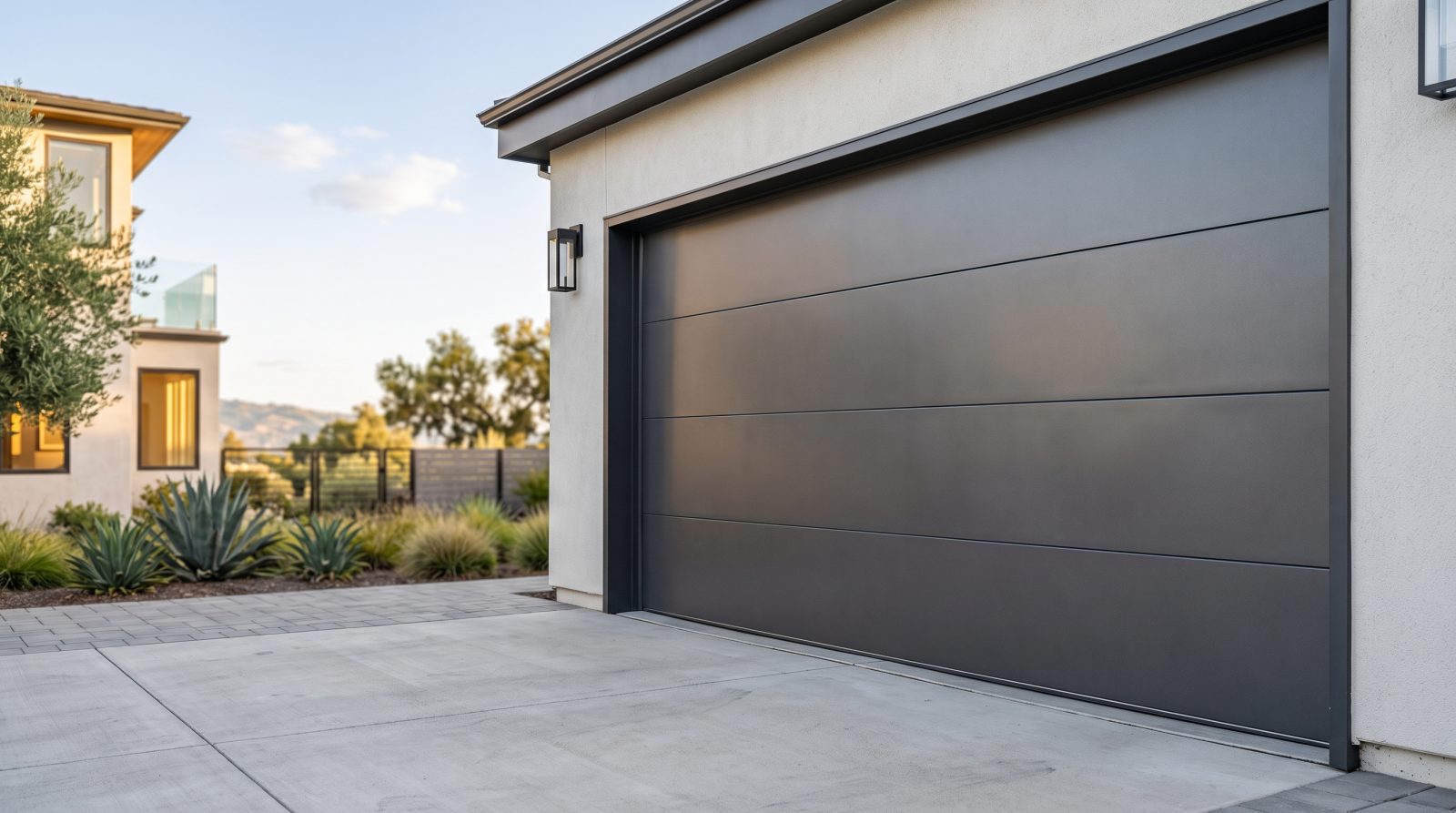
How Steel Garage Doors Are Built (Gauge, Layers, and Why It Matters)
Steel garage doors are described by two numbers that drive almost everything about their strength and feel: gauge and layer count. Gauge measures the thickness of the steel skin, and the scale runs backward — a lower number means thicker, stronger steel. Builder-grade doors often use 27- or 28-gauge steel, mid-range doors typically use 25- or 24-gauge, and premium doors step up to 24-gauge or heavier. The difference shows up in real life as dent resistance, how solid the door sounds when it closes, and how well it holds its shape over years of daily cycling.
Just as important is how many layers the door is made from. A single-layer door is one sheet of formed steel with no insulation — light, inexpensive, and fine for a detached garage in a mild climate, but prone to denting and offering essentially no thermal or sound benefit. A double-layer (two-layer) door adds a backer and a layer of insulation, making it sturdier and quieter. A triple-layer door sandwiches insulation between two steel skins, producing the most rigid, best-insulated, and quietest door — and the one that holds up best to weather, impacts, and time.
The construction you choose also affects the rest of the system. A heavier, well-built steel door puts more demand on the springs, cables, rollers, and opener that carry it. That is why matching the door to correctly rated torsion springs and hardware matters so much: an under-sprung heavy door wears its components faster and is more likely to slam, bind, or come off track — the kinds of urgent failures that leave a car trapped or a garage standing open.
- Gauge runs backward: 24-gauge steel is thicker and stronger than 27-gauge
- Single-layer = lightest and cheapest, but dents easily and adds no insulation
- Double- and triple-layer doors are quieter, more rigid, and more weather-resistant
- A heavier steel door must be matched to correctly rated springs and hardware to avoid premature wear
Durability: What Makes Steel Last (and What Makes It Fail Early)
Steel's biggest advantage is that it resists the problems that plague other materials. Unlike wood, it will not warp, rot, crack, or need repainting every few years. Unlike some composites, a quality steel door holds its dimensions through temperature swings. With modern factory finishes — typically a galvanized coating under a baked-on primer and topcoat — a steel door can hold its appearance and structural integrity for fifteen to thirty years with minimal upkeep. The realistic lifespan depends heavily on construction quality, climate, and how well the moving parts are maintained.
The main enemy of steel is corrosion, and where you live changes the risk a great deal. In coastal regions, salt air accelerates rust, especially at cut edges, seams, and any point where the factory coating is scratched or chipped. In northern climates, road salt and constant freeze-thaw cycles stress both the panels and the hardware. In hot, dry regions, the bigger issues tend to be UV fade on darker colors and the sheer thermal load on an uninsulated door facing the afternoon sun. Choosing the right gauge, a quality finish, and — near the coast — adding routine rinsing and touch-up to your maintenance can meaningfully extend the door's life.
Most steel doors do not fail at the panels first; they fail at the moving parts. Springs are under enormous tension and are typically rated for a set number of open-close cycles, so they wear out on a predictable timeline. Cables fray, rollers wear flat, and tracks bend if the door is forced or struck. A dent in a steel panel is cosmetic, but a snapped spring, a frayed cable, or a section that has jumped its track is a true mechanical and security problem — the door can become impossible to open, or worse, refuse to stay closed, leaving the home exposed.
- Steel resists warping, rotting, and cracking — its main long-term threat is corrosion
- Coastal salt air and northern road salt + freeze-thaw shorten lifespan; rinsing and touch-up help
- UV fade and thermal load are the bigger concerns in hot, sunny regions
- Panels usually outlast the hardware — springs, cables, and rollers are the parts that fail first
Insulation and R-Value: What It Actually Does for Your Garage
Insulated steel doors are rated by R-value, which measures resistance to heat transfer — the higher the number, the better the door slows heat moving in or out. For residential garage doors, common ratings run from roughly R-6 to R-9 for standard insulated doors, with high-end triple-layer doors reaching R-12 to R-18. It is worth understanding that the jump from R-9 to R-16 produces a much smaller real-world difference than the jump from an uninsulated door to an insulated one. The single biggest gain is simply moving from no insulation to any insulation.
Whether insulation is worth the upgrade depends on how you use the space and where you live. If your garage is attached to the house, shares a wall with a living area, or sits beneath a bedroom, an insulated door helps stabilize indoor temperatures and can reduce strain on your heating and cooling. If you use the garage as a workshop, gym, or home office, insulation is close to essential for year-round comfort. In extreme climates — deep-cold northern winters or intense southern heat — the comfort and energy benefits are most pronounced. For a detached, unconditioned garage you rarely enter, a basic door may be perfectly sensible.
There is also a benefit many homeowners do not anticipate: a well-insulated, multi-layer steel door is noticeably quieter and more rigid. It rattles less, opens and closes more smoothly, and feels more solid — which also tends to mean less stress on the opener and hardware over time. The two main insulation materials are polystyrene (rigid foam boards fitted between layers) and polyurethane (foam injected and expanded to fill the panel completely). Polyurethane generally delivers a higher R-value per inch and bonds the layers together for a stronger, quieter door, while polystyrene is the more economical option.
- Standard insulated doors run about R-6 to R-9; premium triple-layer doors reach R-12 to R-18
- The biggest gain is going from none to some insulation — beyond that, returns diminish
- Most valuable for attached garages, rooms above the garage, and workshop/gym/office use
- Polyurethane (injected foam) generally outperforms polystyrene (foam board) on R-value, strength, and quietness
Steel Garage Door Cost: Typical Industry Ranges
Pricing varies widely by door size, gauge, number of layers, insulation type, window and hardware options, and your region's labor rates, so the figures below are typical industry ranges and estimates — not a quote or guarantee. Your actual cost depends on the specifics of your door and home. As a general national picture, a basic non-insulated single-car steel door commonly runs about $600 to $900 installed, while an insulated single-car door is often in the range of $800 to $1,200 installed. Double-wide doors cost more: roughly $1,000 to $1,800 for simpler models and about $1,800 to $3,200 installed for well-insulated, higher-construction double doors.
Several factors push a project toward the higher end of these ranges. Heavier gauge steel, triple-layer construction with polyurethane insulation, decorative window sections, carriage-house styling, custom colors, and upgraded hardware all add cost. Labor is a separate line item — installation alone commonly runs about $150 to $500 for a single door and $300 to $700 for a double — and removing and disposing of the old door, reinforcing a panel for a heavy opener, or correcting prior bad installation can add to the total.
One practical point worth weighing: replacing a steel door is not always necessary. If your panels are sound and the door's trouble is a broken spring, a frayed cable, worn rollers, a misaligned track, or a tired opener, a targeted repair is usually far less expensive than a full replacement — and it can often be done quickly. A genuine inspection should tell you honestly whether you are facing a same-day repair or a planned replacement, rather than defaulting to the most expensive option.
- Basic single-car steel door: roughly $600–$900 installed (typical estimate)
- Insulated single-car door: roughly $800–$1,200 installed (typical estimate)
- Insulated double-wide door: roughly $1,800–$3,200 installed (typical estimate)
- Labor commonly runs $150–$500 (single) or $300–$700 (double); ranges vary by region, scope, and material
- A spring, cable, roller, or track repair is usually far cheaper than full replacement
When a Steel Door Becomes Urgent: Safety, Security, and What to Do Right Now
Because steel doors are heavy and run on parts under high tension, their failures can move from annoying to dangerous fast. The most urgent scenarios are a door that will not open (a car trapped inside before work or an appointment), a door that will not close or has jumped its track (leaving your home and everything in the garage exposed), a visibly bent or sagging section, and the unmistakable bang of a broken spring. These are not problems to power through — they are reasons to stop, stay clear, and get help the same day.
The most important safety rule with a steel door is this: do not force it. If the door is stuck, off-track, or you suspect a broken spring or cable, do not repeatedly hit the opener button and do not try to muscle a jammed door up or down. Garage door springs and cables store tremendous energy; a snapped cable can whip, and a heavy steel section can drop without warning. Forcing a binding door can also bend the track or panels further, turning a modest repair into a major one. If the door is partway open and unsafe, keep people, pets, and vehicles out from under it.
If the door is stuck closed and you must get a vehicle out, locate the emergency release — the red cord hanging from the opener trolley — and pull it only when the door is fully closed and at rest, never while it is partway up, since the door can slam down once disconnected. Then leave the rest to a professional. A door that is stuck open is a security risk that deserves same-day attention; if you cannot safely secure it, stay nearby, keep valuables out of view, and arrange fast help. For any spring, cable, off-track, or stuck-door situation, the safe path is a same-day professional inspection — request a free quote and we will assess the door and tell you honestly whether it needs a quick repair or a replacement.
- Treat these as urgent: door won't open (car trapped), won't close or is off-track (security risk), a bent/sagging section, or the bang of a broken spring
- Never force a stuck door or keep hitting the opener — you can bend the track and worsen the damage
- Springs and cables store dangerous energy; stay clear and never attempt a spring repair yourself
- Use the emergency release cord only when the door is fully closed and at rest, never while it is partway open
- A door stuck open is a security risk that warrants same-day help — secure valuables and arrange fast service