How Smart Garage Door Openers Actually Work
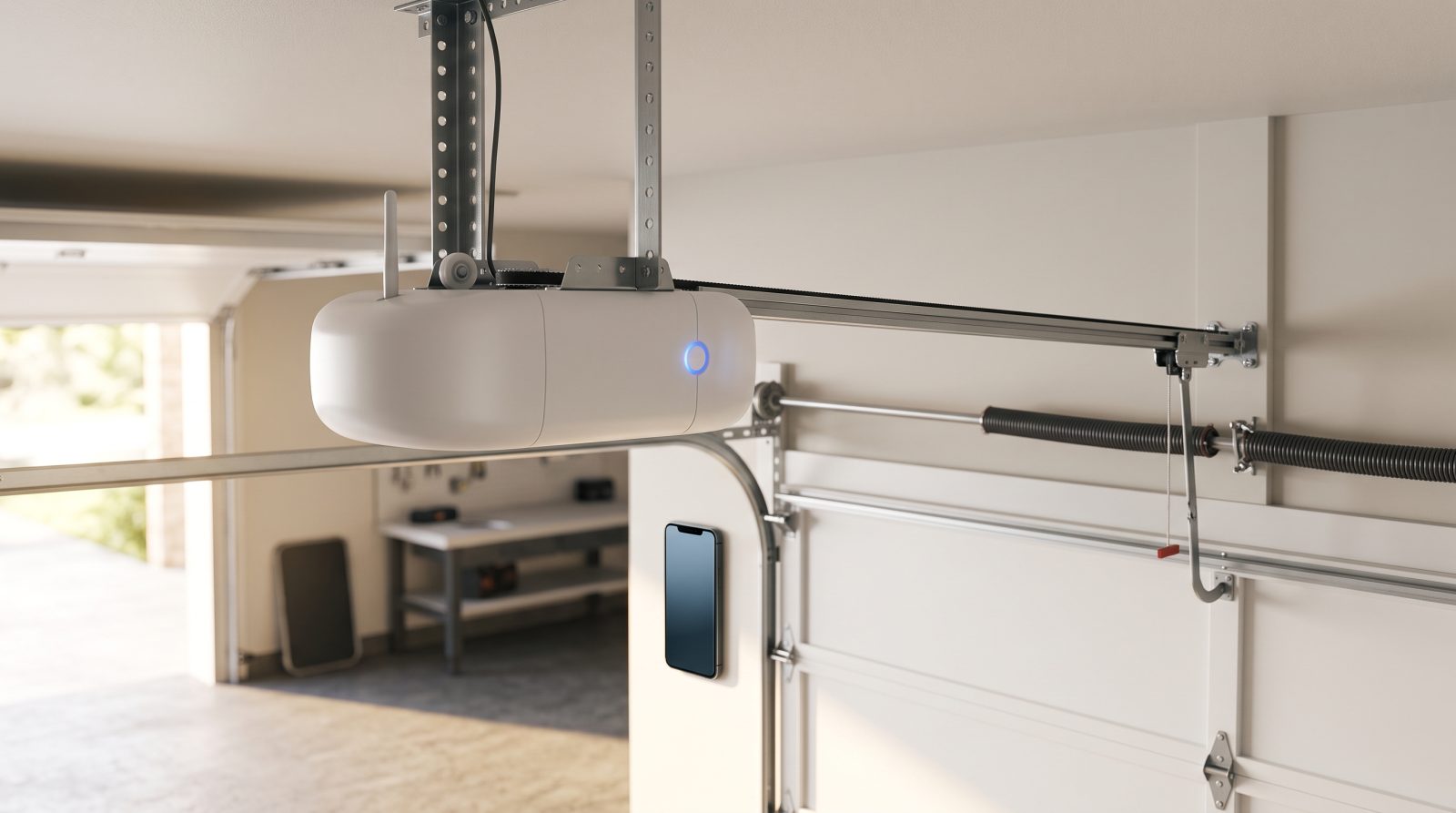
A smart garage door opener is, at its core, the same motor unit that pulls your door up and down on a track. What makes it "smart" is a WiFi radio and a small controller that connect the opener to your home network and, through that, to an app on your phone. When you tap open or close, the command travels from your phone to the manufacturer's cloud service, then back down to the opener in your garage, which triggers the same logic board that a physical wall button or remote would. The whole round trip usually happens in a second or two over a normal home connection.
There are two broad ways to get smart control. The first is a fully integrated opener that ships with WiFi built in, common on units sold in the last several years. The second is a retrofit kit, a separate device that wires into a conventional opener's terminals and adds a connected door sensor, letting an older but mechanically sound unit gain app control without replacing the whole motor. Retrofit kits are popular because the motor on a well-maintained opener can last well over a decade, so there is often no reason to discard a working unit just to get an app.
A critical point most marketing skips: the smart layer does not change the physics of the door. The opener still relies on torsion or extension springs to do the heavy lifting of counterbalancing the door's weight, on cables and a track to guide it, and on safety sensors near the floor to stop or reverse if something is in the path. The app is a convenient remote and a monitor; it is not a mechanic. If the springs are failing or the door is binding on its track, a smart opener will struggle, strain, or refuse to move exactly as a standard one would, it will just tell you about it on your phone.
- Built-in WiFi openers: connectivity is integrated into the motor unit from the factory
- Retrofit kits: a separate module adds app control to an existing, mechanically sound opener
- Commands route phone to cloud to opener, so a stable home internet connection matters
- The smart layer controls and monitors, it does not replace springs, cables, track, or sensors
Features Worth Paying For (and Which Ones Are Hype)
The single most valuable feature is real-time status with alerts. Being able to glance at your phone and confirm the door is closed, and to get a push notification if it has been open for a set number of minutes, solves the most common everyday garage anxiety: did I leave it up? An open garage is a standing invitation, both to opportunistic theft and, in many climates, to wind-driven rain, snow, pests, and freezing pipes along an attached wall. Remote close is what turns that alert into a fix you can act on from anywhere.
Guest and scheduled access is the next genuinely useful tier. Most smart platforms let you grant a family member, house cleaner, or delivery service temporary or recurring access without copying a physical remote, and you can revoke it instantly. Some delivery programs integrate directly so a driver can place a package inside a closed garage rather than leaving it exposed on a porch. Scheduling, such as auto-closing the door every night at a set time, is a quiet but powerful safeguard against the human habit of forgetting.
Integration with voice assistants and broader smart-home routines is where you should be more discerning. It is pleasant to close the garage by voice or as part of a "leaving home" routine, but for safety reasons reputable systems require a PIN or confirmation to open the door by voice, since a door that opens on a misheard command is a security hole. Treat camera add-ons, battery backup, and the quality of the safety sensors as more important than novelty integrations. Battery backup in particular is required by law in some regions and is valuable anywhere, because it lets the door operate during a power outage, which is precisely when you may most need to get a car out.
- High value: door-open alerts plus remote close, the fix for the most common garage worry
- High value: revocable guest access and scheduled auto-close to cover human forgetfulness
- Verify: voice control should require a PIN or confirmation before opening the door
- Underrated: battery backup keeps the door working during an outage and is mandated in some areas
- Lower priority: novelty smart-home integrations matter less than sensor quality and reliability
Security and Privacy: What to Know Before You Connect
Connecting your garage to the internet means the door is now only as secure as the account that controls it. The most important protections are basic but non-negotiable: use a strong, unique password on the manufacturer's app account, turn on two-factor authentication if it is offered, and keep the opener's firmware updated, since updates frequently patch security flaws. Treat the app login with the same seriousness you would your email, because anyone who gains it can potentially open your home.
Modern reputable openers use rolling-code technology for their physical remotes, meaning the code changes with every press so a captured signal cannot simply be replayed. On the app side, well-built platforms encrypt the connection between your phone, the cloud, and the opener. When you compare products, it is reasonable to favor established manufacturers with a track record of issuing security updates over the cheapest unbranded kit, because long-term update support is part of what you are buying.
Privacy deserves a thought too. Smart openers log when the door opens and closes, and camera-equipped models record video. Review what the manufacturer stores, for how long, and who can see it, and decide whether that fits your comfort level. Finally, do not let convenience erode physical safety habits. Keep the manual release cord (the red handle) accessible and know how to use it, never leave the app logged in on a shared or lost device without remote sign-out, and if you sell your home or change who has access, reset accounts and remove old guest permissions.
- Use a strong, unique password and enable two-factor authentication on the opener account
- Keep firmware updated, updates often close real security gaps
- Favor manufacturers with rolling-code remotes, encrypted connections, and ongoing update support
- Review what door logs and camera footage are stored, for how long, and who can access them
- Keep the manual release cord accessible and revoke old or guest access when circumstances change
Cost, Installation, and Regional Considerations
Costs vary widely by product type and how you install, so treat the following as typical industry ranges that are estimates only, not a quote, and expect real figures to shift with brand, features, your door's setup, and local labor rates. A retrofit smart-control kit for an existing opener commonly falls in the lower tens to roughly one hundred fifty dollars for the hardware, and many homeowners install these themselves. A complete new smart opener unit typically ranges from a couple hundred dollars up to several hundred or more for higher-horsepower, quieter belt-drive models with cameras and battery backup. Professional installation of a full opener adds a labor charge that depends on your market and on whether old equipment must be removed.
Whether to DIY depends honestly on your comfort with both wiring and the mechanical side. Pairing a retrofit kit and configuring an app is well within reach for many people. Replacing an entire opener, however, can involve working near the high-tension spring system, and that is genuinely dangerous, garage door springs store enormous energy and can cause serious injury if mishandled. If a full replacement touches the springs, cables, or the door balance, that portion is best left to a professional even if you handle the smart setup yourself.
Region and climate matter more than people expect. In cold-winter areas, metal contracts and grease stiffens, so an opener may strain on the coldest mornings and door balance should be checked seasonally; battery backup is especially worthwhile where ice storms cause outages. In hot, humid, or coastal regions, corrosion on cables and hardware accelerates and WiFi-connected electronics in an un-conditioned garage face heat stress. High-wind and storm-prone areas often have building requirements for reinforced or rated doors, and a smart opener does nothing to add that structural strength. Always match the opener's pulling power to your door's size and weight, a heavy insulated or solid-wood door needs more capacity than a light single-panel aluminum one.
- Retrofit kit hardware: often low tens to about one hundred fifty dollars (estimate, varies)
- Full new smart opener: roughly a couple hundred to several hundred-plus dollars (estimate, varies)
- DIY suits retrofit kits and app setup; full replacements that involve springs should go to a pro
- Cold climates: check balance seasonally and value battery backup against outages
- Hot, humid, or coastal areas: watch for faster corrosion and heat stress on electronics
- Match opener pulling power to your door's actual size, material, and weight
When Smart Tech Can't Fix a Mechanical Problem
This is the most important section for a reason. A smart opener is a wonderful convenience, but it can also become a way of papering over a problem that is actually getting more dangerous. If your door is jerking, suddenly heavy, slamming down, opening crooked, or refusing to move, no app setting will solve that, and forcing it with the opener can turn a repair into a replacement or an injury.
The clearest red flag is a broken spring. If you hear a loud bang from the garage and the door then feels enormously heavy or will not lift, a spring has very likely failed. A broken-spring door can drop without warning and should not be operated. Other urgent signs include the door coming off its track, a snapped cable hanging loose, the door stuck partway and refusing to close (a real security concern if it is stuck open) or stuck shut with a vehicle trapped inside. In every one of these cases, the safe move is to stop using the opener, keep people and pets clear of the door path, and get same-day professional help rather than repeatedly hitting the button or the app.
There is also a temptation to add smart control to an opener that is already showing its age, struggling, grinding, or tripping its safety reversal repeatedly. Adding connectivity to a failing unit just gives you a nicer way to watch it fail. The better sequence is to confirm the door's mechanical health first, fix or replace what is worn, verify the door is properly balanced and the safety sensors reverse correctly, and then layer smart control on top of a sound, safe system. If you are unsure where your door stands, a quick professional inspection is the safest starting point, and you can request a free quote to understand your options before you spend on either repairs or new technology.
- A loud bang followed by a very heavy or stuck door usually means a broken spring, stop using it
- Off-track doors, snapped cables, and doors stuck open or shut are urgent, not app problems
- Stuck open is a security risk; stuck shut can trap a vehicle, both warrant same-day help
- Never force a struggling door with the opener or app, you can worsen the damage or get hurt
- Fix and balance the mechanics first, then add smart control to a sound, safe system