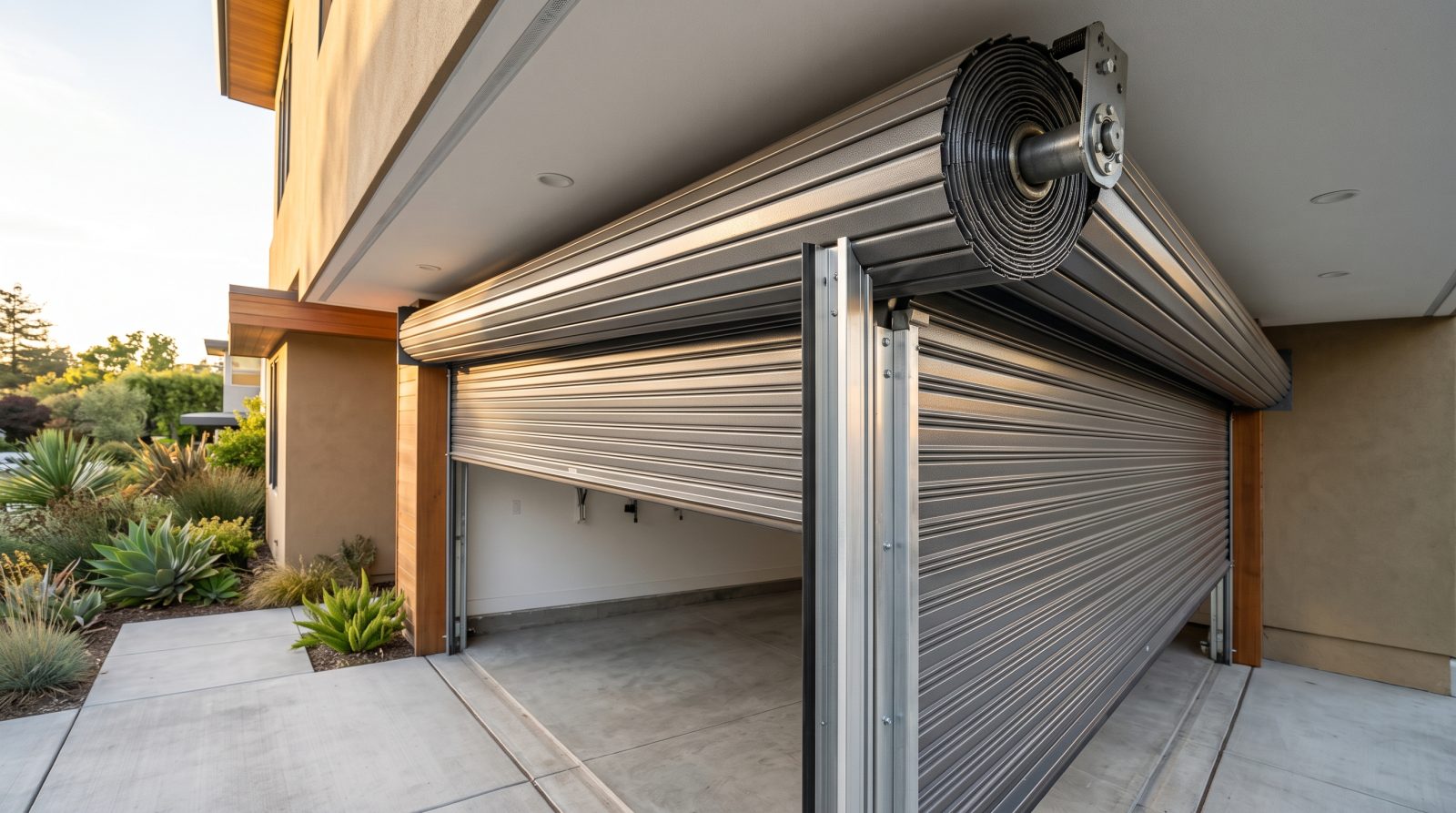
What a roll-up door is — and how it differs from a sectional door
The garage doors most people picture are sectional doors: four or five hinged horizontal panels that bend around a curved track and rest flat against the ceiling. A roll-up door works on a completely different principle. The door curtain is built from many narrow interlocking slats (or, on some residential models, thinner steel sections) that coil tightly around a barrel mounted above the opening, much like a window roller shade scaled up to industrial size. When it opens, the door doesn't travel back along your ceiling — it disappears into a compact roll at the top of the frame.
That distinction matters for where these doors get used. Because they need almost no overhead or back-room space, roll-up and coiling doors dominate commercial settings: warehouse loading docks, self-storage units, retail security shutters, fire stations, and parking structures. In homes, they show up where ceilings are low, where a detached garage doubles as a workshop, or in compact and urban builds where every inch of overhead room is precious. There are two broad families to know. Heavier rolling steel doors, common on commercial buildings, use thick slats and a counterbalance spring sealed inside the barrel. Lighter roll-up doors, including many residential and self-storage models, use a torsion-style spring on the barrel and a thinner curtain.
Understanding which type you have is the first step in any repair conversation, because the parts, the tension involved, and what is safe to touch differ significantly between a light residential roll-up and a heavy commercial coiling shutter.
- Roll-up / coiling doors curl into a barrel above the opening instead of folding back along the ceiling
- Ideal for low-ceiling garages, compact homes, workshops, and almost every commercial or storefront opening
- Two common families: heavier commercial rolling steel doors and lighter residential or self-storage roll-ups
- The counterbalance spring usually lives inside or on the barrel, not in two springs across a header bar like many sectional doors
Why roll-up doors get stuck, jam, or won't move — and which are emergencies
A roll-up door that suddenly won't move is one of the more stressful failures a property owner faces, because the door is often the only way in or out of a garage or storefront, and the contents behind it may be trapped or exposed. The good news is that most failures trace back to a handful of mechanical causes. The challenge is telling the harmless ones from the genuinely unsafe ones before you put your hands on the door.
A door that feels suddenly, dramatically heavy or rises only a few inches before stopping usually points to a failed counterbalance spring on the barrel. On a coiling door, that spring is doing the heavy lifting; when it breaks, the motor or your arms are fighting the full dead weight of the curtain, which can be substantial on a steel door. A door that binds, scrapes, or stalls at the same spot every time often means a bent slat, debris in the side guides, or a guide that's been knocked out of alignment — frequently after a forklift, bumper, or cart strikes it. A curtain that looks crooked, telescopes to one side, or has slats walking out of the guide has effectively come off its track and should be treated as a do-not-operate situation. And a door that hums or clicks but doesn't budge usually points to an opener, motor, or control problem rather than the door itself.
Two scenarios deserve special urgency. A door stuck open leaves your home or business unsecured and the curtain hanging on a possibly compromised spring — a security risk and a safety risk at once. A door stuck closed can trap a vehicle you need, lock a storefront before opening, or block the only exit from a space. In both cases the instinct to yank, pry, or hammer the door back into motion is exactly the wrong move, because a coiling door under spring tension can release stored energy violently if forced.
- Door feels very heavy or rises only inches: likely a broken counterbalance spring on the barrel
- Binds or scrapes at the same point: bent slat, debris in the guides, or a guide knocked out of alignment
- Curtain crooked or slats leaving the guide: the door is effectively off-track — stop using it
- Motor hums or clicks but nothing moves: usually an opener, motor, or control fault, not the door
- Stuck open (unsecured property) or stuck closed (trapped vehicle, blocked exit) are urgent — don't force it
What you can safely check yourself before calling for help
Not every stuck door is a repair call, and a few calm checks can save you time and money — as long as you stop the moment anything involves the spring, the barrel, or the curtain under load. The dividing line is simple: troubleshooting power, sensors, and obvious debris is fair game; touching anything that holds the door's weight is not.
Start with the basics if the door is powered. Confirm the opener is plugged in and the outlet has power, since a tripped breaker or unplugged unit is a common false alarm. If you have a manual chain or crank, see whether the door is set to manual or has been disengaged. On models with photo-eye safety sensors near the floor, check that they're clean and aligned with steady indicator lights, because a misaligned sensor will stop a door from closing. Look along both side guides for visible debris — a stone, a chunk of ice, a stray bolt, or built-up grime — that may be blocking the curtain's path, and clear only what you can reach safely from the side without reaching into the moving channel. A quick visual scan of the curtain for an obviously bent, dented, or protruding slat tells you whether the problem is mechanical damage rather than electrical.
Where you must stop is anything involving tension. Do not try to adjust, wind, or unwind the counterbalance spring; do not pull a heavy curtain back into its guides by hand; and do not stand under a door that's hanging open on a suspect spring. These components store enough energy to cause serious injury, and on commercial coiling doors the forces are higher still. If your safe checks don't restore normal, balanced operation, that's the signal to bring in a technician rather than escalate the force you're applying.
- Safe to check: power and breaker, manual-release or crank setting, photo-eye sensors, and visible debris in the guides
- Safe to inspect visually: a bent, dented, or protruding slat that signals mechanical damage
- Never DIY: winding or adjusting the counterbalance spring, or working on the barrel
- Never DIY: muscling a heavy curtain back into its side guides while it's under load
- Never stand or park under a door hanging open on a spring you suspect has failed
Maintenance, climate, and lifespan: keeping a roll-up door reliable
Roll-up doors reward routine care more than almost any other door type, because their many moving slats and the constant coil-and-uncoil cycle create lots of small friction points. A sensible rhythm for most properties is a tune-up roughly once a year, and more often for commercial doors cycled dozens of times a day. A good maintenance pass includes lubricating the side guides and the curtain's interlocks with a proper garage-door lubricant rather than a general-purpose spray that attracts grit, tightening the hardware that anchors the guides and brackets, checking the curtain for bent or fatigued slats, clearing the guides of debris, and having a technician verify the counterbalance spring tension and the door's balance. On powered doors, the opener's safety reverse and any sensors should be tested too.
Climate plays a real role, and it varies meaningfully by region. In cold-winter and northern areas, the bottom slat can freeze to the threshold and ice can build in the guides, so doors that are forced when frozen are a frequent source of bent slats and snapped components — clearing ice and never powering through resistance matters most here. In coastal and humid regions, salt air and moisture accelerate corrosion on steel curtains and springs, making rust the limiting factor and regular cleaning and protective lubrication more important. In hot, dry, and dusty climates, fine grit works into the guides and barrel and acts like sandpaper on moving parts, so debris removal and lubrication move up the priority list. None of these are reasons to panic; they're reasons to match your maintenance cadence to your environment.
On lifespan, it's fair to think in terms of cycles rather than calendar years. A door cycled a few times a day in a single-family home behaves very differently from a storage-facility or loading-dock door opened constantly. Springs in particular are wear items rated for a finite number of cycles, so on a high-use commercial door the spring is often the first major component to need replacement — not a defect, just the nature of the part. Quality of the original installation and how consistently the door is maintained will influence its working life as much as the brand on the slats.
- Aim for a yearly tune-up on residential doors, and more often for high-cycle commercial doors
- Lubricate the guides and slat interlocks with a real garage-door lubricant, not a grit-attracting general spray
- Cold climates: clear ice from the threshold and guides and never force a frozen door
- Coastal/humid climates: watch for rust on steel curtains and springs; clean and protect more often
- Dry, dusty climates: keep grit out of the guides and barrel, which otherwise wears parts prematurely
- Think in cycles, not just years — springs are finite-cycle wear items, especially on commercial doors
Repair, replace, or upgrade: making a sound decision
When a roll-up door fails, the practical question is whether to repair the specific fault or replace the door. Repair is usually the right call when the curtain and barrel are fundamentally sound and a defined component has failed — a broken spring, worn guides, a single damaged slat, or a faulty opener. These are targeted fixes that restore a door with plenty of life left. Replacement deserves serious thought when there's widespread rust or corrosion eating into a steel curtain, when many slats are bent or impact-damaged, when the door is very old and matching parts are hard to source, or when the cost of repeated repairs starts approaching the price of a new door. A trustworthy technician should lay out both paths honestly and let you weigh safety and long-term value rather than push you toward the bigger ticket.
Cost is the question everyone wants answered, and the honest answer is that it depends. Roll-up door repair costs vary widely with the type of door, the part involved, the size and weight of the curtain, whether it's a light residential model or a heavy commercial coiling shutter, and regional labor rates. As a general orientation only, a single-slat or guide adjustment tends to sit at the lower end, spring or opener replacement in the middle, and a full commercial door replacement at the higher end. Any figure you see should be treated as a typical industry range and an estimate that varies by door, material, and scope — never a fixed quote. The right number for your door comes from an on-site assessment, and a reputable provider gives you a clear, itemized estimate before any work begins.
If you're considering an upgrade rather than a like-for-like fix, roll-up doors offer real options: insulated curtains for temperature-sensitive garages and storefronts, heavier-gauge steel for security, weather seals to keep out drafts and water, and modern openers with safety reversing and sensors. For commercial properties, fire-rated coiling doors and high-cycle springs are worth discussing if the opening demands them. The best upgrade is the one that solves the problem you actually have, so describe how the door is used and what's been going wrong, and let the specifics drive the recommendation.
- Repair when the curtain and barrel are sound and a single part has failed (spring, guide, slat, opener)
- Replace when there's widespread rust, multiple damaged slats, obsolete parts, or repair costs near a new door
- Treat all prices as typical industry ranges and estimates that vary by door, material, region, and scope — never a fixed quote
- Upgrades to consider: insulated curtains, heavier-gauge steel, weather seals, and safer modern openers
- For commercial openings, ask about fire-rated coiling doors and high-cycle springs where appropriate