How a Sectional Garage Door Actually Works
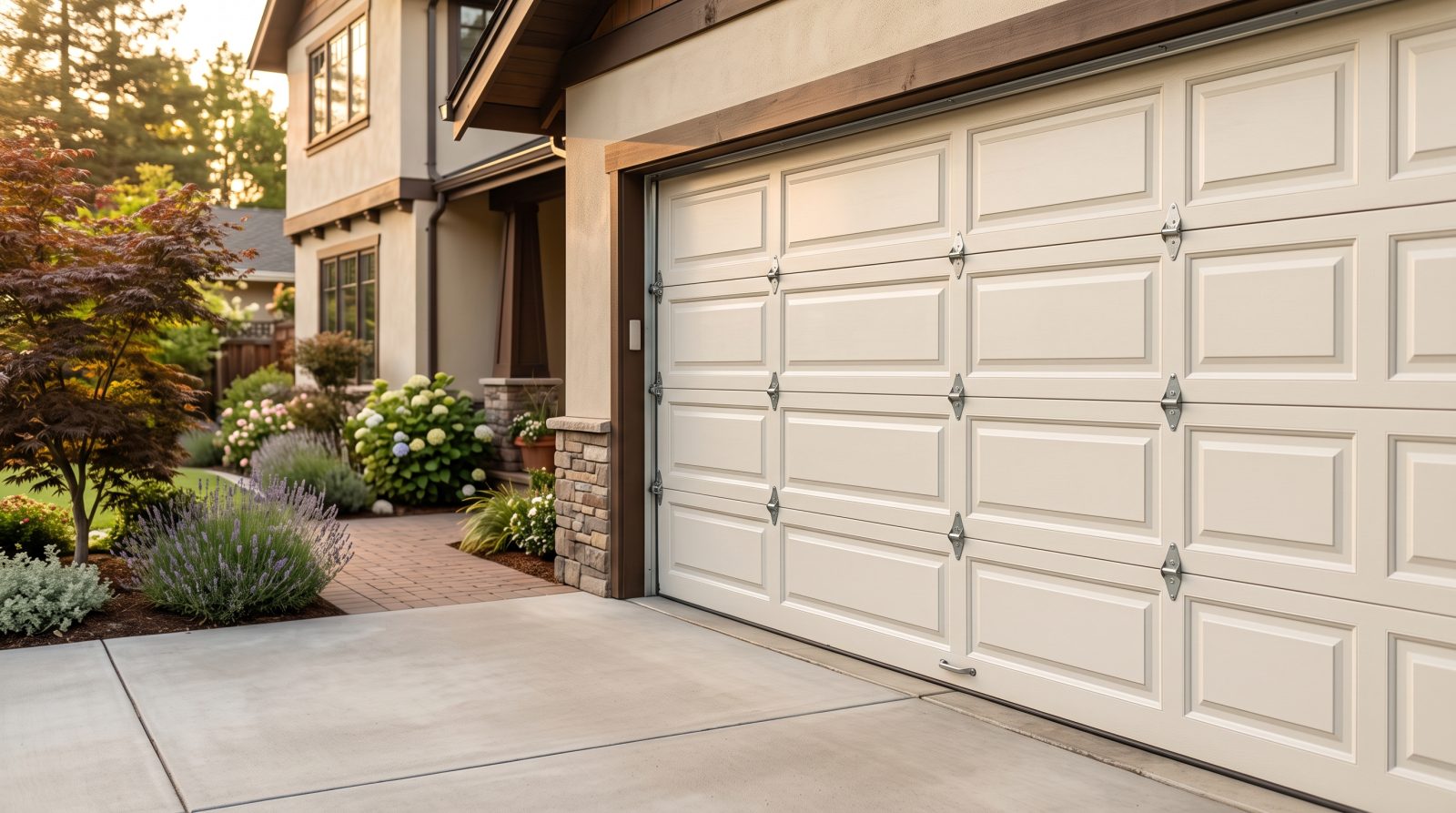
A sectional door is made of three to five (sometimes more) horizontal panels, or sections, joined by hinges along their top and bottom edges. Each panel carries small wheels called rollers that ride inside a steel track on each side of the opening. The track runs vertically up the door jamb and then curves backward and runs horizontally along the ceiling. As the door opens, the panels articulate at the hinges, follow the curve of the track, and end up lying flat and parallel to the ceiling, completely out of the doorway. This is what lets a sectional door work in a garage with a driveway right up against it, where an old-style one-piece door that swings outward would be a hazard.
The part most people never think about is the counterbalance system, and it is the heart of the door. A typical residential sectional door weighs anywhere from roughly 130 to over 350 pounds depending on size, material, and insulation. You are not lifting that weight when you open it, and neither is your opener. Instead, a spring system stores energy to offset the door's weight so it feels nearly weightless and stays put wherever you leave it. There are two common arrangements: a torsion spring (or a pair of them) mounted on a steel shaft above the door, which winds and unwinds as the door moves; and extension springs, which stretch along the horizontal tracks on each side. Steel cables connect the spring system to the bottom of the door and transfer that stored force.
The garage door opener, despite appearances, is not what does the heavy lifting. A properly balanced door should be liftable by hand with modest effort even with the opener disconnected. The opener simply guides the already-balanced door up and down and holds it closed. This distinction matters enormously in a failure: if a spring breaks, the opener is suddenly being asked to lift the full dead weight of the door, which it was never designed to do, and you can burn out a motor or strip a gear trying to force it.
- Panels (sections): the horizontal slabs, hinged together so the door can bend around the track's curve
- Tracks: vertical-then-horizontal steel rails that guide the rollers; the door's path and alignment depend on them
- Rollers: the wheels on each panel edge that ride in the track; worn rollers cause grinding, sticking, and noise
- Springs (torsion or extension): the counterbalance that offsets the door's weight so it moves easily and safely
- Cables: high-tension steel lines tying the springs to the door; never to be touched while under load
- Opener: guides and secures the balanced door; it is not designed to lift the door's full weight
Why Sectional Doors Are So Popular (and Where the Style Varies)
Sectional doors dominate residential garages for practical reasons. Because they roll up overhead and store flat against the ceiling, they reclaim the driveway and the ceiling-adjacent wall space that swing-out doors waste. The panel-and-track design also seals the opening well: with proper weatherstripping between sections and along the perimeter, a sectional door keeps out wind, rain, dust, and pests far better than older one-piece or barn-style doors. And because individual panels can be replaced, a dent or damaged section can sometimes be fixed without replacing the entire door.
There is also a lot of room for customization, which is why sectional doors suit everything from a modest bungalow to a high-end custom home. Panels come in steel, aluminum, wood, composite, and fiberglass, with or without windows, in flush, raised, or carriage-house styles. Insulation is a meaningful variable: an insulated sectional door with a polyurethane or polystyrene core not only holds temperature far better but is also noticeably quieter and more rigid than a single-skin door.
Insulation and material choice tend to track with climate, and this is where regional differences are real rather than cosmetic. In cold-winter regions like the northern U.S. and Canada, insulated doors with a high R-value are common because an attached garage is part of the home's thermal envelope and a cold garage drives up heating bills. In hot, sun-intense regions like the Southwest, insulation helps keep an attached garage and the rooms above it cooler, and fade-resistant or light-colored finishes are valued. In coastal and high-humidity areas, corrosion is the enemy, so galvanized or aluminum hardware and rust-resistant components matter more, and springs and cables may wear faster from salt air. None of this changes how the door fundamentally works, but it does change what fails first and how often.
- Space-saving: stores flat overhead, freeing the driveway and wall space
- Weather-tight: per-section and perimeter seals beat one-piece and swing-out doors
- Repairable by panel: a single damaged section can sometimes be swapped without a full replacement
- Highly customizable: steel, wood, aluminum, composite; flush, raised, or carriage styles; optional windows
- Climate-driven choices: more insulation up north, heat and fade resistance in the Southwest, corrosion-resistant hardware near the coast
The Most Common Sectional Door Failures (and Why They Happen)
Because a sectional door is a system, most emergencies trace back to one of a handful of components giving out. By far the most common and the most disruptive is a broken spring. Springs are wear parts with a finite number of cycles, and they fail with age, with cold snaps that make steel brittle, and with the simple fatigue of thousands of open-close cycles. When a torsion spring breaks, you will often hear a loud bang like a firecracker, and afterward the door feels impossibly heavy and won't open, or the opener strains and stops. A door with a broken spring is the single most dangerous situation on this list to handle yourself, because the remaining spring and the cables are still holding tremendous force.
Off-track doors are the next big category. Rollers can jump out of the track after an impact (a vehicle bumping the door is extremely common), when a cable slips or breaks and lets one side drop, or when the track itself is bent or loose. An off-track door may hang crookedly, bind, or jam halfway. Running the opener on an off-track door tends to make the damage dramatically worse and can pull the door down. Snapped cables produce a similar effect: one corner of the door drops, the door goes crooked, and it can become genuinely unsafe to operate.
Beyond the high-tension failures, there are the everyday culprits. Worn or broken rollers cause grinding, sticking, and loud operation. Misaligned or blocked photo-eye safety sensors near the floor will cause an opener to refuse to close (or reverse immediately), which alarms people but is usually a quick fix. Bent track, loose hinges, dead opener batteries (in the wall button, keypad, or remote), tripped lock features, and even a door frozen to the slab in winter can all leave a door stuck. Climate plays a role here too: extreme cold stiffens grease and embrittles springs, summer heat and humidity can swell wood panels and warp alignment, and salt air accelerates rust on cables, springs, and rollers.
- Broken spring: loud bang, door suddenly very heavy, opener strains — the most dangerous to DIY
- Off-track door: rollers out of the rail after an impact, cable failure, or bent/loose track; hangs crooked or jams
- Snapped cable: one corner drops, door goes crooked and unsafe to run
- Worn rollers: grinding, sticking, and noisy operation
- Misaligned safety sensors: door won't close or reverses immediately — often a fast realignment
- Weather effects: cold embrittles springs and stiffens grease; heat swells panels; salt air rusts hardware
What to Do Right Now If Your Sectional Door Is Stuck
If your door is misbehaving, the first rule is also the most important: do not force it. A sectional door that is stuck, crooked, or unusually heavy is almost always telling you that something is under abnormal load, and pushing, pulling, or repeatedly hitting the opener button can convert a contained problem into a falling door or an injury. Stop, step back, and assess before you touch anything.
Run through the safe checks first. Make sure nothing is physically blocking the tracks or the path of the door. Check that the manual lock or slide-bolt isn't engaged. Look at the small photo-eye sensors near the bottom of each track — if a light on them is blinking or off, gently wipe the lenses and nudge them back into alignment, because a closing problem is very often just a bumped sensor. Try fresh batteries in the remote or keypad, and try the hardwired wall button to rule out a dead remote. If the door simply froze to the floor in winter, do not run the opener; the motor can tear the bottom seal or the door, and gentle thawing is the safer path.
Now the hard line on what not to do. Do not attempt to adjust, loosen, wind, or unwind a torsion or extension spring, and do not touch the lifting cables. These hold enough stored energy to cause serious, even life-altering injuries, and they are the leading cause of garage door injuries handled by professionals for exactly that reason. If you suspect a broken spring, a snapped cable, or an off-track door, leave the door where it is and keep people and vehicles clear of it. If the door is stuck open, that is also a security concern, not just a convenience problem — an open garage can expose your home, so it is worth getting same-day help rather than waiting. If you must get a trapped car out and the door is otherwise intact, only use the manual release (the red cord) when the door is fully closed and you are certain no spring or cable has failed, because pulling the release on a door that is unbalanced or partly open can let it slam down. When the situation involves tension parts or you simply aren't sure, the right move is to request a free quote and get a same-day technician out.
- Do not force a stuck, heavy, or crooked door — abnormal resistance means abnormal load
- Clear the tracks, check the manual lock, and wipe/realign the floor-level safety sensors
- Swap remote/keypad batteries and test the wall button before assuming a bigger fault
- Never adjust springs or touch cables yourself — this is the top cause of serious garage door injuries
- A door stuck open is a security risk; treat it as same-day, not someday
- Use the red manual release only on a fully closed, balanced door — never to free a partly open or unbalanced one
Maintenance That Prevents the Emergency in the First Place
Most sectional door emergencies are not random; they are the predictable end of a wear curve that simple maintenance slows down. A few minutes a couple of times a year goes a long way, and almost all of it is safe to do yourself because it never involves the high-tension spring and cable system.
Start with a balance test, because balance is the truest sign of a healthy counterbalance system. With the door closed, disconnect the opener using the manual release cord and lift the door by hand to about waist height, then let go. A well-balanced door will mostly stay put. If it slams down or shoots up, the spring tension is off and the system is straining — that is a call to a professional, not a DIY adjustment. Re-engage the opener when you're done. Beyond that, keep the rollers, hinges, and springs lightly lubricated with a garage-door-specific lubricant (not heavy grease, and not a degreaser like WD-40 as a long-term lube), keep the tracks clean but not oiled, and check that the track mounting brackets and hinge bolts are snug.
Twice a year, also test the safety features: the photo-eye reversal (wave an object through the beam as the door closes — it should reverse) and the mechanical reversal (lay a roll of paper towels flat under the door — it should reverse on contact). These protect children and pets, and they are the kind of thing that is easy to ignore until it matters. Pay attention to early warning signs and act before they become a roadside-style breakdown: new grinding or popping noises, jerky or uneven movement, a door that suddenly feels heavier, visible gaps or kinks in a spring, frayed strands on a cable, or a door that sits crooked. Catching any of these early usually means a planned, lower-cost repair instead of an emergency. As a rough, honest sense of scale, common sectional-door repairs such as roller, hinge, or sensor work tend to fall in a modest range, while spring replacement and off-track corrections run higher because of the labor and risk involved; full door replacement is a larger investment again. These are typical industry ranges only and vary widely by door size, material, hardware, scope, and your region — they are estimates, not a quote.
- Do the balance test twice a year (opener disconnected); a door that won't stay put needs a pro
- Lubricate rollers, hinges, and springs with a garage-door-specific lubricant; keep tracks clean, not oiled
- Keep track brackets and hinge bolts snug; clear debris from the tracks
- Test both safety reversals (photo-eye and contact) every six months
- Treat new noise, jerky motion, sudden heaviness, or visible spring/cable damage as an early warning
- Costs vary widely by door, material, scope, and region — any figure is a typical estimate, not a fixed quote