First, Make Sure It's Really the Opener
Before spending on a new opener, confirm the opener is actually the problem. A surprising number of "my opener is broken" situations turn out to be a snapped torsion spring, a door that has jumped its track, or frayed lift cables, and none of those are fixed by a new motor unit. The opener doesn't do the heavy lifting; the springs do. The opener just guides a properly balanced door up and down. If the springs are broken, a brand-new opener will strain, overheat, and fail early trying to do a job it was never built for.
A fast at-home check: with the door fully closed, pull the red emergency-release cord to disconnect the opener, then lift the door by hand. A healthy, balanced door should rise smoothly and stay put around waist or chest height. If it slams down, won't budge, or feels brutally heavy, the issue is the spring system, not the opener, and that is a job for a professional because spring tension can cause serious injury.
Important safety note for urgent situations: if your door is stuck open (leaving your home exposed) or stuck closed (trapping your vehicle), do not repeatedly force it or yank on it. Forcing a door that's off-track or under broken-spring tension can drop the door, bend panels, or pull a cable loose under load. Get the underlying fault diagnosed first, then decide whether you also need a new opener.
The Four Drive Types: Belt, Chain, Screw, and Wall-Mount
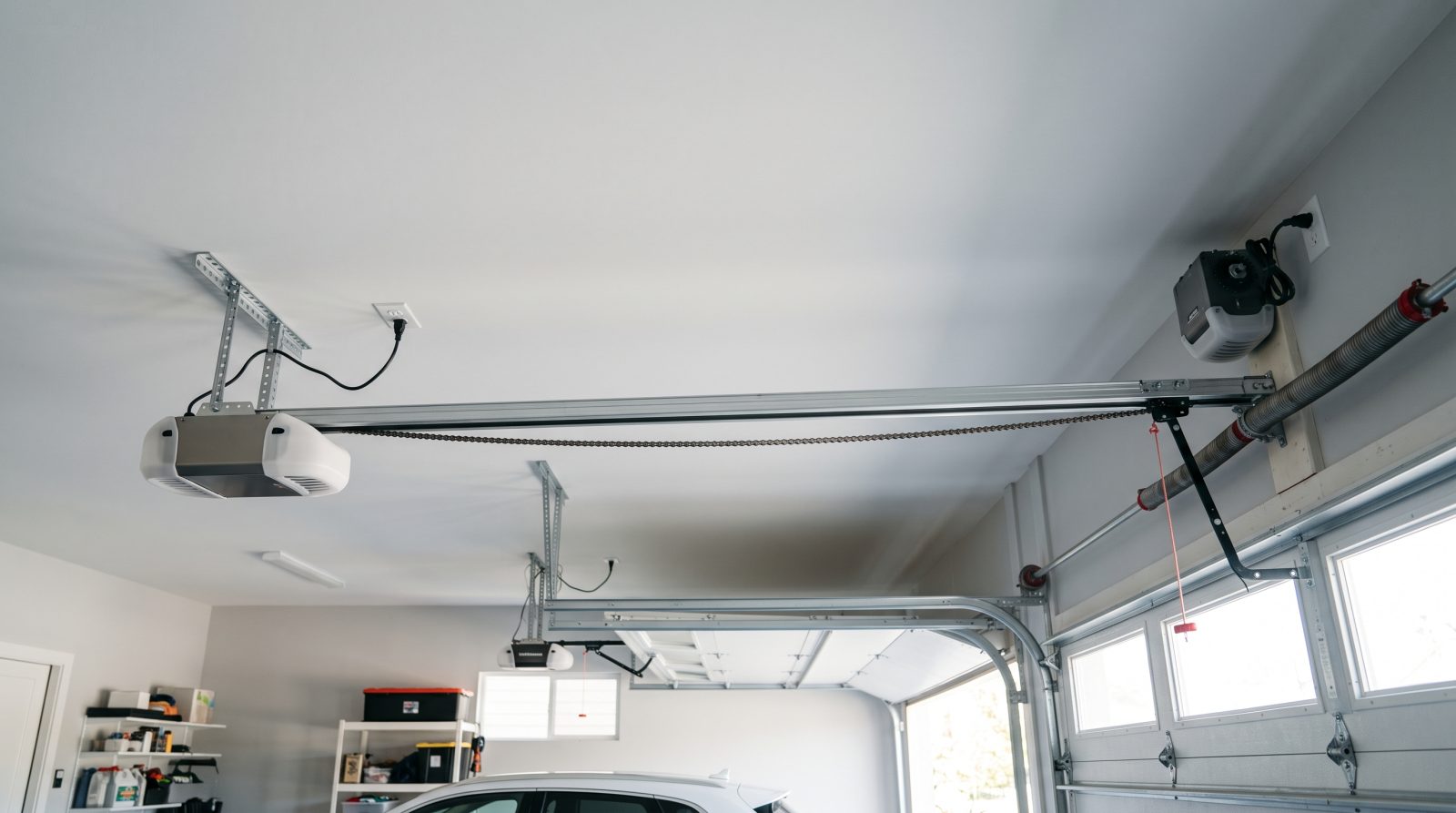
The biggest decision is the drive system, the mechanism that moves your door. There are four common types, and the right one depends on noise tolerance, door weight, garage layout, and climate. None is "best" universally; each has a clear sweet spot.
Belt drive is the quiet favorite. A reinforced rubber belt moves the trolley with very little vibration, which matters enormously when there's living space above or beside the garage, a common layout in attached homes and newer construction nationwide. It's typically the priciest of the rail-style drives but the most pleasant to live with.
Chain drive is the workhorse. A metal chain (like a bicycle chain) is durable, affordable, and handles heavy doors well, which is why it's a long-time standard for detached garages and budget-conscious replacements. The tradeoff is noise and vibration. In cold-climate regions, owners sometimes prefer chain for its tolerance of temperature swings, though it benefits from periodic lubrication, especially in winter.
Screw drive uses a threaded steel rod to move the trolley, with fewer moving parts and solid pulling power. Performance can be sensitive to temperature extremes, so in regions with hot summers or hard freezes, look for models rated for those conditions or use the manufacturer's recommended lubricant. Wall-mount (jackshaft) openers are the modern premium option: they bolt to the wall beside the door instead of hanging from the ceiling. They free up overhead space (great for high, cathedral, or storage-heavy ceilings), run very quietly, and pair well with insulated and heavier doors, but they require specific spring hardware and professional setup.
- Belt drive: quietest, best for attached garages and rooms above/beside the garage; higher cost.
- Chain drive: most affordable and rugged for heavy or detached-garage doors; louder, needs periodic lubrication.
- Screw drive: few moving parts and strong pull; verify temperature rating in very hot or freezing climates.
- Wall-mount/jackshaft: frees ceiling space, very quiet, premium price; needs compatible springs and pro install.
How Much Horsepower (or Power) Do You Actually Need?
Opener power is commonly described in horsepower (HP) for traditional AC models or in newtons/force ratings for DC and battery-backup models. The goal isn't the biggest number, it's matching power to your door's size, weight, and material so the opener isn't constantly straining.
As a general guide: lightweight single doors and standard non-insulated steel doors are usually well served by a 1/2 HP (or equivalent) opener. Heavier doors, insulated doors, two-car-wide doors, and solid-wood or carriage-style doors are better matched to 3/4 HP, while oversized, very heavy, or premium wood and full-view glass doors often warrant 1 HP or higher. DC-motor openers with soft start/stop tend to feel more powerful and quieter than their raw rating suggests, and they're what most battery-backup-capable units use.
Right-sizing matters for longevity. An underpowered opener on a heavy, insulated door works at its limit on every cycle, runs hot, and wears out faster, often the real reason a "new" opener died young. When in doubt, size up modestly, particularly for insulated doors common in cold-winter and hot-summer regions where insulation (and therefore weight) is a smart energy choice.
- 1/2 HP or equivalent: standard single or light steel doors.
- 3/4 HP: heavier, insulated, or double-wide doors.
- 1 HP and up: oversized, solid-wood, carriage, or full-view glass doors.
- Insulated doors weigh more, so favor a bit more power if you live where insulation matters (cold or very hot climates).
Features Worth Paying For (and Which to Skip)
Modern openers bundle a long list of features. A few genuinely improve safety and daily life; others are nice-to-have. Here's how to prioritize so you spend on what counts.
Battery backup is increasingly worth it, and in some areas it's effectively expected: it lets you open and close the door during a power outage without the awkward manual release, which is a real benefit anywhere prone to storms, heat-related grid strain, or winter outages. Smart connectivity (Wi-Fi/app control) lets you check whether the door is open from your phone, get alerts, and close it remotely, useful for the classic "did I leave the garage open?" worry and for households juggling kids, deliveries, and pets. Look for rolling-code security, which changes the access code with each use to prevent code-grabbing, this is now standard on quality units and is an important security feature.
Quiet operation (DC motors plus belt or wall-mount drives), bright integrated LED lighting, and motion-activated lights add real day-to-day comfort. Auto-close timers and integrated cameras can be handy for some households. Features you can usually deprioritize unless you specifically want them: high-end camera ecosystems, premium subscription add-ons, and gimmicky extras that raise the price without solving a problem you actually have.
One safety feature is non-negotiable and standard on openers sold in the U.S.: photo-eye sensors near the floor that reverse the door if something crosses the beam, plus auto-reverse on contact. If you're replacing an older opener, this is a major safety upgrade on its own. Never disable these sensors to "get the door to close", a door that won't close usually means the sensors are misaligned or blocked, which is a quick fix, not a reason to bypass protection.
- Battery backup: open/close during outages; high value in storm-, heat-, or freeze-prone regions.
- Smart Wi-Fi control: remote status, alerts, and close-from-phone peace of mind.
- Rolling-code security: prevents code theft; insist on it.
- Photo-eye + auto-reverse safety sensors: standard and essential, never bypass them.
- Often skippable: premium camera subscriptions and novelty extras that don't solve a real need.
Compatibility, Installation, and What It Typically Costs
A new opener has to play nicely with your existing door and hardware. Most rail-style openers fit standard sectional doors, but check headroom (the space above the door), backroom (the depth of the garage), and ceiling height, low-headroom and high-lift setups may need specific kits or favor a wall-mount unit. Wall-mount openers in particular require a torsion-spring system with the right shaft hardware, so they aren't a drop-in for every garage.
Installation is where the opener meets the rest of the door system, and it's worth getting right. A professional install includes mounting and aligning the unit, setting travel limits and force settings so the door stops and reverses correctly, aligning the photo-eye sensors, programming remotes/keypad and any smart features, and, critically, verifying the door's balance and spring tension so the new opener isn't fighting a poorly balanced door. Skipping the balance check is a common DIY mistake that shortens opener life.
On cost, treat all figures as typical industry ranges that vary by drive type, horsepower, features, your door's weight, and your region, never a fixed quote. As rough estimates, opener units commonly range from around $150 to $500 or more for premium wall-mount or fully smart models, with professional installation often adding roughly $100 to $300 depending on complexity, hardware needs, and whether old equipment must be hauled away. Belt, smart, and wall-mount units tend to sit at the higher end; basic chain drives at the lower end. If your existing springs, cables, or rollers are worn, addressing them at the same time usually costs less than separate visits and protects your new opener from day one. When you're ready, you can request a free quote and get a recommendation matched to your specific door rather than a one-size-fits-all guess.
- Check headroom, backroom, and ceiling height before choosing; low-headroom garages may need a kit or wall-mount.
- Pro install sets travel/force limits, aligns safety sensors, programs controls, and verifies door balance.
- Typical estimates (vary by door, features, and region): units roughly $150-$500+, install often $100-$300.
- Bundling worn springs/cables/rollers with the opener swap usually saves money and protects the new motor.