Quick Answer: Typical Installed Cost by Material
Below are typical installed price ranges for a standard single-car door (roughly 8 to 9 feet wide) and a standard double-car door (roughly 16 feet wide), including a basic professional installation. These are industry estimate ranges that vary by region, insulation level, design, hardware, and door condition, not fixed quotes. Double-car doors generally cost less than two single doors of the same material because you're buying one larger panel system and paying for one installation visit.
Read these as starting points. The same material can sit at the low end as a builder-grade, single-layer, windowless model, or at the high end as an insulated, designer-paneled door with windows, decorative hardware, and a smart opener. The material sets the floor; your options set the ceiling.
- Steel (single layer, no insulation): roughly $700-$1,500 single car; $1,000-$2,500 double car installed (estimate).
- Steel (insulated, double or triple layer): roughly $1,200-$3,000 single; $1,800-$4,500 double (estimate).
- Aluminum with glass / full-view: roughly $1,500-$4,000 single; $2,500-$6,000+ double (estimate).
- Wood (paint-grade to semi-custom): roughly $1,500-$4,500 single; $2,500-$8,000+ double (estimate).
- Wood (true custom / premium species): can exceed $10,000+ double car installed (estimate).
- Fiberglass / composite: roughly $1,200-$3,500 single; $2,000-$5,000 double (estimate).
- Vinyl: roughly $1,000-$2,800 single; $1,500-$4,000 double (estimate).
Steel: The Default Choice for Most Homes
Steel is the most common residential garage door material in North America, and for good reason: it offers the widest range of price points, the best strength-to-cost ratio, and low maintenance. A bare, single-layer steel door is the least expensive way to close a garage opening. Step up to a double-layer (steel skin plus polystyrene) or triple-layer (steel, insulation, and an interior steel skin) and you gain insulation, quieter operation, and a more rigid panel that resists denting and warping over time.
Insulation is where steel pricing really moves, and it matters more than most homeowners expect. In hot southern and southwestern climates, an insulated door helps keep an attached garage and the rooms above it from baking. In cold northern climates, insulation reduces heat loss and helps prevent the door from becoming a giant cold panel against your house. If your garage is attached, finished, or used as a workshop or gym, the upcharge for a triple-layer insulated steel door usually pays for itself in comfort.
The main drawbacks of steel are dents and corrosion. Thin single-layer doors dent easily from a stray basketball or a backed-into bumper, and in coastal regions, salt air can attack lower-grade steel and exposed hardware faster than inland. Coastal homeowners should ask specifically about corrosion-resistant coatings and hardware.
- Best for: most homeowners who want durability and value without high maintenance.
- Price drivers: number of layers (insulation), gauge (thickness) of the steel, windows, and finish.
- Climate note: insulated steel is worth it for attached, heated, or air-conditioned garages in both hot and cold regions.
- Watch-out: low-gauge single-layer doors dent easily; near the coast, ask about rust-resistant coatings.
Wood, Aluminum, Fiberglass, Vinyl & Composite Compared
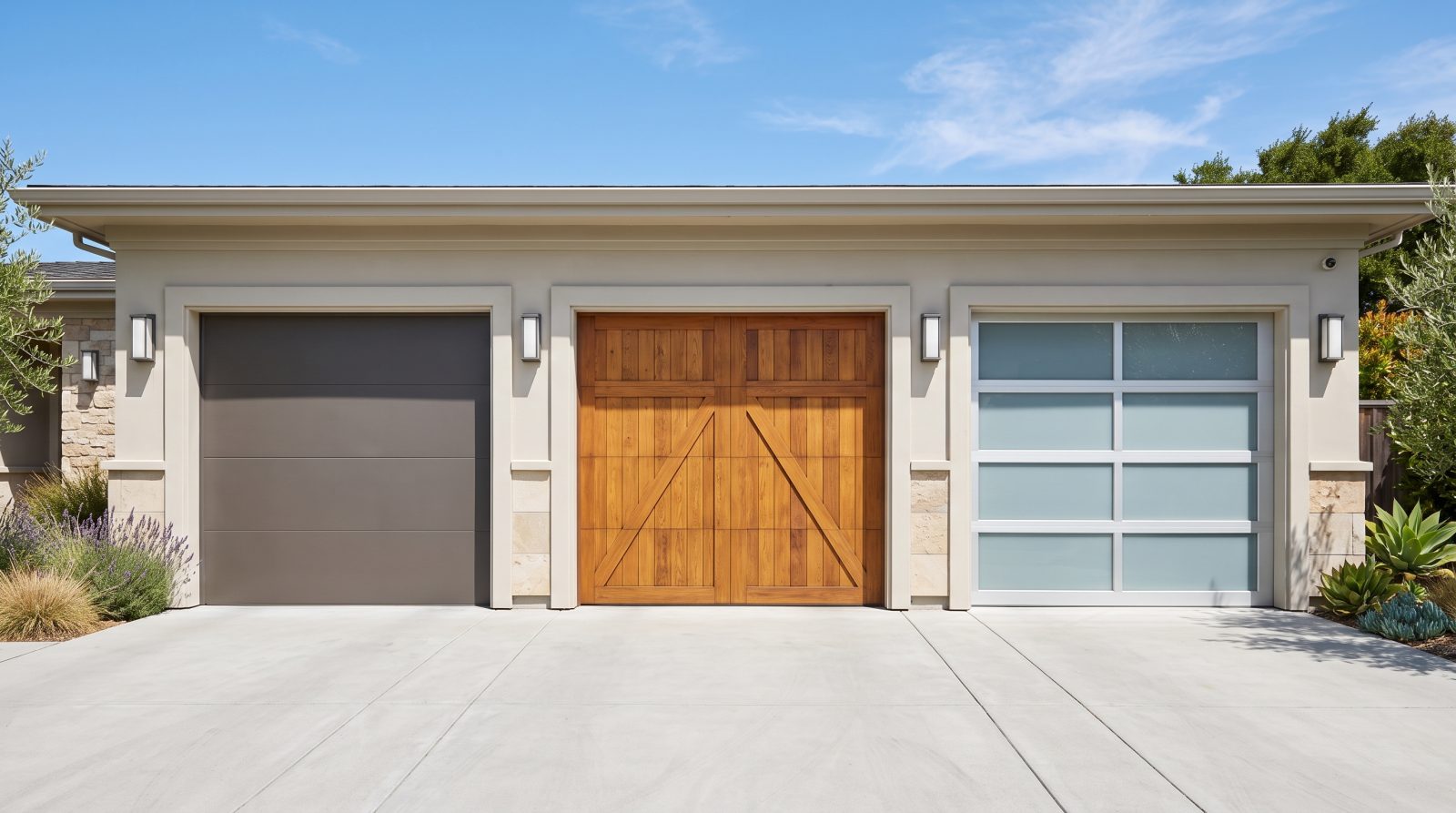
Once you move past steel, you're usually paying for looks, a specific climate advantage, or low maintenance, rather than pure value. Wood delivers genuine warmth and curb appeal that printed steel woodgrain can't fully match, and it can be custom-built to almost any design. The trade-off is cost and upkeep: real wood needs periodic refinishing or sealing, and in humid or rainy regions it can swell, crack, or rot if it's neglected. Premium hardwoods and true custom builds sit at the very top of the price range.
Aluminum with large glass panels (the modern full-view look) is popular for contemporary homes and for spaces converted to studios or showrooms. Aluminum frames are light and rust-resistant, which makes them a sensible coastal option, but the glass and framing push cost up and insulation value down unless you choose insulated or frosted glass. Fiberglass and composite doors aim for the best of several worlds: they resist denting, won't rot or rust, and can convincingly mimic wood grain, which makes them a strong pick in coastal and humid climates where steel rusts and wood swells. Fiberglass can become brittle and fade in years of harsh, direct sun, so it's less ideal for the most intense Sun Belt exposures.
Vinyl doors are the most damage- and dent-resistant of the common materials, which makes them a favorite for households with kids and active driveways. They won't rust or rot and need little maintenance, though color and design selection is more limited and extreme cold can make some vinyl more brittle. Composite (often an engineered-wood or wood-fiber product over an insulated core) gives you a wood look with far less upkeep, landing in price between steel and true custom wood.
- Wood: highest curb appeal and full custom flexibility; highest maintenance; can swell or rot in humid/rainy regions.
- Aluminum + glass (full-view): modern look, light, rust-resistant (good near coast); higher cost, lower insulation unless upgraded.
- Fiberglass / composite: dent-, rot- and rust-proof with a wood look; great for coastal/humid areas; fiberglass can fade or get brittle in intense sun.
- Vinyl: most dent- and damage-resistant; low maintenance; fewer design/color options; can stiffen in extreme cold.
- Composite (engineered wood): wood appearance with lower upkeep; typically priced between steel and custom wood.
What Actually Drives Your Final Price
Two homes can pick the same material and get very different quotes. After material, the biggest variables are size and insulation. A 16-foot double door costs more than an 8-foot single, and an R-value upgrade (more or denser insulation) adds cost but also comfort and quieter operation. Windows, decorative hardware, custom colors, and specialty panel designs each add up quickly; a row of windows or carriage-house hardware can add hundreds to the bottom line.
Installation conditions matter just as much as the door itself. If your tracks, rollers, hinges, springs, or opener are worn out or mismatched to the new door's weight, a quality installer will recommend replacing them so the new door operates safely and lasts. A heavier insulated or wood door may require different (or dual) springs than your old lightweight door used, and a builder-grade opener may not be rated to lift it smoothly. These aren't upsells so much as the difference between a door that works for a decade and one that fails early.
Region and labor rates create real spread, too. Installation labor, permit requirements, and even material availability vary across the country, so the same door can cost noticeably more in a high-cost metro than in a rural area. Hurricane- and high-wind-zone regions often require wind-rated or reinforced doors that meet local building codes, which adds cost but is not optional where it's mandated. Always get the quote in writing and ask what's included: removal and disposal of the old door, new hardware, springs, weatherstripping, and any opener work.
- Size: double-car doors cost more than single, but less than two singles.
- Insulation / R-value: higher insulation adds cost, comfort, and quieter operation.
- Add-ons: windows, decorative hardware, custom paint, and specialty panels raise the price.
- Hidden but important: new springs, rollers, tracks, and an opener rated for the door's weight.
- Region & code: labor rates, permits, and wind-rating requirements vary widely by area.
- Always confirm in writing what the quote includes (old-door haul-away, hardware, springs, weatherstrip).
Repair vs. Replace: When You Don't Need a New Door
If you landed here because your door suddenly stopped working, take a breath. The most common urgent failures are repairs, not replacements. A broken torsion spring (you'll often hear a loud bang from the garage, then the door is too heavy to lift), a door that's come off its track, or a snapped lifting cable are all problems a technician can typically fix the same day for a fraction of a full replacement. A door that won't respond to the remote is frequently an opener, sensor, or power issue, not a reason to buy a new door.
Replacement starts to make more sense when the panels themselves are badly dented, rusted through, rotted, or warped; when multiple major components are failing at once on an old door; or when an older door is so worn that you're repairing it repeatedly. A safety note that's worth repeating: torsion springs and cables are under extreme tension and can cause serious injury. These are not safe DIY jobs. If a spring or cable has failed, keep the door down, keep people and cars clear, and have a professional handle it.
If you're weighing the two, a good rule of thumb: if the repair costs a small fraction of a new door and the rest of the system is sound, repair it. If you're facing major component failure on an already-old, dented, or rusted door, the replacement cost ranges above will help you budget. Either way, you can request a free quote and get a calm, same-day assessment of whether you need a fix or a full replacement.
- Usually a same-day repair, not a replacement: broken springs, off-track doors, snapped cables, dead remotes.
- Lean toward replacement when: panels are dented/rusted/rotted/warped or several major parts fail at once on an old door.
- Safety: never DIY a torsion spring or cable; keep the door down and call a pro.
- Budget rule of thumb: small repair on a sound system = fix it; major failure on an old, damaged door = price a replacement.