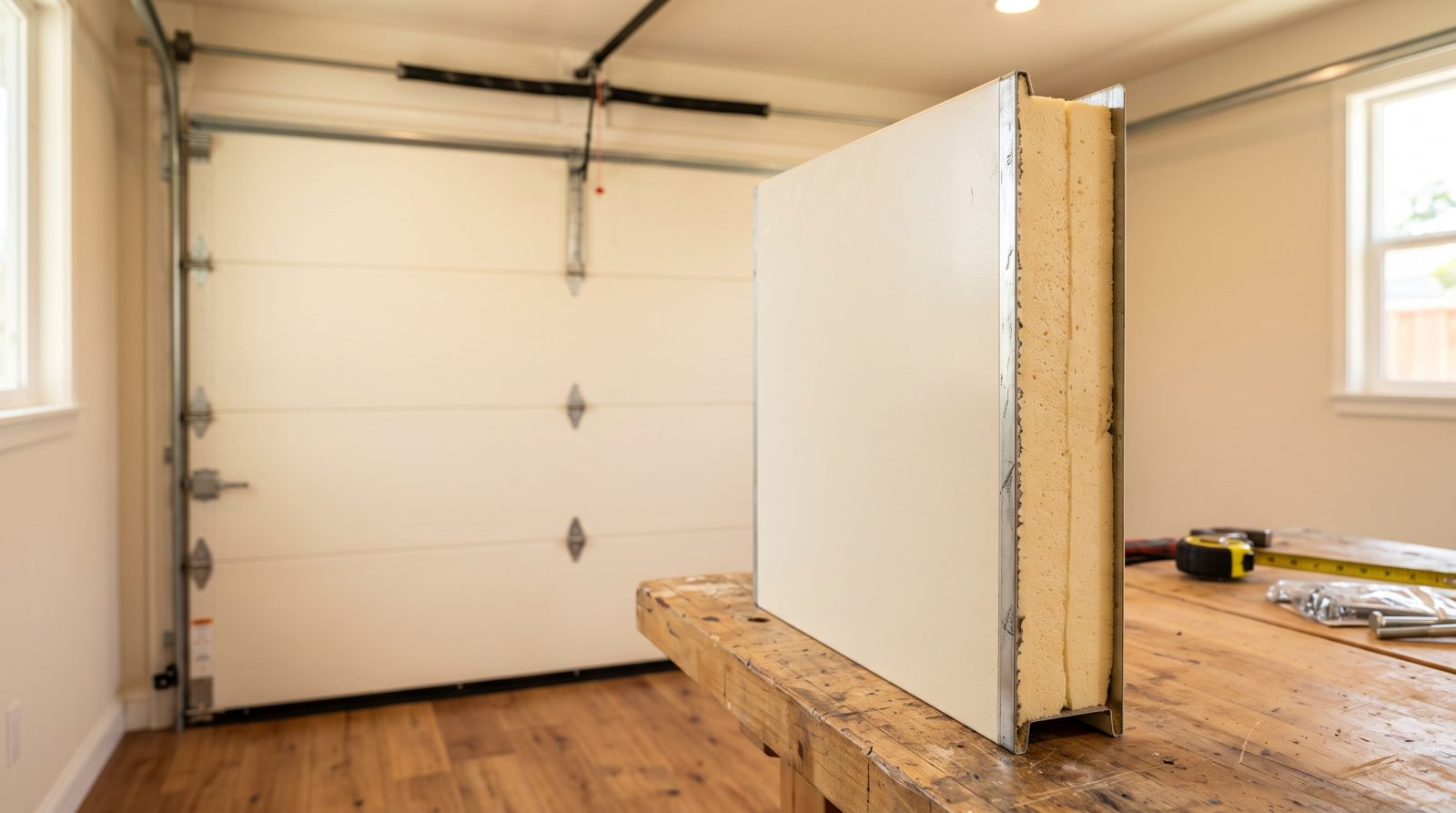
What an insulated garage door actually does
Most people picture insulation as a winter feature, but a garage door does far more than slow heat loss. The garage is usually the largest uninsulated opening in a home, and on many houses it shares a wall — and a ceiling — with living space, a bedroom above, or a kitchen behind it. An insulated door reduces how much outdoor temperature swings through that shared barrier, which steadies the rooms next to and above the garage, not just the garage itself.
Insulation also changes the door physically. A single-layer steel door is essentially a thin sheet that flexes, drums in the wind, and transmits every street sound. Adding an insulating core sandwiched between layers stiffens the whole panel. The result is a door that feels solid, closes with a muffled thud instead of a clang, dents less easily, and resists the daily warping and racking that, over years, is one of the quiet reasons doors drift off-track or stop sealing properly.
It's worth being honest about limits, too. An insulated door is not a heater, and it cannot fully condition an unsealed, drafty garage on its own. Its job is to slow the transfer of heat and cold and to dampen sound — and it does that job best when the rest of the opening (weather seals, the gap under the door, the gaps around the frame) is in good shape. Insulation and a good seal are partners; one without the other leaves real performance on the table.
- Steadier temperatures in rooms that share a wall or floor with the garage
- A noticeably quieter door — less drumming, banging, and street noise
- A stiffer, more dent- and warp-resistant panel that holds its shape over time
- More usable garage space for a workshop, gym, home office, or storage that can't take temperature extremes
- Better protection for anything heat- or cold-sensitive parked or stored inside
R-value, U-factor, and the numbers that actually matter
R-value measures resistance to heat flow — higher means more resistance, and therefore more insulating performance. Garage doors are commonly sold anywhere from roughly R-6 on a basic insulated model up to the high teens or low twenties on premium polyurethane doors. As a rule of thumb, the difference between an uninsulated door and a mid-range insulated one is large and easy to feel; the difference between a high-R door and a very-high-R door is real but more subtle, and worth paying for mainly when the garage is conditioned or attached to living space.
The catch is that R-value is often quoted in two different ways, which is why two doors with the same headline number can perform differently. A 'calculated' or 'center-of-panel' R-value measures only the insulated core at its thickest point. A 'whole-door' or system R-value accounts for the frame, seams, and the metal that bridges from inside to outside (thermal bridging). Whole-door numbers are always lower — and more honest. When you compare doors, try to compare the same kind of number, and treat a suspiciously high center-of-panel figure with healthy skepticism.
You may also see U-factor, which is essentially the inverse of R-value: it measures how readily heat passes through, so lower is better. It's the same physics described from the other direction. For everyday shopping, R-value is the more familiar yardstick — just make sure you know whether it's a core number or a whole-door number before you let it drive the decision.
- Higher R-value = more resistance to heat flow; the biggest jump is from uninsulated to insulated
- Center-of-panel R-value measures only the core; whole-door R-value is lower and more realistic
- U-factor is the inverse of R-value — lower U-factor means better insulation
- Diminishing returns: very high R-values matter most for conditioned or attached garages
- Compare like-for-like numbers between doors; ignore a single dramatic figure with no context
Polystyrene vs. polyurethane: the two cores that define the door
Almost every insulated garage door uses one of two cores, and the choice shapes price, performance, and durability more than any other single factor. Polystyrene is rigid foam board cut to fit inside the panel — the same family of material as a foam cooler. Polyurethane is foam that's injected as a liquid and expands to fill every void inside the panel, bonding to the steel skins as it cures.
Polystyrene is the more affordable option and still a meaningful upgrade over no insulation at all. It typically lands in the lower-to-mid R-value range and is a sensible pick for a detached garage, a milder climate, or a budget-conscious project where the goal is mainly to take the edge off temperatures and quiet the door. Because the board is fitted into the panel rather than bonded throughout, these doors are generally a bit less rigid than their polyurethane counterparts.
Polyurethane delivers a higher R-value in the same panel thickness because the expanding foam leaves no air gaps and bonds the inner and outer steel together. That bonding is the underrated benefit: it creates a structurally stronger panel that resists denting and warping and tends to stay quiet for longer. It costs more, but for an attached garage, a conditioned space, or a harsh climate — very cold winters or punishing summer heat — it's usually the better long-term value. Many premium doors with the highest insulation ratings rely on polyurethane for exactly this reason.
- Polystyrene: rigid foam board, lower cost, solid mid-range performance, good for detached or mild-climate garages
- Polyurethane: injected expanding foam, higher R-value per inch, no air gaps, bonded for strength
- Polyurethane panels are typically stiffer, quieter, and more dent- and warp-resistant over time
- Single-layer (no insulation) is cheapest but flexes, drums, and dents most easily
- Triple-layer construction (steel-foam-steel) gives the cleanest interior finish and the best sound damping
Choosing by climate, garage type, and how you use the space
The right amount of insulation is genuinely regional. In hot southern and southwestern climates, the priority is keeping radiant heat out so an attached garage doesn't turn into an oven that pushes heat into the house and overworks the air conditioning — here a higher R-value and a light-colored, heat-reflective exterior both help. In cold northern climates, the goal is retaining heat and preventing the kind of deep freeze that makes a garage miserable and can stiffen door hardware; a high-R polyurethane door earns its keep through long winters. In mild coastal or temperate regions, a moderate, mid-range door is often plenty, and spending up to the highest ratings may be more than the climate ever calls for.
Whether the garage is attached or detached matters just as much as the weather. An attached garage shares thermal boundaries with your living space, so insulating its door has a real, measurable effect on the comfort and energy use of the rooms beside and above it — this is where higher R-values pay back fastest. A fully detached garage has no living space to protect, so insulation there is about the garage's own comfort and the door's durability rather than your utility bill, which often makes a mid-range door the smart spend.
Finally, be honest about how you use the space. If the garage is purely for parking and storage, modest insulation is fine. If it's a workshop, a gym, a home office, a band room, or a place you keep paint, electronics, or anything temperature-sensitive, lean toward higher R-value and polyurethane — and pair the door with good perimeter seals so the insulation has something to work with.
- Hot climates: prioritize a higher R-value plus a light, heat-reflective exterior color
- Cold climates: a high-R polyurethane door pays off through long, harsh winters
- Mild/temperate regions: a mid-range insulated door is often all you truly need
- Attached garage: insulation directly affects home comfort and energy bills — invest more here
- Detached garage: insulation is mostly about garage comfort and door durability — mid-range often wins
- Conditioned or living-adjacent spaces (workshop, gym, office): go higher and seal the perimeter well
Where insulation meets safety: when comfort becomes a repair issue
An insulated door is heavier than a single-layer one, and that weight is part of why insulated doors feel so solid — but it also means the springs, cables, and opener are carrying more load. This usually isn't a problem on a properly balanced door, but it's exactly why a door's performance and its safety are connected. When an insulated door starts losing the smooth, quiet operation it was known for, that's often an early warning that the balance or hardware needs attention, not just an insulation question.
The most urgent of those warnings involves the spring system. Garage door springs are under enormous tension and store the energy that lets the door — insulated and heavy or not — move safely. A broken spring can leave a door stuck closed with your car trapped inside, or stuck partway with the door at risk of dropping. This is the single clearest 'do not force it' situation: never try to muscle a heavy insulated door open or closed when a spring or cable has failed, and don't stand or reach under a door that's behaving unevenly. Forcing it can damage panels, snap cables, or cause the door to fall.
Insulation can also mask a developing seal problem. If you start feeling drafts, seeing daylight along the edges, or noticing the bottom of the door no longer meeting the floor cleanly, the door may be sagging, slightly off-track, or losing its weatherstripping — all of which quietly erase the comfort you paid for and, left alone, can progress into an off-track door that won't open or close safely. When that happens, the smart move is a same-day, fast assessment rather than repeated forcing, which tends to turn a small fix into a bigger one.
- Insulated doors are heavier, so balance, springs, cables, and the opener all work harder
- A door that's gotten loud, jerky, or uneven may be warning you about balance or hardware — not just insulation
- Broken spring or cable = stop. Don't force a heavy door; a trapped car is safer than a falling door
- New drafts, daylight at the edges, or a door not meeting the floor can signal sagging, off-track, or worn seals
- If the door won't open or close, or moves unevenly, treat it as urgent and get fast, same-day help instead of forcing it
What insulated garage doors typically cost (and what drives the price)
Pricing varies widely, so think in ranges rather than a single figure — and treat any number as a typical industry estimate that shifts with your door size, material, insulation type, finish, and region, not a quote. As a general guide, basic single-layer (uninsulated) steel doors sit at the low end, mid-range polystyrene-insulated doors occupy the broad middle, and premium polyurethane doors with high R-values, decorative finishes, glass sections, or wood-look construction reach the top of the scale. Larger two-car doors and custom sizes cost more simply because there's more door.
Installation is its own line item and is genuinely worth professional handling. An insulated door's added weight has to be matched to the correct spring system and balanced precisely; getting that wrong stresses the opener and creates a safety hazard. Costs also rise if old hardware, tracks, or the spring system need replacing at the same time, or if the existing opening needs prep. Climate plays a role too — regions with extreme weather often justify spending more on a higher-R, polyurethane door because the energy and comfort payback is larger there.
The most useful way to budget is to weigh upfront cost against daily payback. For a detached garage in a mild climate, a mid-range door is often the rational choice. For an attached or conditioned garage in a hot or cold region, the higher-R door frequently earns back its premium through lower energy use and real, year-round comfort. The honest answer for most homes lives in the middle — enough insulation to feel the difference, matched to the climate and how the space is actually used.
- Treat all figures as typical estimate ranges that vary by size, material, insulation, finish, and region — never a fixed quote
- Single-layer (uninsulated): lowest cost; polystyrene-insulated: mid-range; polyurethane/high-R/decorative: highest
- Two-car and custom sizes cost more; glass, wood-look, and premium finishes add to the total
- Professional installation matters: the spring system must match the door's added weight and be balanced correctly
- Higher-R doors pay back faster on attached/conditioned garages and in extreme climates