Is a Damaged Panel an Emergency? Read This First
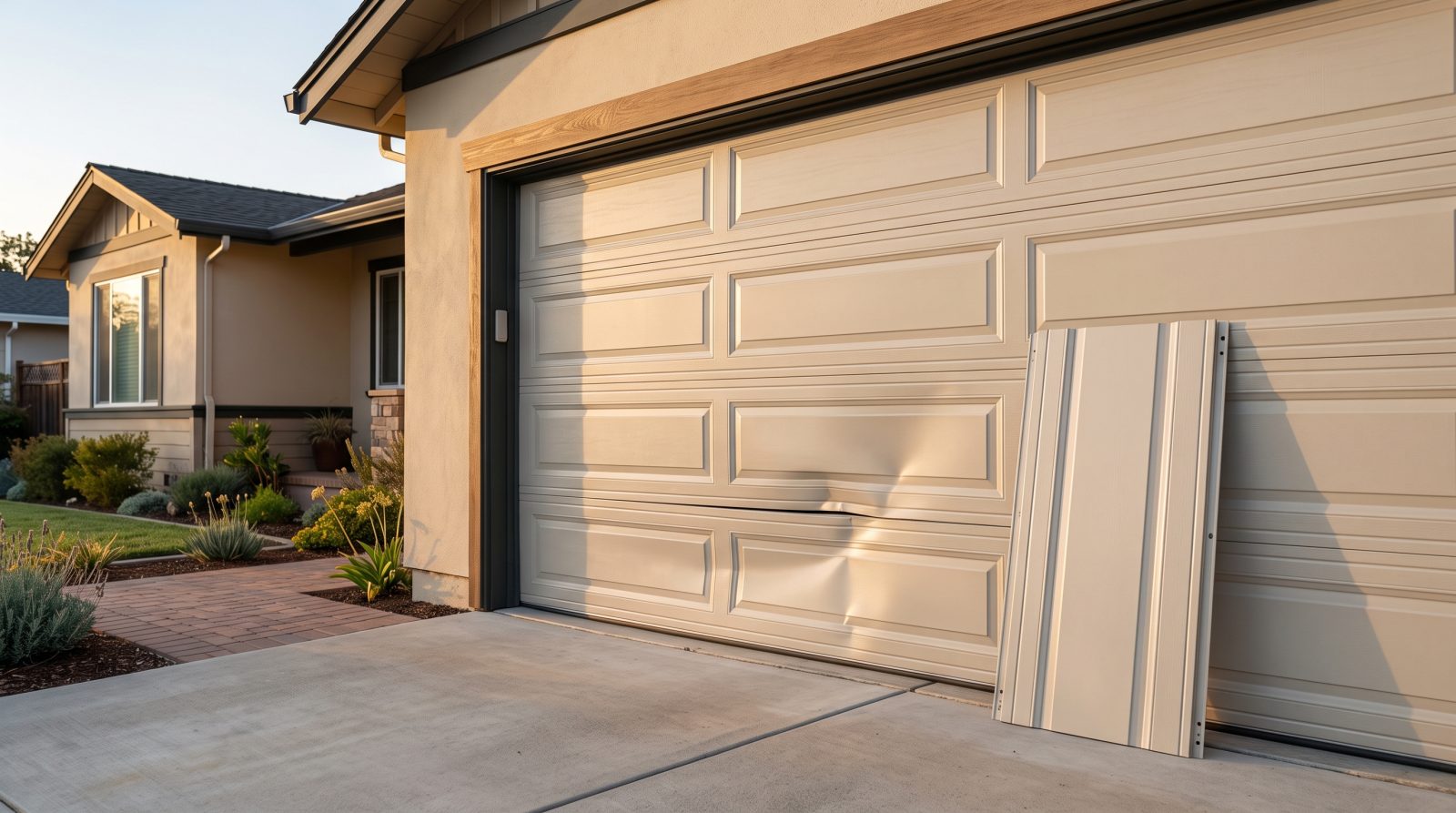
Most dented panels are a same-day annoyance, not a danger. But some are an urgent safety issue, and the difference matters before you press the opener button again. The risk is that a deformed panel changes the shape of the door. If a section is bowed, buckled, or pushed out of plane, it may no longer slide cleanly through the tracks. Force it with the opener and you can pull the door off-track, snap a roller, or jam the whole assembly halfway, leaving you with a door stuck open (a security exposure) or stuck closed with your car trapped inside.
Treat it as urgent if any of these are true: the door binds, scrapes, or stalls partway when it moves; a panel is visibly bowing outward or pulling away from its neighbors; the impact also bent a track, snapped a cable, or knocked a roller out; or the bottom section is so damaged the door no longer seals and sits crooked. In those cases, stop using the opener. Repeatedly cycling a compromised door is how a fixable single-panel job turns into a bent-track, broken-cable, off-the-rails job.
If the damage is purely a surface dent and the door still opens and closes smoothly, evenly, and quietly, you are not in danger. You can plan the replacement on your schedule rather than scrambling. The deciding question is always movement: a door that travels normally is telling you the structure is intact; a door that fights you is telling you it is not.
- Stop pressing the opener if the door binds, scrapes, stalls, or sounds different after the impact
- Do not force a bowed or buckled panel through the tracks; you can pull the door off-track
- Disconnect the opener with the manual release only if you can do so safely and the door is fully down
- Never stand under or reach into a partially open door that is hung up on a damaged section
- A damaged bottom panel that breaks the floor seal is also a pest, water, and security gap; address it promptly
Repair the Panel or Replace It? How the Decision Is Made
The first thing a good technician asks is not whether the panel looks bad, but whether the section is still structurally sound. Garage door panels do real work: they hold the hinges, rollers, and (on the bottom) the cable brackets that the entire counterbalance system pulls against. A dent that only deforms the face skin is cosmetic. A dent that creases the core, cracks a strut channel, or distorts the edges where hinges bolt on is structural, and that section needs to come out.
Steel doors are the most common nationwide, and light dents in a single-layer steel skin can sometimes be improved with careful dent pulling or a reinforcing strut, though results are rarely invisible. Insulated steel doors (two skins around a foam core) usually cannot be straightened convincingly once the core is crushed; replacement of the section is the honest answer. Aluminum panels dent easily but are light to swap. Wood and wood-composite panels can sometimes be repaired with filler and refinishing, but a cracked or split wood section is typically replaced. Glass or full-view aluminum panels with a broken pane are a glass-and-section job.
Replacing a single section is genuinely possible on most modern sectional doors, and it is the budget-friendly path when it works. The catch is that it only works when two things line up: the rest of the door is in good shape (you are not putting a fresh panel on a tired, rusted, or sun-baked door that will look mismatched anyway), and a matching panel can actually be sourced. When either of those fails, replacing the whole door often delivers better value and a result you will not have to look at and wince every time you pull in.
- Cosmetic dent (face skin only, door still operates smoothly): often repairable or simply lived with
- Structural damage (creased core, cracked struts, bent hinge or cable-bracket edges): replace the section
- Bottom panel damage is higher stakes; it carries the cable brackets and the weather seal
- Single-section swap makes sense when the rest of the door is sound and a match exists
- Whole-door replacement often wins when the door is old, faded, rusted, or the panel is discontinued
The Matching Problem: Why One New Panel Can Be the Hard Part
On paper, replacing one panel sounds simple. In practice, matching is where single-section jobs succeed or fail. A garage door panel has to match on several axes at once: the manufacturer and model line, the exact panel design (raised-panel, flush, ribbed, carriage-house, full-view), the gauge and construction (single-layer, insulated, the specific foam thickness), the color, and the surface texture or woodgrain stamp. Miss any one and the new section announces itself.
Color is the sneaky one. Even a perfectly correct factory-color panel can look off next to panels that have spent years in the sun. Climate matters here, and it varies a lot by region. A door baking under intense southern or southwestern sun, or one on a south-facing wall, may have faded, chalked, or shifted in tone far more than a sheltered door in a milder, cloudier northern climate. The result is that a brand-new factory-matched panel can read as too bright or too saturated against its weathered neighbors. Sometimes the right call is to accept a slight difference, sometimes to repaint the full door, and sometimes to replace the whole door so everything ages together from here.
Discontinued and older doors raise the difficulty further. Manufacturers retire panel designs and colors over time, and a door that is a couple of decades old may have no current-production match at all. A reputable technician will try to identify the manufacturer (often from a label on the inside of a panel or on the track) and source either a genuine match or the closest available equivalent, and will tell you honestly when no clean match exists rather than bolting on an obvious mismatch. The truthful position is that a perfect invisible match is realistic on newer, common doors and increasingly unlikely the older or more specialized the door is.
- Match on: manufacturer/model, panel design, construction and insulation, color, and surface texture
- Sun-faded panels (worse in high-UV southern and high-altitude regions) make exact color matching harder
- Identify the maker from the panel or track label before assuming a part is available
- Discontinued designs and older doors may have no current factory match
- An honest tech will tell you when a clean match isn't possible instead of installing an obvious one
What a Panel Replacement Actually Involves
Section replacement is a real disassembly job, not a quick patch, and it intersects directly with the parts of the door that store dangerous energy. To remove a damaged section, a technician typically has to relieve tension in the system, disconnect the affected panel from its neighbors at the hinges, free it from the rollers in the track, and lift it out, then reverse the process with the new panel and re-align everything so the door tracks straight and seals at the floor.
The reason this is not a casual DIY project is the counterbalance system. The springs and cables that make a heavy door feel light are under extreme tension, and the bottom panel in particular carries the cable brackets that those cables pull against. Disconnecting hardware near loaded springs or cables without the right tools and technique is exactly the scenario that causes serious injuries. If a panel replacement also requires touching springs or cables, that portion is professional work, full stop.
A proper job also includes the things that are easy to skip: checking that the impact did not bend a track or knock the door out of square, replacing damaged rollers or hinges that came off the old panel rather than reusing bent ones, confirming the new section's weight matches so the existing springs are still balanced, and testing the door's safety reversal so it stops and reverses if something is under it. After the swap, the door should travel smoothly, sit level, seal at the floor, and reverse on contact. If it does any less than that, the job is not finished.
- Expect a full section removal and reinstall, not a surface patch
- Springs and cables are under high tension; anything involving them is professional work
- The bottom panel carries cable brackets, raising the stakes on that section specifically
- A complete job re-checks tracks, rollers, hinges, balance, and the floor seal
- The safety reversal must be tested after reassembly so the door stops and reverses on contact
Typical Cost Ranges and What Drives Them
Costs vary widely, so treat every figure here as a typical industry range and an estimate, not a quote. What you will actually pay depends on the door's brand and construction, how many sections are damaged, whether a matching panel can be sourced or must be special-ordered, the material (steel, insulated steel, aluminum, wood, or full-view glass), your region and local labor rates, and whether the impact also damaged tracks, rollers, cables, or springs that have to be addressed at the same time.
As broad, ballpark guidance only: replacing a single steel section commonly lands in the low-to-mid hundreds of dollars including labor, with insulated, wood, carriage-house, or full-view glass sections running higher because the panels themselves cost more and may need special ordering. Multi-section damage, or damage to the bottom panel that also involves cable brackets, pushes the figure up. At a certain point the math flips: if a single replacement section approaches a large share of the cost of a new door, especially on an older or faded door where matching is poor, replacing the whole door is often the better value.
Insurance is worth a word. If the damage came from a vehicle, storm, or another covered event, a homeowner's or auto policy may apply, and your deductible may be a bigger factor than the repair price itself. Keep photos of the damage and any estimate. The honest bottom line is that no one can give you a real number from a description; a fixed price requires someone seeing the actual door, model, and full extent of the damage.
- All figures are typical ranges and estimates only; they vary by door, material, region, and scope
- Single steel sections are the lower end; insulated, wood, carriage-house, and glass run higher
- Special-order and discontinued panels add cost and lead time
- When a section nears a large share of a new door's price, full replacement is often better value
- Vehicle, storm, or impact damage may be insurable; keep photos and an itemized estimate
What to Do Right Now and How to Prevent the Next Dent
If a panel is damaged and the door is misbehaving, the safest sequence is simple: stop operating it, do not force it, and keep people and cars clear of it until it has been looked at. If the door is fully closed and you can reach the manual release cord safely, you can disconnect the opener so no one cycles it by habit, but never pull the release on a door that is partially open or visibly under tension. If the door is stuck open and you are worried about security, prioritize a same-day professional look rather than improvising a fix that could send a heavy section down unexpectedly.
Once the door is stable, document the damage with a few photos (helpful for both the technician and any insurance claim) and try to find the manufacturer label inside a panel or on the track. That single piece of information dramatically speeds up sourcing a matching section. Then get a professional assessment of whether this is a one-panel swap or a whole-door decision, because that judgment depends on the door's age, condition, and the realistic availability of a match.
Preventing the next one is mostly about clearance and impact. The most common causes of panel damage are vehicles (backing or pulling in before the door is fully up, or nudging a closed door), weather and wind-blown debris in storm-prone regions, and basic wear that leaves an older door brittle. Pull all the way in or out only when the door is fully open, keep bikes and tools clear of the door's path, and have the door's balance and hardware checked periodically so a small problem does not set up a bigger failure. When you are ready, request a free quote and have the door assessed in person so you get an honest single-panel-versus-new-door recommendation for your specific situation.
- Stop using the opener and keep cars and people clear until the door is assessed
- Only use the manual release on a fully closed door, never a partially open one
- Photograph the damage and locate the manufacturer label to speed up matching
- Wait for the door to be fully open before pulling a vehicle in or out
- Have balance and hardware checked periodically to catch small issues early