Why Maintenance Is Really Emergency Prevention
A residential garage door is the largest and heaviest moving object in most homes, often weighing between 130 and 350 pounds depending on whether it is single-layer steel, insulated, or solid wood. All of that weight is balanced by springs under extreme tension and held in place by cables, rollers, hinges, and a track system. When any one part wears out, the whole system is forced to compensate, which accelerates wear everywhere else. A neglected door does not fail gracefully; it fails suddenly, and usually at the worst moment.
The two failure modes that turn into true emergencies are a door stuck closed, which can trap your car inside when you need to leave, and a door stuck open or partially open, which leaves your home and everything in the garage exposed. Both are commonly traced back to parts that gave plenty of warning. Routine maintenance is not about cosmetics. It is the single most effective thing a homeowner can do to avoid being caught off guard by one of these situations.
Climate plays a real role in how fast things wear. In cold northern regions, metal contracts and lubricant thickens in winter, putting extra strain on springs on the coldest mornings, exactly when many spring breaks happen. In hot, dry, or coastal areas, sun, dust, and salt air degrade rollers, weatherstripping, and finishes faster. Humid regions tend to see more rust on springs, hinges, and tracks. None of this means failure is inevitable, but it does mean your maintenance rhythm should match your climate, with extra attention going into the season your area is hardest on.
The Core DIY Checklist (Safe to Do Yourself)
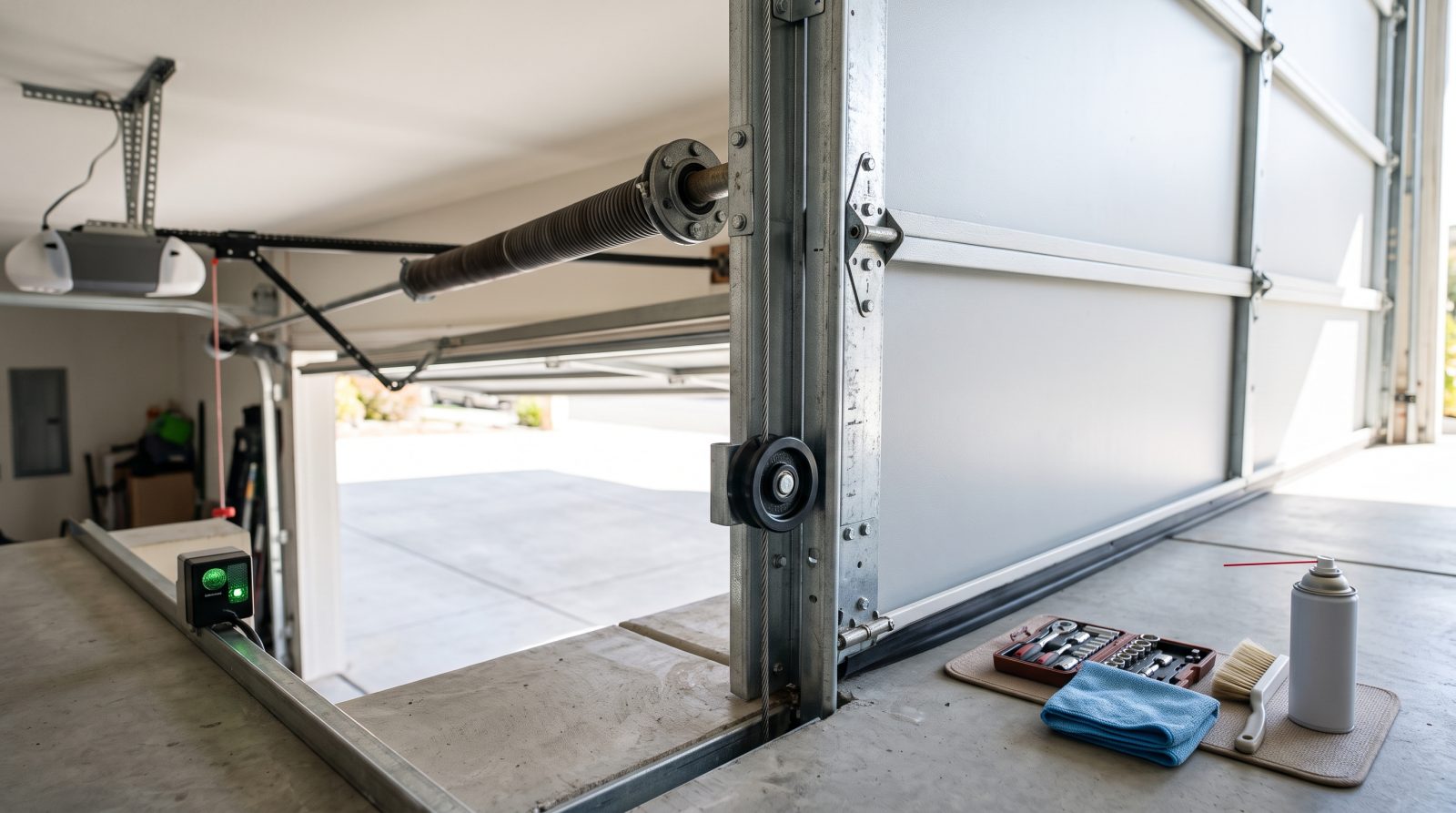
These are the tasks any homeowner can perform safely, with no special tools beyond a step stool, a cloth, a level, and the right lubricant. The golden rule before you touch anything: disconnect power to the opener at the outlet or breaker so the door cannot be activated while your hands are near moving parts. Work with the door fully closed unless a step specifically says otherwise.
- Look and listen first: with the door closed, stand inside and scan the springs, cables, rollers, and track for anything obviously rusted, frayed, loose, or out of place. Then run the door once and listen. Grinding, popping, scraping, or a door that jerks or hesitates are all early warnings worth noting.
- Tighten the hardware: vibration from daily use slowly loosens bolts and brackets. With the door closed, snug up the roller brackets and the bolts along the track and hinges with a socket wrench. Firm, not forced, you do not want to strip threads or over-tighten.
- Lubricate the moving parts: apply a garage-door-specific lubricant (a lithium-based or silicone spray, not WD-40, which is a cleaner and degreaser, not a long-term lubricant) to the rollers, hinges, springs, and bearings. Wipe the tracks clean but do not grease the inside of the tracks, the rollers should roll, not slide through grease.
- Check the rollers: spin each roller by hand. They should turn freely. A roller that is cracked, chipped, or will not spin is on its way out and can cause the door to bind or jump the track.
- Inspect the weatherstripping: check the rubber seal along the bottom of the door and the stripping along the sides. Cracked or brittle seals let in water, pests, and drafts and are an easy, low-cost DIY replacement.
- Clear the photo-eye sensors: wipe the two small sensors near the bottom of the track on each side and confirm they are aligned. Misaligned or dirty sensors are one of the most common reasons a door refuses to close.
- Test the auto-reverse safety: lay a sturdy object like a roll of paper towels flat on the floor in the door's path and close the door. It should touch the object and immediately reverse. If it does not, the safety system needs attention before anything else.
The Balance Test: The Most Important Two Minutes
If you do only one diagnostic each season, make it the balance test. It tells you whether your springs, the part most likely to cause a sudden emergency, are still doing their job. A properly balanced door is held almost entirely by its spring system, so the opener only has to do a little work. When springs weaken, the opener is forced to haul the full weight of the door, which burns out the opener motor and signals that a spring break may be coming.
To perform the test, close the door, then pull the opener's red emergency release cord to disconnect the door from the opener. By hand, lift the door to about waist height and let go. A well-balanced door will stay roughly in place or drift only slightly. If it slams down or flies up on its own, the door is out of balance, which almost always means the spring tension is off or a spring is wearing out. When you are done, lower the door fully and re-engage the opener by following the manufacturer's reconnect step, never leave the door disconnected and open.
Here is the critical safety line: the balance test is something you can do, but adjusting or replacing springs is not a DIY job. Torsion and extension springs store an enormous amount of energy, and they are responsible for some of the most serious injuries in home repair when handled without the right training and tools. If your door fails the balance test, the correct response is to limit use and arrange professional service, not to reach for a wrench. Catching a failing spring through this test, before it snaps, is exactly how a planned same-day visit replaces a stressful emergency.
A Season-by-Season Plan
Spreading maintenance across the year keeps it manageable and lines up each task with the conditions your door is about to face. Adjust the emphasis to your local climate, the season your region is harshest in deserves the most thorough check.
- Spring: a full top-to-bottom inspection after winter. Cold weather is hard on springs and lubricant, so look closely for any rust, cracks, or fatigue that developed over the cold months. Clean and re-lubricate, and clear out debris, leaves, and grit that built up in the tracks.
- Summer: focus on heat and dust. In hot and dry regions, check that lubricant has not baked off, inspect rollers and weatherstripping for sun damage, and make sure the opener is not straining in the heat. This is also a good time to confirm the auto-reverse and sensors are working before kids are home more often.
- Fall: prepare for the cold. This is the most important tune-up in cold climates, do it before the first freeze. Lubricate thoroughly so parts are not running dry on the coldest mornings, run the balance test, and replace any worn weatherstripping so winter weather and pests stay out.
- Winter: monitor and respond. In freezing regions, watch for the door sticking to the floor, slow operation, and any new noises on cold mornings. Keep the bottom seal clear of ice and never force a frozen or stiff door, forcing it is a leading cause of bent tracks, snapped cables, and broken springs.
Early Warning Signs and When to Stop
Maintenance is also about knowing when to put the tools down. Some symptoms are the door telling you a failure is close, and continuing to operate it, or trying to fix it yourself, can turn a manageable repair into an injury or a much larger bill. Treat the following as reasons to limit use and arrange same-day professional help.
A visible gap in a torsion spring, or a frayed, loose, or broken cable, means the door's weight is no longer safely supported. A door that has come off its track, sits crooked, or has rollers that have left the track should not be operated at all, forcing it can bend the track and cause the door to fall. A loud bang from the garage followed by a door that will not open is the classic signature of a spring break, the door is now far heavier than the opener can handle.
Other signals are subtler but still matter: a door that suddenly feels very heavy by hand, that closes faster than it should, that hesitates or reverses without an obstruction, or an opener that strains and grinds. Any of these means the system is out of balance or a component is failing. The safest move is to stop using the door, keep people and pets clear of it, and get it looked at promptly rather than risk it failing while someone is underneath.
The whole point of a maintenance routine is to move problems out of the emergency column and into the planned-service column. A door you inspect each season rarely surprises you, and when it does flag something, you catch it early enough to schedule a calm, same-day fix instead of standing in the driveway with a trapped car or an exposed home. If your checklist turned up a worn spring, a failing cable, an off-track door, or an opener that is clearly struggling, do not force it, request a free quote and let a professional handle the parts that store real danger.