How the Roller and Track System Actually Works (and Why It Fails)
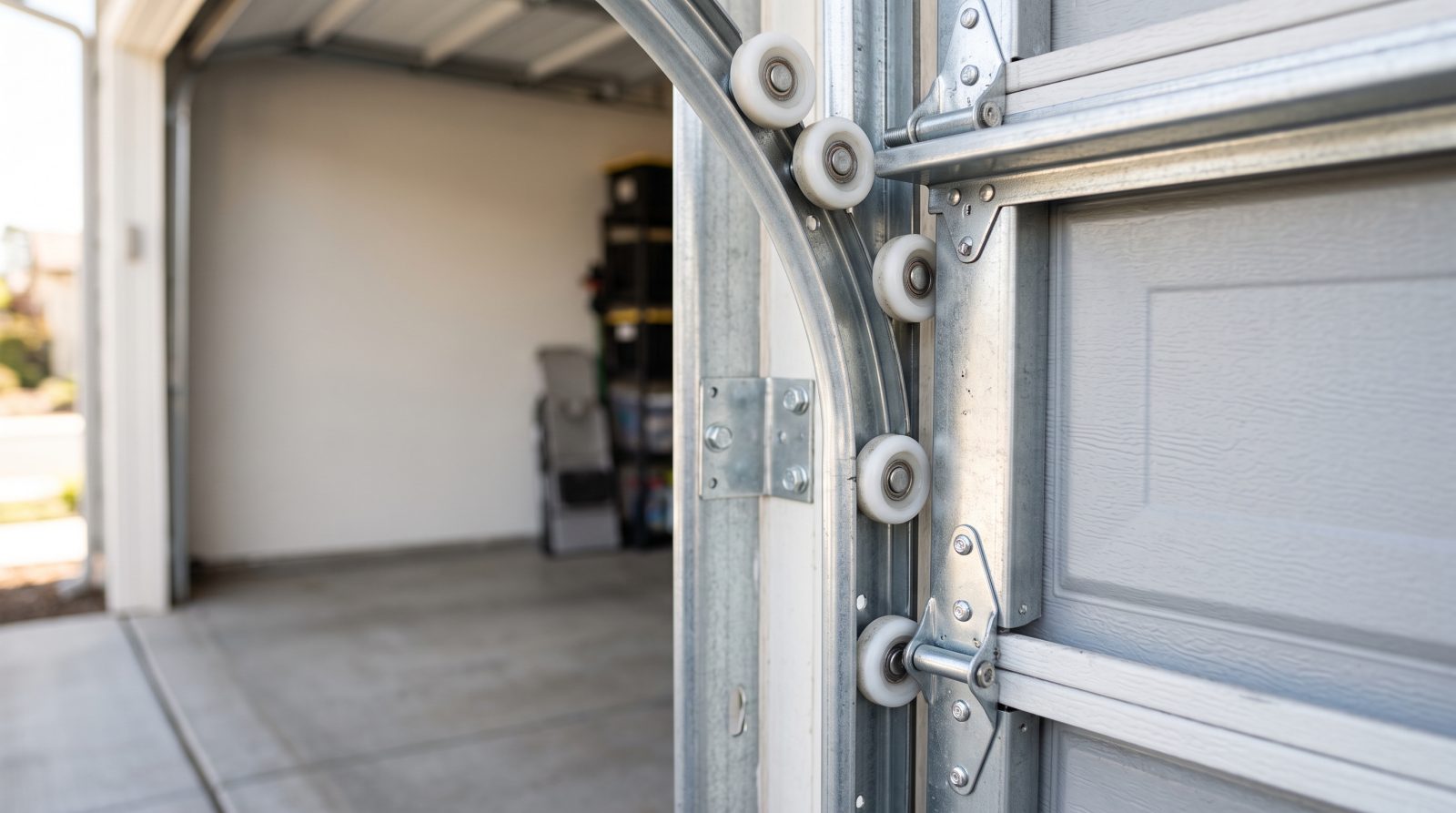
A sectional garage door is not lifted in one piece — it bends. Each panel is connected by hinges, and small wheels called rollers ride inside two vertical tracks that curve overhead into horizontal tracks near the ceiling. As the opener or springs raise the door, the rollers carry the panels up and around that curve, holding everything in alignment so the door moves as one smooth unit. The whole system depends on tight tolerances: the rollers have to spin freely, the tracks have to stay straight and properly spaced, and the brackets that hold the tracks to the wall have to stay tight. When any one of those goes out of spec, the door fights itself.
Rollers fail in predictable ways. The cheapest builder-grade rollers are often plastic or steel with exposed, unsealed bearings; over thousands of cycles the bearings dry out, the wheels develop flat spots, stems bend, and the roller starts dragging instead of rolling. A dragging roller chews at the track, throws off alignment, and forces the opener and springs to work harder than they should. Nylon rollers with sealed ball bearings last far longer and run dramatically quieter, which is why an upgrade is one of the most cost-effective fixes on a noisy door.
Tracks fail for different reasons — almost always impact or stress. A bumper tap from a car, a ladder leaned against the rail, a settling garage frame, or a door that was forced when it shouldn't have been can all bend, crimp, or twist a track. Loose mounting bolts let a track sag or shift outward. Once the track geometry is off even a little, the rollers no longer have a clean path to follow, and that is when you get the binding, the grinding, and ultimately a door that derails.
Warning Signs You Have a Roller or Track Problem
The good news about roller and track trouble is that it almost always announces itself before it becomes an emergency. Doors rarely jump the track without warning — they spend days or weeks telling you something is wrong. Learning to read those signals lets you book a same-day repair on your schedule instead of dealing with a fully jammed door at the worst possible moment.
- New or worsening noise — grinding, squealing, rattling, or a rhythmic clunk as a flat-spotted roller hits the same point each cycle
- The door jerks, hesitates, or moves unevenly instead of gliding in one smooth motion
- Visible gaps between a roller and the track, or rollers that look tilted, cracked, or are riding at the edge of the rail
- A track that looks bent, crimped, pinched, or pulled away from the wall, with daylight where the bracket should be flush
- The door looks crooked in the opening, sits lower on one side, or rubs the frame as it travels
- Grease, black dust, or metal shavings collecting below the tracks — a sign of metal-on-metal wear
- The opener strains, reverses, or trips its safety stop because the door has become hard to move
What to Do Right Now — and Why You Shouldn't Force It
If your door is binding, partially off its track, or refusing to move, the single most important thing is this: stop operating it. Every time you hit the button on a door that is fighting its tracks, you risk turning a minor repair into a major one — a roller that is merely dragging can pop free, a slightly bent track can crimp completely, and a door under load can shift into a position that is dangerous to stand near. Forcing a stuck door by hand is no safer, because the door is connected to springs and cables under enormous tension, and a sudden release of a bound door can move fast.
If the door is stuck open, that is a security concern — your home and everything in the garage is exposed. If it is stuck closed, your vehicle may be trapped. In either case, resist the urge to muscle it. Do not pull the red emergency release cord on a door that is jammed or partially off-track unless you fully understand the spring system; on a door that is bound up, releasing the opener can let weight drop or shift unexpectedly. Keep children and pets away from the door, and do not try to stand under or reach into a door that is hanging unevenly.
A few things you safely can do: clear the immediate area, take a photo of the problem (especially a visibly bent track or a roller out of its channel) so the technician knows what they're walking into, and make sure no obvious obstruction — a stone, a tool, a piece of debris — is wedged in the track. Beyond that, the right move is a fast, professional repair. A same-day technician can secure the door, get it safely off its load, correct the alignment, and replace what's worn — without the risk that comes from improvising.
How Professional Roller and Track Repair Works
A proper repair starts with diagnosis, not parts-swapping. A technician will run the door (carefully, by hand where needed) to watch where it binds, inspect every roller for flat spots and bearing play, check each track for bends and proper spacing, and confirm the mounting brackets are tight and square. Roller and track problems frequently travel with related wear — tired hinges, loose bolts, springs and cables near the end of their life — so a good inspection looks at the whole system rather than treating one symptom in isolation.
From there, the work depends on what's found. Worn rollers are replaced, and upgrading to sealed-bearing nylon rollers is a common recommendation because they run quieter and last longer. Minor track damage can sometimes be straightened and re-secured; a track that is badly bent, crimped, or kinked should be replaced rather than coaxed back, because a compromised track will never give the rollers a clean path again. Tracks are then re-aligned to the correct spacing and plumb, brackets are re-tightened, and the system is lubricated with a proper garage-door lubricant — not a generic spray that gums up over time.
Finally, a technician should balance-test the door and check that it travels smoothly end to end and that the opener's safety reverse still works. Done right, a roller and track repair doesn't just stop the noise — it restores the geometry the whole door depends on, which protects your springs, cables, and opener from the extra strain a misaligned door was putting on them.
Costs, Climate, and Why Regions Differ
Roller and track repair is generally one of the more affordable garage door services, but the real number depends on what's wrong and what your door needs. As a rough, industry-typical guide — these are estimates that vary by door size, material, parts quality, and your region, not a quote — replacing a full set of rollers is usually a modest job, often in the low-to-mid hundreds depending on whether you choose basic or premium sealed-bearing nylon rollers. Track straightening and re-alignment is frequently in a similar range. Replacing a damaged track section costs more than realigning one, and a job that turns up worn springs, cables, or hinges alongside the track issue will naturally run higher. Always ask for the diagnosis and the options before work begins.
Climate genuinely shapes how these parts age, which is worth understanding as a nationwide concern. In cold-winter regions, grease stiffens and bearings drag in freezing temperatures, so cheap rollers tend to fail sooner and doors are noisier and harder to move in the morning — sealed nylon rollers and the right cold-rated lubricant make a real difference there. In coastal and humid areas, salt air and moisture accelerate rust on steel rollers, track surfaces, and brackets, so corrosion is the more common culprit. In hot, dry, dusty climates, airborne grit works into roller bearings and track channels and grinds them down faster, which is why regular cleaning and re-lubrication pays off.
The practical takeaway is the same everywhere: rollers and tracks are wear items, and the smartest, cheapest time to address them is when you first hear the noise or see the misalignment — not after the door has come off its track. A small, same-day repair today is almost always less than the bigger fix that follows a derailment.