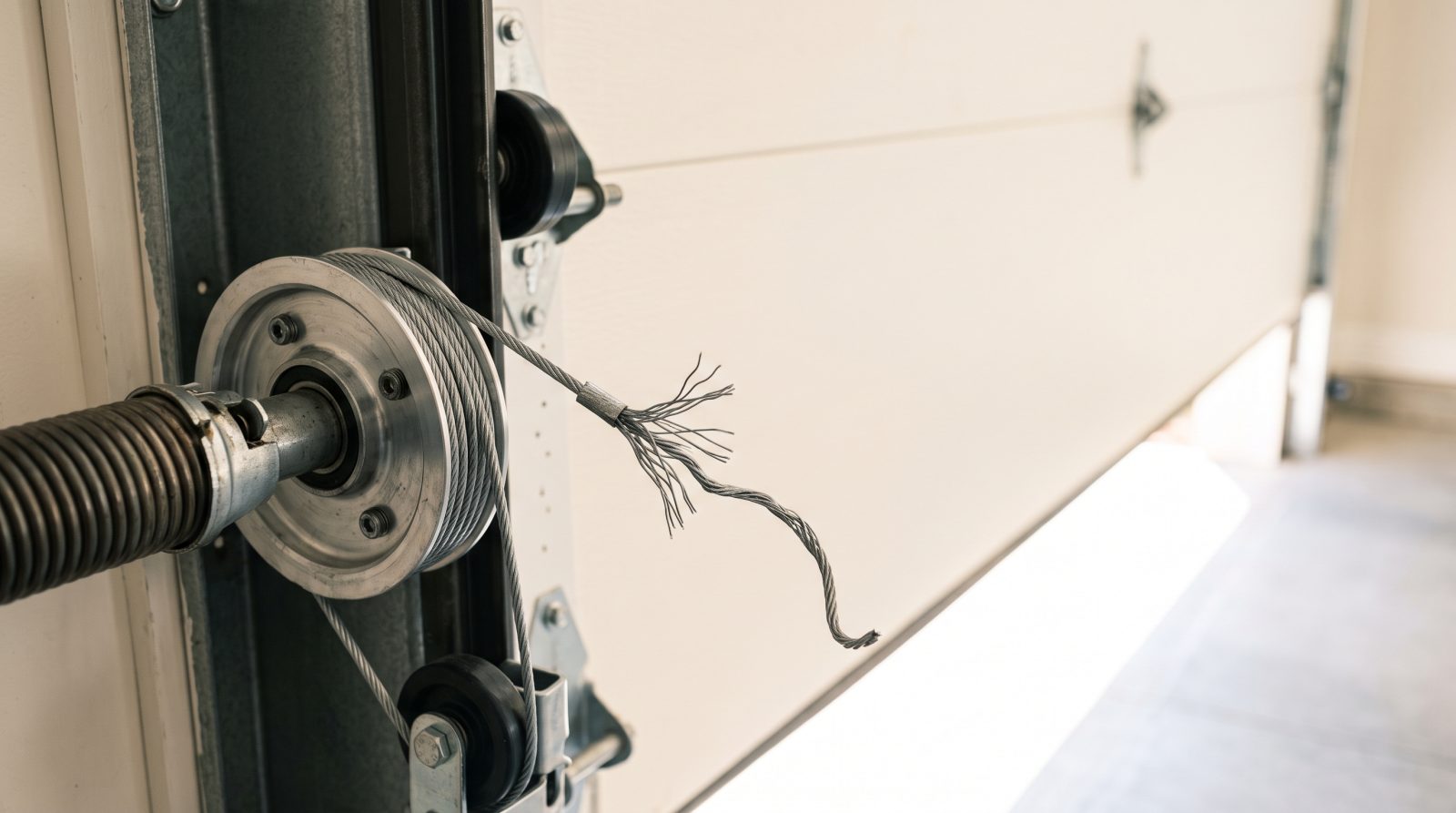
What Garage Door Lift Cables Do (and Why Failure Is So Sudden)
Your garage door is heavy. A standard double door can weigh well over a hundred pounds, and insulated or solid-wood doors weigh considerably more. The reason it glides up with a light touch is a counterbalance system: torsion or extension springs store energy, and steel lift cables transfer that energy to the bottom corners of the door, carrying its weight up and down. The cables are the link between the spring system and the door itself, which means they live under sustained tension the entire time the door is closed.
Because cables are always loaded, failure tends to be abrupt. A cable doesn't gently stop working — it lets go. One strand frays, then another, the remaining strands carry more load than they were rated for, and eventually the cable snaps or jumps off its drum or pulley. When that happens, the counterbalance on that side disappears instantly. The door can lurch, tilt, bind in the tracks, or drop. That suddenness is exactly why a frayed cable spotted early is a far better situation than a snapped one discovered after the fact.
- Lift cables transfer spring tension to the door's bottom brackets, balancing its full weight
- On torsion-spring systems, cables wind onto drums at the top corners; on extension systems, they run through pulleys
- Cables are sized to the door's weight — a heavier or insulated door puts more daily strain on them
- When a cable fails, the door loses balance on that side immediately, often binding or dropping
Warning Signs Your Cable Is Frayed or Failing
Cables usually give you clues before they snap, but the warning window can be short. Catching the early signs is the difference between a planned repair and an emergency where your door is stuck, crooked, or unsafe to touch. Get in the habit of glancing at the cables on each side of the door — they should be taut, neatly wound or routed, and free of visible damage.
The clearest red flag is a cable that looks frayed: individual wire strands sticking out like a worn shoelace, kinks, rust, or a section that's gone thin and stringy. You may also notice the door operating unevenly — one bottom corner lagging or lifting higher than the other — or a door that suddenly feels much heavier. A loose, slack, or dangling cable, or one that has clearly come off its drum or pulley, means the failure has already started and the door should not be operated.
- Visible fraying: broken or splayed wire strands, kinks, or a thinning, stringy section
- Rust or corrosion along the cable, common in humid coastal and high-moisture climates
- The door rises or closes crooked, with one bottom corner higher or lower than the other
- A loud bang followed by the door jamming, tilting, or refusing to move evenly
- A cable hanging loose, gone slack, or visibly off its drum or pulley
Why You Should Never Force a Door With a Bad Cable
When a cable is frayed or already snapped, the instinct is to force the door — yank it up to get the car out, or push it down to close up the house. This is the single most dangerous mistake homeowners make with garage doors, and it's worth understanding why the experts treat it as a hard stop.
With one cable compromised, the door's weight is no longer balanced. Forcing it can cause the door to slam down with enough force to crush whatever is underneath, including hands and feet, or to come off the track entirely and fall. Even more critically, a cable failure often goes hand-in-hand with the high-tension spring system. Torsion and extension springs hold tremendous stored energy; manipulating a door that has a failed cable can disturb that system in unpredictable, sometimes violent ways. The safe move is always the same: leave the door where it is, keep people, pets, and vehicles clear of it, and stop using the opener so the motor doesn't fight the imbalance and cause more damage.
- An unbalanced door can drop suddenly — a crushing hazard to anyone or anything beneath it
- Forcing the door can pull it off the track, where it may fall or jam dangerously
- Cable repair frequently involves the spring system, which stores dangerous high tension
- Repeatedly running the opener against a bad cable can damage the motor, drum, and track
- If the door is stuck partway open, treat it as a security risk and keep it monitored until repaired
How Professional Cable Repair Works
Proper cable repair is methodical, and it almost never means just clipping in a fresh cable and walking away. A technician first secures the door so it can't move during the work — this is the foundational safety step, because the whole system has to be stabilized before any tension is released or restored. From there, the failed cable is removed and the system is inspected as a whole.
Cables and springs are a matched system, so a good repair looks beyond the broken part. If one cable has frayed from age or wear, the cable on the opposite side is usually the same age and heading the same way, which is why cables are often replaced in pairs. The technician will also check the drums or pulleys for grooving and damage, verify the springs aren't worn or broken, confirm the new cables are correctly rated for your door's weight, and re-set the tension and tracking so both sides lift evenly. Finally, the door's balance is tested through a full cycle to confirm it travels smoothly, stops where it should, and reverses safely on the opener's safety features.
- The door is secured and stabilized before any tension work begins
- The failed cable is removed and the full counterbalance system is inspected
- Cables are commonly replaced in pairs, since both sides wear at a similar rate
- Drums, pulleys, springs, and track are checked for related wear or damage
- New cables are matched to the door's weight, then tension and balance are reset and tested
What Cable Repair Typically Costs (Industry Ranges, Not a Quote)
Homeowners understandably want a number. The honest answer is that cable repair pricing varies, and any figure online should be treated as a typical industry range — an estimate, not a fixed quote or guarantee. As a general guide, replacing garage door lift cables commonly falls in the range of roughly $130 to $200 for the cables and labor on a standard residential door, with simpler single-cable jobs sometimes lower and larger or more complex doors higher. Your actual price depends on real, specific factors about your door and your area.
Several things move that number. Heavier insulated, carriage-style, or oversized doors take more cable and more careful balancing. If the cable failure damaged the springs, drums, or track, that work is added. Regional labor rates differ across the country, and emergency or after-hours same-day visits can carry a premium over a scheduled appointment. The most reliable way to know your cost is an on-site assessment, where a technician can see the door, confirm what failed, and identify any related wear before giving you a real figure. Because cables and springs are interrelated, a thorough inspection often prevents a second breakdown soon after.
- Typical cable replacement often runs roughly $130–$200 for parts and labor on a standard door (estimate only, varies by door and region)
- Heavier insulated, wood, or oversized doors generally cost more due to weight and complexity
- Related damage to springs, drums, or track adds to the total
- Labor rates vary by region, and same-day or after-hours service may cost more than a scheduled visit
- An on-site assessment is the only way to get an accurate, door-specific price