First, Stay Calm: What's Safe to Try and What Isn't
When a garage door won't budge, the instinct is to keep hitting the remote or to grab the bottom of the door and heave. Resist both. Mashing the button on a door that's mechanically jammed can burn out the opener motor, and pulling on a door whose spring or cable has failed can let it slam down or twist off its track. The single most useful habit in this moment is to look and listen before you pull. Does the opener make a sound? Does the door move an inch and stop, or do nothing at all? Those clues point you straight at the cause.
There's a clear line between safe checks and unsafe ones. Safe to do yourself: check the power, swap the remote battery, look at the safety sensors, clear obvious obstructions, and gently test the door by hand only after disconnecting the opener. Not safe to do yourself: anything involving the springs above the door, the lift cables running down each side, or trying to force a crooked or off-track door back into place. Those components are under extreme tension or are load-bearing, and they're the parts that cause the serious injuries every year.
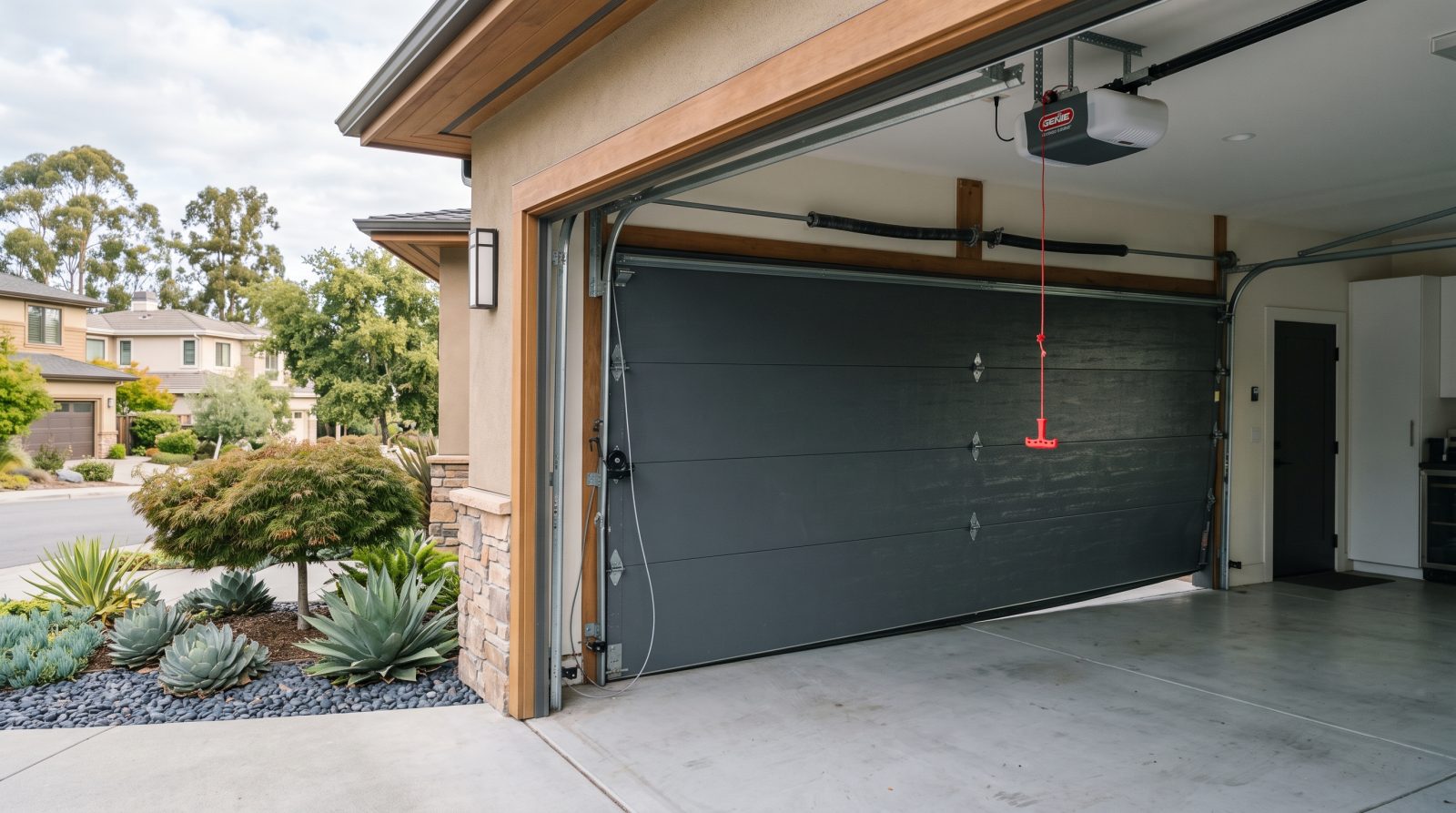
A quick safety triage helps you decide your next move. If the door is fully closed and simply won't open, you have time, work through the checks below in order. If the door is stuck partway open, jammed at an angle, or you can see a snapped cable or a gap in the spring coil, stop touching it and keep people and pets out from under it until it's inspected.
- Safe to try: confirm power, change the remote battery, inspect and realign the photo-eye sensors, clear track debris.
- Stop immediately if: the door is crooked, hangs lower on one side, or you see a separated spring or a loose/snapped cable.
- Never stand or walk under a door that's stuck partway, it can fall without warning.
- Don't keep pressing the opener if the motor strains, hums, or runs without the door moving, you'll risk overheating it.
The Most Common Reasons a Garage Door Won't Open
Most no-open situations trace back to one of about seven causes, and they fall into two groups: opener and power problems, which are often minor, and mechanical failures, which usually are not. Knowing which group you're in tells you whether to keep troubleshooting or to step back and call for help.
On the opener side, the usual suspects are a dead remote battery, a tripped breaker or unplugged opener, misaligned safety sensors, or an engaged lock or vacation mode. Power flickers and outages are a frequent culprit too, and they vary by region, homes in storm-prone or extreme-weather areas tend to see opener resets and tripped circuits far more often, which is also why a manual-release backup matters so much.
On the mechanical side, the heavy hitters are a broken torsion or extension spring, a snapped or frayed lift cable, a door that has come off its track, and worn or seized rollers. A broken spring is the most common serious failure of all: the springs do the real work of counterbalancing the door's weight, so when one breaks, the opener simply can't lift the load, and the door feels like it weighs a ton. These are the failures where forcing the door does the most damage, and where a trained tech and the right tools matter.
- Dead or weak remote battery, or a remote that lost its programming.
- No power: unplugged opener, tripped GFCI/breaker, or a recent outage.
- Misaligned or blocked safety sensors (more often blocks closing, but can also confuse the system).
- Engaged lock mode, vacation mode, or a manual slide-lock left thrown.
- Broken spring, the door feels extremely heavy and won't lift more than a few inches.
- Snapped or off-track cable, often paired with the door hanging crooked.
- Door off its track or seized rollers, grinding, scraping, or stuck partway.
A Safe Step-by-Step Checklist Before You Call
Work through these in order. They move from the quickest, safest checks to the point where you should stop and get a professional. If you reach a step that points to a spring, cable, or track problem, that's your signal to stop, not to push harder.
Start with power and the remote. Confirm the opener is plugged in and the outlet has power, then test the hardwired wall button. If the wall button opens the door but the remote doesn't, you've found it, replace the remote battery or reprogram it, and the door itself is fine. If neither works, check your breaker panel for a tripped circuit and look for a slide-lock or lock-mode indicator on the wall console.
Next, look at the door and the hardware, without touching the springs or cables. Glance at the safety sensors near the floor; a steady indicator light usually means they're aligned. Scan the tracks for a stray object, a stone, or a buildup of debris pinning a roller. Then look up: if you can see a clear gap in the coiled spring above the door, a cable dangling loose, or the door sitting unevenly, you've found a mechanical failure, and this is where you stop.
Finally, the manual test, but only if the springs and cables look intact. With the door fully closed, pull the manual-release cord (the red handle) to disconnect the opener, then lift the door by hand a foot or so. A healthy, balanced door lifts smoothly and roughly stays put when you let go. If it's extremely heavy, won't rise, or crashes back down, that confirms a spring or balance problem, lower it carefully, leave it closed, and call for service.
- 1. Confirm power and test the wall button; if it works and the remote doesn't, replace the remote battery.
- 2. Check the breaker/GFCI and look for engaged lock or vacation mode on the console.
- 3. Inspect the photo-eye sensors for a steady light and clear any track debris.
- 4. Visually check springs and cables, any gap, slack, or crookedness means stop here.
- 5. Only if those look intact: pull the red manual release and gently hand-test the closed door.
- If the hand-test door is very heavy or won't lift, leave it closed and call, don't force it.
When the Car Is Trapped Inside (or You're Locked Out)
A stuck door becomes urgent fast when your only vehicle is sealed inside and you need to get somewhere. Before you panic about being stranded, check whether you can reach the manual release at all, because most openers have one and it's designed exactly for this moment. If you're inside the garage, the red emergency-release cord hangs from the opener trolley; pulling it disconnects the door from the motor so it can be operated by hand, assuming the springs and cables are intact.
If you're locked out and the only entrance is the garage, the situation is trickier but not hopeless. Many detached and attached garages have a separate service door or an interior door from the house, try those first. Some garage doors have an exterior emergency-release kit (a small lock on the door face with a cable to the trolley) for exactly this scenario. What you should not do is try to pry the door up from the bottom or wedge it open; that can damage the panels, bend the track, and, if a spring has already failed, put you directly under a heavy door that could drop.
If the manual release won't help, because the door is off track, a spring is broken, or a cable has snapped, then hand-operating it is unsafe no matter how urgent the trip is. In that case the fastest safe path is to call for same-day service, explain that a vehicle is trapped, and let a technician release and stabilize the door properly. It's frustrating to wait, but a forced door that falls turns a delay into an injury or a much bigger repair bill.
- Look for the red manual-release cord on the opener, only use it if springs and cables are intact.
- Check for a side service door or an interior door from the house as an alternate exit.
- Some doors have an exterior emergency-release lock for when you're locked out, look on the door face.
- Never pry the door up by hand if a spring is broken or a cable has snapped, it can fall.
- If the manual release won't safely work, request same-day help and mention the trapped vehicle.
Why Forcing a Stuck Door Is Dangerous (and What It Costs You)
It's tempting to muscle a stubborn door, but a garage door is one of the heaviest moving objects in a home, and the parts that hold it under control are under serious load. Torsion and extension springs store a tremendous amount of energy; when one is already compromised, adding force from the opener or by hand can cause a sudden, violent failure. Lift cables are similar, they carry the door's weight, and a frayed cable that's forced can snap and whip. This is precisely why broken springs and cables are not DIY repairs.
Forcing a door that's off track or jammed doesn't just risk injury, it usually turns a small problem into a large one. A door pushed against a bent track can crease panels, bend the track further, and pull rollers loose, so a repair that might have been a single part becomes a multi-part job or even a full section replacement. The opener takes a beating too: running the motor against a load it can't move can strip gears or burn out the unit, adding the cost of an opener to whatever was wrong in the first place.
As a rough guide, costs vary widely by door type, materials, region, and the extent of damage, and any figure here is a typical industry estimate, not a quote. A spring or cable replacement is generally a moderate, defined repair when caught early; a door that's been forced off track and damaged can climb significantly higher because more parts and labor are involved. The honest takeaway is simple: stopping at the first sign of a mechanical failure almost always costs less than pushing through it, and a reputable technician will give you a clear price range before any work begins.
- Springs and cables are high-tension, load-bearing parts, forcing them can cause sudden failure and injury.
- A forced off-track door often damages panels, tracks, and rollers, turning a small fix into a big one.
- Running the opener against a stuck door can strip gears or burn out the motor.
- Repair costs are typical industry estimates that vary by door, material, region, and scope, never a fixed quote.
- Catching a failure early and not forcing it is usually the cheaper outcome.
How a Professional Diagnoses and Fixes a Door That Won't Open
When a technician arrives for a no-open call, the first step is diagnosis, not parts. A good tech starts by watching and listening: testing the opener, checking the springs and cables for breaks or slack, inspecting the tracks and rollers for alignment and wear, and hand-balancing the door with the opener disconnected. That sequence quickly separates a five-minute fix (a misaligned sensor, a dead remote, a thrown lock) from a real mechanical repair, and it means you're not paying for a spring you didn't need.
If it's a spring, the safe repair uses winding bars and proper technique to release and replace it under control, and on a two-spring system many techs recommend replacing both at once since they wear together and a single new spring against an old one fails sooner. Cables are replaced in pairs for the same reason. An off-track door is carefully realigned and the cause, a bent track, a worn roller, an impact, is addressed so it doesn't recur. Opener issues range from a simple gear or logic-board fix to a unit that's reached the end of its life.
Climate and usage shape what wears out and how fast, which is worth knowing as a homeowner anywhere in the country. Coastal and humid regions see more rust on springs, cables, and hardware; cold-weather areas see grease stiffen and metal contract, so doors that open fine in summer can balk in a hard freeze; and high-cycle households (multiple openings a day) simply reach spring fatigue sooner. None of that means a fixed maintenance calendar, it means an honest tech will tell you what your specific door and environment actually need, and a yearly tune-up that lubricates parts, checks balance, and tests the auto-reverse safety is one of the best ways to avoid the next emergency. If your door won't open right now, you don't have to figure it out alone, request a free quote and we'll help you find the safest next step.
- Diagnosis comes first: testing the opener, checking springs/cables, inspecting track and rollers, hand-balancing the door.
- Springs and cables are typically replaced in pairs so a new part isn't fighting a worn one.
- Off-track doors are realigned and the root cause is fixed so it doesn't happen again.
- Region matters: coastal humidity rusts hardware, cold stiffens parts, heavy use shortens spring life.
- A yearly tune-up (lubrication, balance check, auto-reverse test) is the best prevention against the next no-open emergency.