How garage door springs work (and why they fail so suddenly)
Your garage door is heavy. The springs, not the opener, do almost all the work of lifting that weight. The opener is really just there to guide the door up and down; the springs are what make a hundred-plus-pound door feel light enough to raise by hand. That's why a broken spring so dramatically changes how the door behaves: once the spring can no longer counterbalance the weight, you're suddenly fighting the full mass of the door.
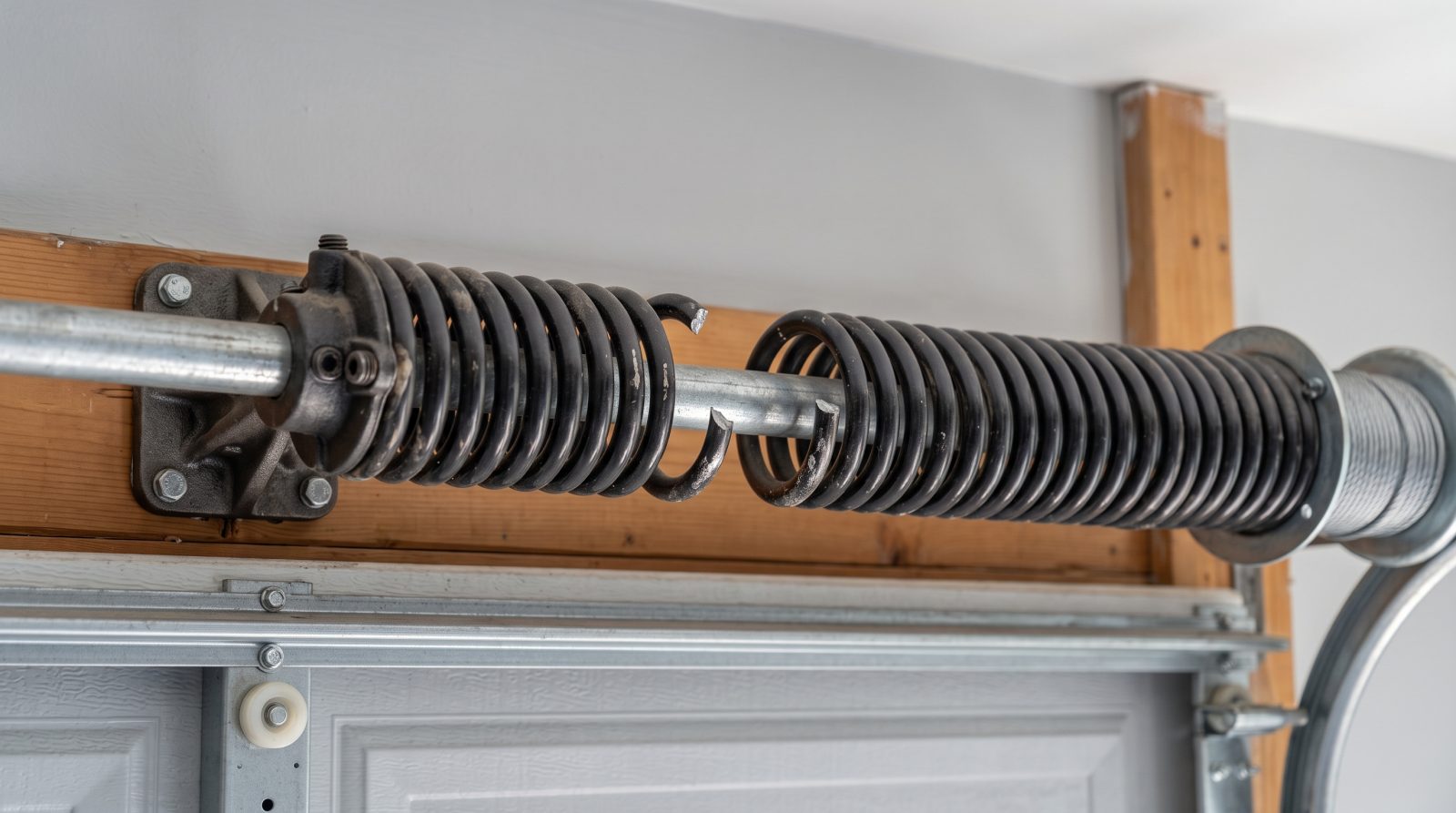
There are two main spring systems. Torsion springs are the most common today and sit on a metal shaft above the door opening, winding and unwinding as the door moves. Extension springs run along the horizontal tracks on either side and stretch and contract instead. Both store an enormous amount of energy when the door is closed, which is exactly why a sudden break can be violent and why this is never a safe place to improvise a fix.
Springs fail suddenly because they wear out from the inside as metal fatigue, not from a single dramatic event. Each open-and-close cycle stresses the steel a little more. Springs are rated for a certain number of cycles, and once that limit is reached the spring simply lets go, often in the cold of an early morning when the metal is most brittle. This is why so many homeowners say the door 'was working perfectly yesterday' right before it broke.
- Springs, not the opener, carry the weight of the door
- Torsion springs mount on a shaft above the door; extension springs run along the side tracks
- Springs fail from accumulated metal fatigue over thousands of cycles, not abuse
- Cold weather makes brittle, end-of-life springs more likely to snap, which is why breaks cluster in winter mornings
The clearest signs your spring is broken
Some signs of a broken spring are unmistakable, and recognizing them quickly helps you avoid making the situation worse. The single most telling sign is a visible gap in the spring itself. On a torsion spring above the door, look for a one- to two-inch gap where the tightly coiled metal has separated into two pieces. On extension springs along the tracks, a break may look like a spring hanging loose or stretched out of shape. If you can safely see a gap from the floor without climbing, that's your answer.
The next clearest sign is weight. With a working spring, you can usually lift the door by hand fairly easily once it's disconnected from the opener. With a broken spring, the door feels like it weighs a ton, won't move at all, or lifts only a few inches before stopping. If you have an automatic opener, it may strain, hum, lift the door a short way and then reverse or stop, because it isn't built to haul the full weight on its own and many openers have a safety cutoff to protect the motor.
Many people also report hearing the break before they see it: a loud bang or pop from the garage, sometimes loud enough to sound like a gunshot, when no one was touching the door. That sound is the spring releasing its stored tension all at once. Other strong indicators include a door that slams down hard and fast instead of lowering smoothly, a door that looks crooked or hangs unevenly, or visible slack in the lift cables where they've gone loose because the spring is no longer holding tension.
- A visible gap or separation in the coiled spring (the most definitive sign)
- The door suddenly feels extremely heavy or won't lift more than a few inches
- The opener strains, hums, or lifts a little and then reverses or stops
- A loud bang or pop from the garage with no one near the door
- The door slams down fast, hangs crooked, or the cables have gone slack
Subtle early warning signs before a spring breaks
A spring rarely gives much notice, but there are quieter signals worth paying attention to, because catching them early can turn an emergency into a planned, lower-stress repair. One of the most useful is a balance check you can do yourself in under a minute. With the door fully closed, pull the opener's manual release cord (usually a red handle) to disconnect the door from the opener, then lift the door by hand to about waist height and let go. A healthy, balanced door will mostly hold its position. A door that crashes down or shoots up is telling you the spring tension is off and the system needs attention.
Other early signs are sensory. You might notice the door moving more slowly or jerkily than it used to, an opener that sounds like it's working harder than before, or new grinding, squeaking, or popping sounds during normal operation. Visible rust, gaps starting to form between coils, or a spring that looks stretched or deformed compared to the other one are all reasons to have things looked at before the spring fails completely.
Climate plays a real role here, too. In colder northern regions, springs are stressed harder by temperature swings and tend to give out in winter, so an end-of-fall inspection is smart. In coastal and humid areas, salt air and moisture accelerate rust, which weakens springs faster than the cycle count alone would suggest. Homes in any region where the garage door is the main entry, opening and closing many times a day, simply reach the spring's cycle limit sooner. None of these mean a break is imminent, but they're good reasons not to ignore the early signals.
- Run the manual balance test: a balanced door roughly holds position at waist height
- Watch for the door moving slower, jerkier, or noisier than it used to
- Look for rust, gaps forming between coils, or a stretched or deformed spring
- Expect faster wear in cold climates (winter breaks), humid or coastal air (rust), and high-traffic doors
Why you should never force a door with a broken spring
When your car is trapped or the door is stuck, the instinct is to muscle it open. Please don't. With the spring's counterbalance gone, you're trying to lift the full dead weight of the door, and if your grip slips or a strained cable lets go, that weight can come down hard on hands, feet, or whatever is beneath it. This is the core safety message of every broken-spring situation: a door that won't move on its own is telling you something is wrong, and forcing it is how minor failures become injuries and bigger repairs.
Running the opener against a broken spring is its own hazard. The motor isn't designed to lift the door unaided, and forcing it can burn out the opener, bend the tracks, pull rollers off track, or snap the cables, adding to the cost of a repair that started as a single broken spring. If the opener strains and reverses, that's a protective feature doing its job, not a problem to override.
Just as important: replacing or adjusting garage door springs is not a safe do-it-yourself project. The springs are still under tremendous tension even when broken, and the specialized winding bars and technique required to handle them safely are exactly why this is professional work. Well-intentioned homeowners are seriously hurt every year attempting spring replacements. The right move is to leave the spring alone and bring in a trained technician who has the proper tools and experience.
- A door with a broken spring can fall fast and hard, risking serious injury
- Forcing the opener can burn out the motor, bend tracks, derail rollers, or snap cables
- Springs stay under high tension even after they break, making DIY repair genuinely dangerous
- If the opener strains and reverses, that's a safety cutoff working, not something to override
What to do right now, step by step
If you think a spring has broken, the calm, safe sequence below protects both you and the door while you arrange a repair. The goal in these first few minutes is simple: don't make it worse, and don't put anyone underneath the door.
Start by stopping. Don't keep pressing the remote or wall button, and don't try to force the door by hand. If the door is closed and your car is inside, it's frustrating but rarely an emergency that justifies risking injury. If the door is stuck partway open, keep people and pets clear of the opening and don't park or walk directly under it, since a door held up by a compromised system can drop without warning.
If the door is open and you need to secure your home, this is one situation where speed matters for safety. A door stuck in the open position leaves your home and belongings exposed, so getting same-day help to close it securely is reasonable. Avoid the temptation to yank it down yourself; instead, keep the area clear and arrange fast professional help. When you reach out, describe what you're seeing as specifically as you can, whether you spotted a gap in the spring, the door won't lift, the opener strains, or you heard a bang, so the technician arrives with the right replacement springs and can give you an honest, up-front price range before any work begins.
- Stop using the door immediately; don't press the opener or force it by hand
- Keep people, pets, and vehicles out from under a partially open or stuck door
- Pull the manual release only if you can do so safely and the door is fully closed
- If the door is stuck open, prioritize securing your home with fast professional help
- Describe exactly what you see (gap, weight, noise, opener behavior) when you reach out so the right parts come on the first visit
What a professional spring repair involves
Knowing what proper spring work looks like helps you recognize an honest repair and avoid being oversold. A good technician starts by confirming the diagnosis, checking the springs, cables, rollers, and the door's balance rather than assuming. They'll match the replacement spring to your door's weight and size, because a spring that's wrong for the door wears out fast and won't balance correctly.
It's common, and usually sensible, to replace springs in pairs even when only one has broken. On a two-spring system, the second spring has been through the same number of cycles and is likely close to failing too. Replacing both at once means one trip instead of two and a door that's balanced evenly, which is easier on the opener and the rest of the hardware. A trustworthy technician will explain this trade-off rather than pressure you, and will leave the choice with you.
On cost, expect a clear, itemized range up front rather than a fixed promise. Spring replacement pricing varies with the type and size of spring, the weight and configuration of your door, whether one or two springs are being done, and your region, so treat any figure as a typical estimate that can shift once a technician sees the door. The honest standard to look for is simple: a clear explanation of what's wrong, the options, and a price range agreed before the work starts, with no surprises after.
- A proper visit confirms the diagnosis and checks springs, cables, rollers, and balance
- Springs are matched to your specific door's weight and size
- Replacing both springs at once is often recommended on two-spring doors and saves a second visit
- Pricing is a typical range that varies by spring type, door weight, and region, never a fixed guarantee
- Insist on a clear explanation and an up-front price range before any work begins