Why a tune-up is the cheapest emergency you'll never have
A garage door is the largest and heaviest moving object in most homes, often 150 pounds or more, lifted and lowered thousands of times by a system of springs, cables, rollers, and a small motor. Like anything under that much repeated stress, it wears gradually and predictably. The springs lose tension, the cables fray strand by strand, the rollers dry out, and the door slowly falls out of balance. None of that happens overnight, which is exactly why a scheduled tune-up works so well: the problems announce themselves long before they become failures.
The reason this matters on an emergency-focused level is simple. A worn torsion spring doesn't gently retire, it snaps, usually with a loud bang, and a door that took two fingers to lift suddenly weighs its full unbalanced weight. A frayed cable doesn't warn you on the day it lets go. A tune-up is the appointment where a technician finds the spring that's near the end of its rated cycle life, the cable starting to unravel, or the bracket loosening under load, and addresses it on a Tuesday afternoon rather than at 7 a.m. when you're already late.
A maintenance visit is also where small adjustments prevent expensive damage. A door that's even slightly out of balance forces the opener to work harder on every cycle, shortening the life of a motor and gears that cost far more to replace than a spring adjustment. Catching it early protects the most expensive part of the whole system.
- Springs are rated in cycles (one open + close), commonly around 10,000, which is roughly 7 years at typical use, but heavy use can burn through that far faster
- An unbalanced door silently overworks the opener motor, the single most expensive component to replace
- Frayed cables and worn rollers give visible and audible warnings months before they fail completely
- The cost gap between planned maintenance and an after-hours emergency repair is usually large, and entirely avoidable
What a real garage door tune-up actually includes
Not every tune-up is the same, and it's worth knowing what a thorough one covers so you can tell a genuine service from a quick spray of lubricant. A complete tune-up is part inspection, part adjustment, and part preventive replacement of the small, low-cost parts that wear out, before they take something bigger with them.
The single most important step is the balance test. With the door disconnected from the opener, a technician lifts it by hand and checks whether it stays put when stopped at about waist height and halfway up. A properly balanced door feels light and holds its position. If it slams down or shoots up, the spring tension is wrong, and that's the root cause of a huge share of premature opener failures and unexpected breakdowns.
From there, a good service walks the entire system: tightening the dozens of nuts and bolts that vibrate loose over hundreds of cycles, inspecting springs and cables for wear, checking rollers and hinges, testing the auto-reverse safety features, and lubricating the right parts with the right product. Done well, the door comes back quieter, smoother, and meaningfully less likely to leave you stranded.
- Balance test with the opener disconnected, the most important single check on the whole door
- Inspection of torsion or extension springs for wear, rust, and remaining cycle life
- Cable inspection for fraying, rust, and proper seating on the drums
- Tightening all hardware: hinges, brackets, track bolts, and roller carriers loosened by vibration
- Roller and hinge inspection, with worn rollers flagged for replacement
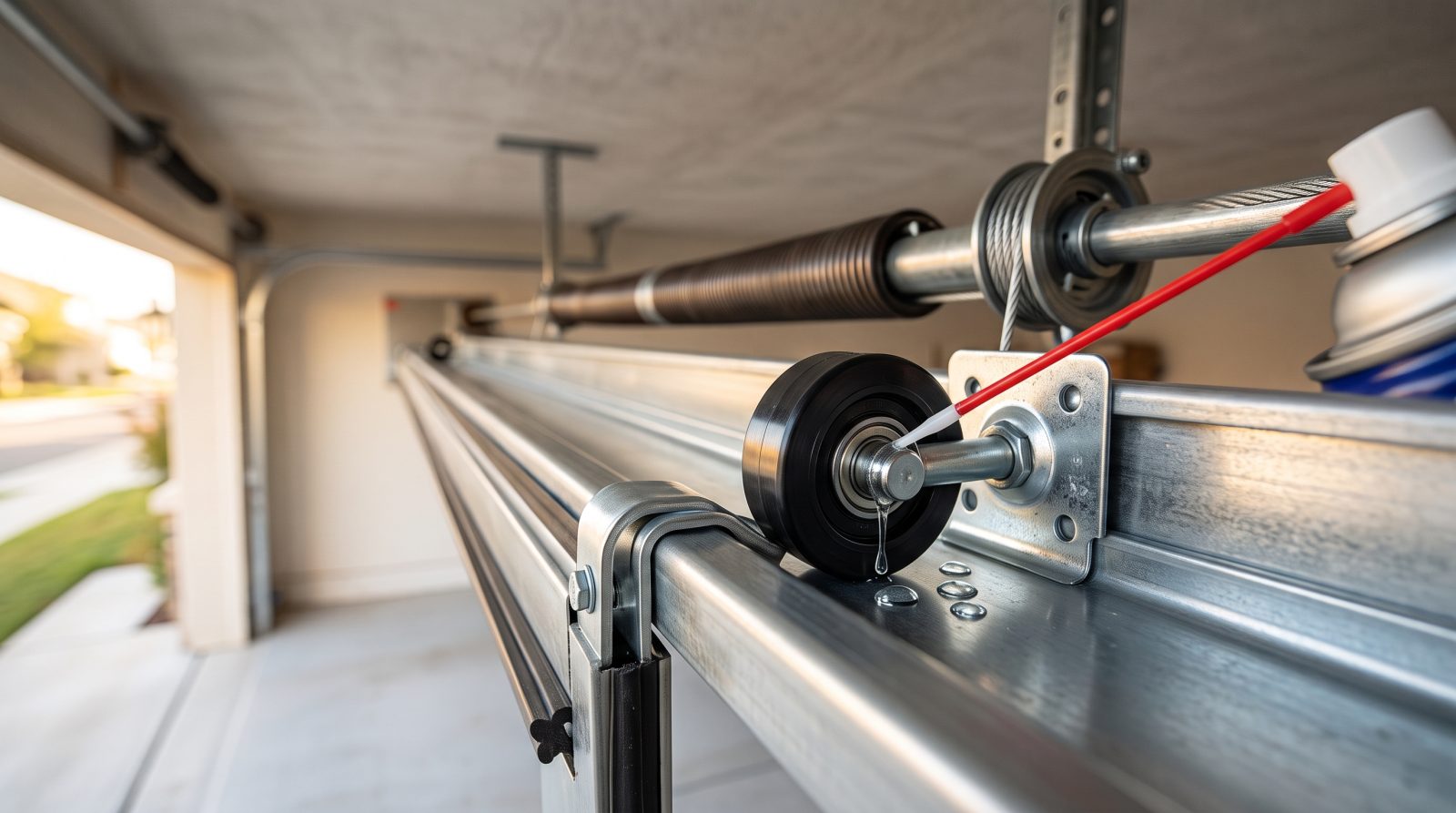
- Lubrication of springs, rollers, hinges, and bearings with a proper garage-door lubricant (never WD-40, which strips lubrication)
- Testing both safety systems: the photo-eye sensors and the mechanical auto-reverse on contact
- Opener check: force settings, travel limits, and chain or belt tension
How often to service your door, and how climate changes the answer
For most households, an annual tune-up is the right baseline. Once a year is frequent enough to catch wear before it becomes failure, and it lines up well with the natural rhythm of seasonal change that affects the door anyway. But the right interval really depends on how much you use the door and the climate it lives in, two factors that vary enormously across the country.
Usage is the biggest driver. A door that opens four to six times a day in a single-car household will age very differently from one that's the family's main entrance, cycling a dozen or more times daily. If your garage door is effectively your front door, consider servicing it twice a year. Spring cycle life is finite, and heavy use simply spends those cycles faster.
Climate matters more than people expect, and it cuts in different directions depending on where you live. In cold-winter regions, metal contracts, lubricant thickens, and springs are under the most stress on the coldest mornings, which is exactly when worn springs tend to snap, so a late-fall tune-up is genuinely valuable. In hot, humid, or coastal areas, the enemy is corrosion: salt air and moisture rust cables, springs, and hardware faster, making inspection the priority. In dry, dusty climates, grit works into rollers and tracks and accelerates wear. The honest takeaway is that one nationwide rule doesn't fit, the door in coastal Florida and the door in a Minnesota winter need attention for different reasons.
- Typical home: once a year is a solid baseline
- Heavy use (main entry, multiple cars, many daily cycles): consider twice a year
- Cold-winter regions: a late-fall service before deep cold is when worn springs are most likely to fail
- Coastal and humid areas: prioritize corrosion inspection on cables, springs, and hardware
- Dry, dusty climates: rollers and tracks need more frequent cleaning and lubrication
- After any major event: a hard impact, a power outage with manual operation, or a door that started sounding different
What you can safely do yourself, and the lines not to cross
A tune-up isn't entirely a professional-only job. There's a short list of genuinely useful homeowner maintenance you can do between visits that keeps the door running smoothly and helps you catch trouble early. The key is knowing exactly where the safe zone ends, because the most dangerous parts of a garage door are also the ones that look most tempting to adjust.
On the safe side: keep the tracks clean and free of debris, wipe down the rollers, and apply a proper garage-door lubricant to the rollers, hinges, and springs a couple of times a year, more often in dusty or coastal conditions. You can and should test the auto-reverse safety features monthly: lay a solid object like a roll of paper towels on the floor in the door's path and confirm the door reverses when it touches it, then wave your hand through the photo-eye beam near the floor while it closes to confirm it stops and reverses. Listen for new grinding, popping, or scraping sounds, and watch for jerky movement or a door that suddenly sits crooked, these are your early-warning system.
Now the lines not to cross, and this is where the emergency calls come from. Never attempt to adjust, loosen, or replace torsion or extension springs, and never touch the cables. The springs hold tremendous stored energy, and a spring or cable released improperly can cause serious injury in an instant. This is not a place to save money with a DIY fix. If the door is heavy, unbalanced, the spring looks separated, or a cable has come off or frayed, stop using the door and request professional help. Forcing a door with a broken spring or off-track cable risks injury and can turn a single-part repair into major damage.
- DO: keep tracks clear, wipe rollers, and lubricate rollers, hinges, and springs with a garage-door lubricant
- DO: test auto-reverse monthly with an object on the floor and a hand-wave through the photo-eye
- DO: listen and watch for new noises, jerky movement, or a door that hangs crooked
- DON'T: ever adjust, loosen, or replace springs or cables, these store dangerous energy
- DON'T: force a door that's heavy, stuck, off-track, or has a visibly broken spring
- DON'T: use WD-40 as a lubricant, it cleans rather than lubricates and can make things worse
What a tune-up typically costs, and the warning signs that mean book now
Tune-up pricing varies by region, the type of door and spring system, how much adjustment the door needs, and whether any worn parts get replaced during the visit. As a general industry guide, a standard maintenance and tune-up service commonly falls in roughly the $75 to $200 range, with the figure rising if rollers, a spring, or other components are replaced as part of the work. These are typical estimates only, not a quote, your actual price depends on your specific door, parts, and local rates, and the only reliable number is one given after someone has seen the door.
It helps to separate routine maintenance from repair. A tune-up is the planned, lower-cost visit that keeps a healthy door healthy. A repair is what happens when a part has already failed, a snapped spring, a broken cable, an off-track door, and those run higher because they're urgent and involve replacing failed components under load. The whole point of maintenance is to spend the smaller, predictable amount so you rarely face the larger, unpredictable one.
Some signs shouldn't wait for the annual visit. If your door has become noticeably heavy or won't stay open on its own, if you hear a loud bang from the garage, if you see a visible gap in a spring, if a cable looks loose or frayed, or if the door is moving unevenly, crooked, or grinding, treat those as priority signals. A door that won't open can trap your car, and a door stuck open is a security risk for your home, both reasons to get same-day help rather than wait. Booking promptly when you see these signs is the difference between a quick service call and an emergency.
- Typical tune-up range: roughly $75 to $200 as an industry estimate, higher if parts are replaced, varies by door, region, and scope
- A tune-up is planned and lower-cost; an emergency repair on a failed part costs more and is urgent
- Book promptly if the door is suddenly heavy, won't hold position, or feels unbalanced
- Book promptly for a loud bang, a visible gap in a spring, or a loose or frayed cable
- A door stuck open is a security risk; a door stuck closed can trap your car, both warrant same-day help
- When in doubt, stop using the door rather than forcing it and risking bigger damage