What a fiberglass garage door actually is
A fiberglass garage door isn't a slab of solid fiberglass. In almost every modern build it's a composite sandwich: thin fiberglass-reinforced skins (sometimes called FRP, fiberglass-reinforced polymer) bonded to the front and back of an insulating foam core, usually polyurethane or polystyrene, all wrapped around a steel or aluminum internal frame for structural rigidity. The fiberglass surface is what touches the weather; the steel skeleton is what carries the load and bolts to the hardware. That construction is why people describe fiberglass doors as 'rust-proof on the outside' — the visible skin won't corrode — while the door still has metal components inside and, critically, all-metal moving parts on the springs and tracks.
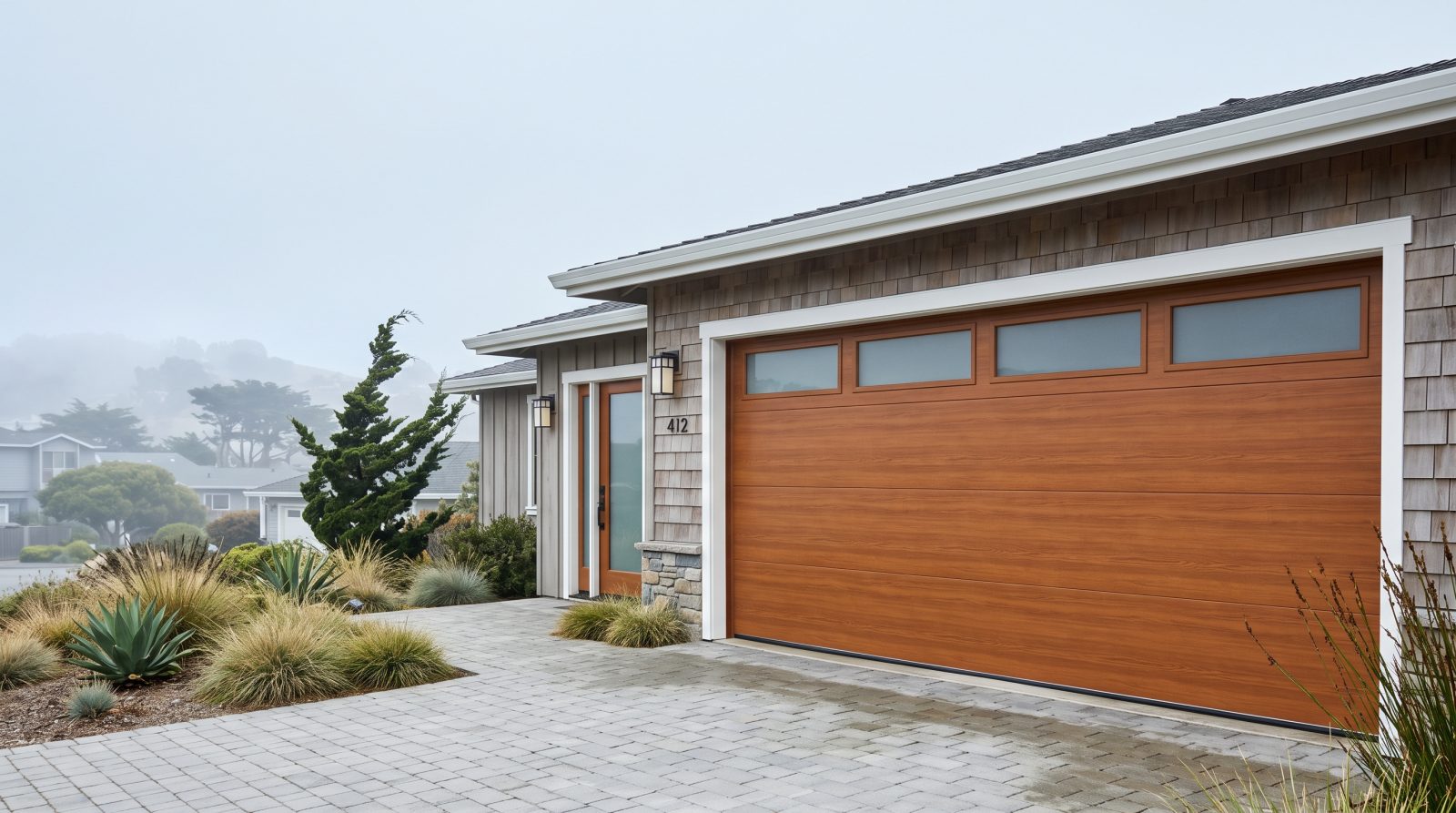
Manufacturers often texture or mold the fiberglass to imitate wood grain, and a good faux-wood fiberglass door can be hard to tell from real cedar or mahogany from the curb, at a fraction of the maintenance. The skin can be painted or factory-finished, and because it's a stable, non-porous surface it tends to hold paint and color reasonably well. Understanding the layered build matters for two reasons: it explains why fiberglass resists moisture and salt better than wood or bare steel, and it explains why a cracked or punctured skin is a real problem — once the weatherproof outer layer is breached, moisture can reach the core and the frame.
Why fiberglass shines in coastal and humid climates
The single biggest reason to choose fiberglass is corrosion resistance. Salt-laden coastal air is brutal on metal. Steel doors, even with quality factory coatings, can develop rust at any scratch, edge, or fastener once salt finds its way in, and that corrosion spreads. Fiberglass skins simply don't rust, so a fiberglass door near the ocean keeps its appearance far longer than a comparable steel door in the same spot. In Gulf Coast, Southeast Atlantic, Pacific coastal, and island settings, this is often the deciding factor.
Fiberglass is also dimensionally stable in humidity. Real wood absorbs moisture, then swells, warps, and can stick or bind in its frame when the air is heavy — a familiar frustration in the humid Southeast and along both coasts. Fiberglass doesn't take on water the way wood does, so it holds its shape and keeps operating smoothly through wet, muggy seasons. That stability is a quiet but real benefit: a door that doesn't swell is a door less likely to drag, misalign, or stress its opener.
Beyond moisture, fiberglass brings a few practical advantages that matter in any climate. It's lightweight, which puts less strain on the opener and the spring system over years of cycles. The insulated core gives it solid thermal performance, helpful in hot southern garages and cold northern ones alike. And its surface doesn't dent the way thin steel does from a stray basketball or a backing bumper — though, as covered below, that toughness has limits in the cold.
- Skin will not rust or corrode — the top reason for choosing it in salt-air coastal zones
- Resists swelling and warping in high humidity, unlike real wood
- Lightweight, so it's gentle on the opener and spring system over time
- Insulated foam core delivers good energy efficiency in hot and cold regions
- Convincing faux-wood textures without wood's upkeep
The honest drawbacks — and how climate changes the math
Fiberglass is not the right answer everywhere, and the biggest limitation is cold-weather brittleness. Fiberglass becomes more rigid and impact-sensitive as temperatures drop, and in hard freezes it can crack or chip — especially older or thinner panels, or any panel that takes a sharp blow. This is why fiberglass is a far easier recommendation in warm coastal and southern climates than in the deep-freeze winters of the Upper Midwest, Northeast, or Mountain West. If you live where winters routinely drop well below freezing, an insulated steel door is often the more durable, lower-risk choice, and the coastal corrosion advantage simply doesn't apply inland.
There's also long-term sun exposure to consider. Years of intense UV — think Southwest desert, Florida, or high-altitude sun — can fade the finish or, on lower-grade doors, chalk and dull the surface over time. Higher-quality fiberglass doors with UV-stable finishes hold up much better, so this is a place where door quality genuinely matters. And while fiberglass resists everyday dents, a cracked panel generally can't be hammered back like steel; it usually has to be replaced. Cosmetic damage on fiberglass tends to be more visible and less forgiving than on other materials.
Put simply, the climate question cuts both ways. Near the ocean or in a humid, warm region, fiberglass's strengths line up almost perfectly with the environment. In a cold inland climate with little salt exposure, those strengths matter less and the brittleness becomes a real liability. Match the material to where you actually live rather than to a general reputation.
- Can crack or become brittle in hard freezes — a real concern in cold-winter regions
- Cracked panels usually require replacement rather than a dent pull-out
- Long-term intense UV can fade or dull lower-grade finishes (Southwest, Florida, high altitude)
- The corrosion advantage is largely wasted inland, away from salt air
Maintenance that protects the door — and the hardware that breaks
The good news on upkeep is that the fiberglass skin itself asks very little. In coastal areas, the most valuable habit is simply rinsing the door periodically with fresh water to wash off accumulated salt and grime, then a mild soap wash a couple of times a year. That keeps the finish looking new and clears salt away from the hardware and tracks, which is where corrosion actually does its damage near the sea. Inspect the skin for any cracks or chips, because a breach in the surface is the one thing that lets moisture reach the core and metal frame.
The part homeowners overlook is that the door panel is the durable piece — the moving hardware is what wears out and fails. Torsion or extension springs, lift cables, rollers, hinges, and the track are all metal, and in coastal climates they're exposed to the same corrosive salt air the fiberglass shrugs off. Springs in particular are consumables: they're wound under enormous tension and rated for a finite number of cycles, and salt and humidity can shorten that life. A fiberglass door can look pristine while a years-old spring is one cycle from snapping. Regular light lubrication of rollers, hinges, and springs with a garage-door-specific lubricant, plus a quick look at the cables for fraying or rust, does more for reliability than anything you do to the panel.
Because the hardware is where failures concentrate, treat any change in how the door sounds, balances, or moves as an early warning. A door that suddenly feels heavy, jerks, hangs crooked, or makes a new grinding or popping noise is telling you a spring, cable, or roller is going. Catching that during a calm inspection is vastly better than discovering it the morning the door won't open.
- Rinse coastal doors with fresh water to clear salt; mild soap wash twice a year
- Inspect the skin for cracks or chips that could expose the core to moisture
- Lubricate rollers, hinges, and springs with a garage-door-specific product
- Check cables for fraying or rust — common in salt-air environments
- Treat new noises, crookedness, or sudden heaviness as a hardware warning, not a quirk
Typical costs — ranges, not quotes
Fiberglass garage doors generally sit in the mid-range of the market. As broad industry estimates that vary widely by door size, insulation level, finish quality, and region, a single-car fiberglass door commonly falls in the rough range of $1,000 to $2,500 installed, with two-car and premium faux-wood or impact-rated coastal models running higher — sometimes well above that for high-end designs or hurricane-rated builds. These are ballpark figures to set expectations, not a price for your home; the only accurate number is a written estimate based on your exact door, opening, and site.
Coastal buyers should budget with a few specifics in mind. Wind-load or impact-rated doors required in many hurricane-prone coastal jurisdictions cost more than standard models, and that's a code and safety issue, not an upsell — check what your local building requirements call for. Stronger, UV-stable finishes and thicker insulated cores also add cost but pay off in longevity exactly where the climate is harshest. Repairs are a separate matter: replacing a broken spring, frayed cable, or damaged roller is a far smaller job than replacing a cracked panel or the whole door, which is one more reason to keep the hardware maintained.
Whatever the figure, get it in writing and ask what's included — removal and disposal of the old door, new hardware versus reusing existing springs and tracks, and any climate-appropriate upgrades. A clear, itemized estimate is the best protection against surprises, and it lets you compare options honestly instead of guessing.
- Single-car fiberglass: roughly $1,000–$2,500 installed (estimate, varies by spec and region)
- Two-car, premium faux-wood, and coastal impact-rated models run higher
- Hurricane wind-load/impact ratings add cost but may be required by local code
- Hardware repairs (springs, cables, rollers) cost far less than panel or full-door replacement
- Always get an itemized written estimate — published ranges are guidance, not your price
When a fiberglass door fails: what to do right now
Even the best fiberglass door is only as reliable as its springs, cables, and tracks — and those fail suddenly. If your door has stopped working, the most important thing is to resist the urge to force it. A door stuck partway, hanging crooked, or refusing to move is almost always a sign of a mechanical failure that gets worse, or dangerous, when fought against.
A broken torsion or extension spring is the most common and most serious failure. Springs hold tremendous stored energy; a door with a snapped spring is effectively unsupported and far heavier than it looks, and the broken spring components are under tension. Do not try to lift the door manually past a broken spring, and never attempt to adjust or replace a spring yourself — this is the part of the system most responsible for serious injuries. The same caution applies to a snapped or frayed cable: if a cable lets go, the door can drop or jam at an angle, and the loose cable can whip. If the door has jumped off its track or is sitting visibly crooked, stop operating the opener immediately — running it can drag the door further off track, bend the rails, or pull a panel apart.
Two failure modes carry an urgency beyond inconvenience. A door stuck fully open is a security problem — your garage, and often your home's interior door, are exposed — and it should be treated as a priority. A door stuck closed can trap a vehicle you need, and forcing it risks the very damage that turns a small repair into a large one. In both cases, the safe move is the same: stop forcing it, keep people and pets clear of a door that could drop, disconnect the opener only if you can do so safely, and get same-day professional help. Fast, qualified hands resolve a sprung or off-track door far more safely than improvising — if your door won't open or close safely, request a free quote and get expert help on the way.
- Never force a stuck door — forcing turns a small repair into a big one
- A broken spring leaves the door unsupported and dangerously heavy; never DIY a spring
- Stop the opener immediately if the door is off-track or crooked — running it causes more damage
- Door stuck open = security risk; door stuck closed = trapped car — both are same-day priorities
- Keep people and pets clear of any door that could drop, then get fast professional help