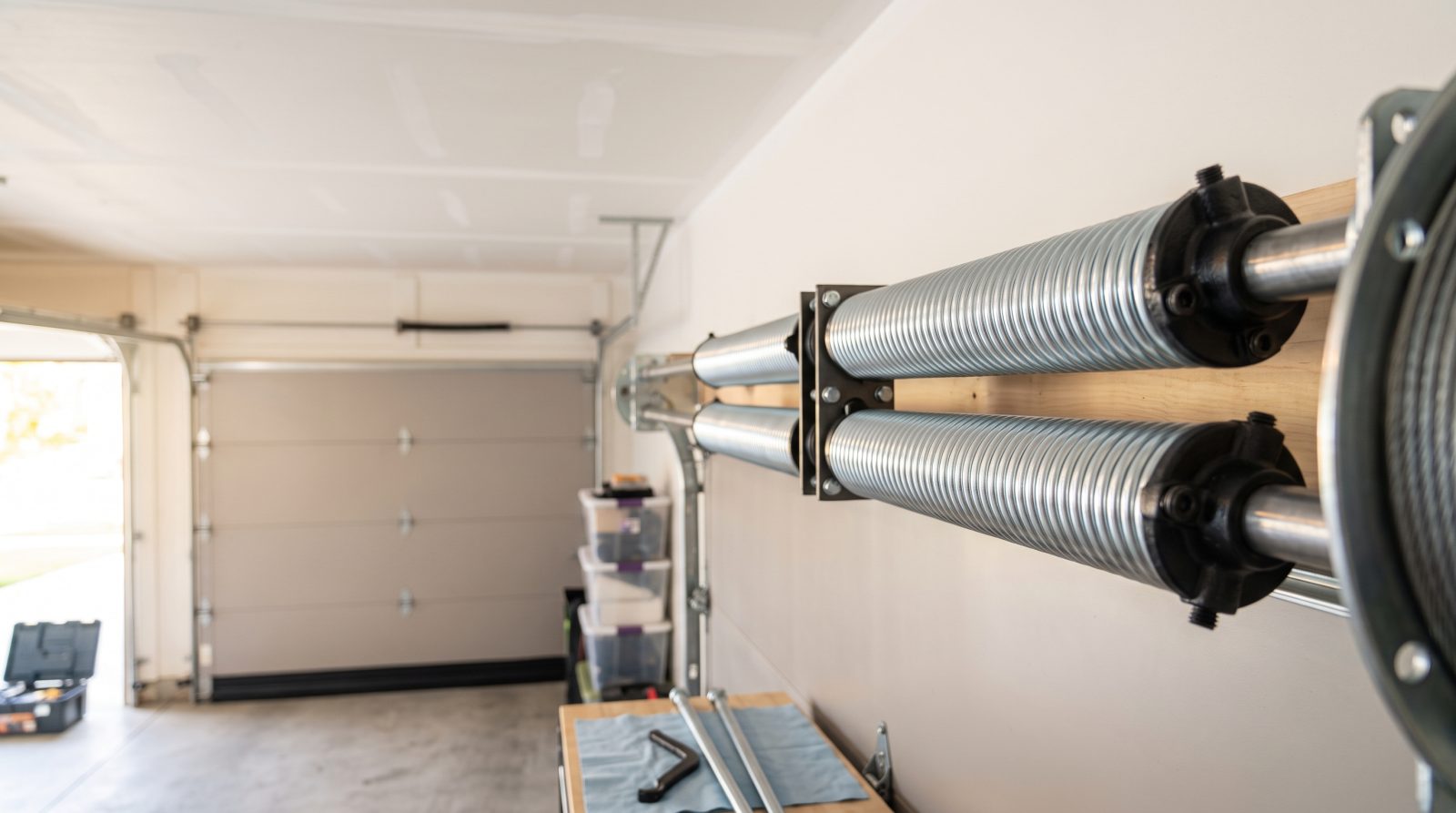
Typical Garage Door Spring Replacement Cost Ranges
Garage door spring replacement is usually priced as a complete job — the spring (or springs), the labor to install and balance the door, and any small worn parts swapped out at the same time. The figures below are typical industry estimate ranges, not quotes. Your actual price depends on the spring type, the number of springs, your door's weight and size, and where you live. Always get a specific estimate for your door before any work begins.
For a standard residential door, replacing a single torsion spring commonly falls in the range of roughly $200 to $350 installed, while replacing a pair of torsion springs (the most common recommendation) typically runs about $300 to $550. Extension springs, found on many older or lighter doors, are often a bit less — frequently around $150 to $350 for a pair installed. Heavy, oversized, or insulated doors and high-cycle springs sit at the upper end and sometimes beyond, because the parts cost more and the door is harder to balance.
These ranges reflect the spring system being the single component you replace. If a technician finds additional failed parts — cables, rollers, bearings, or a damaged drum — the total rises accordingly. A transparent estimate should itemize what's included so you can see exactly what you're paying for.
- Single torsion spring, installed: typically ~$200–$350 (estimate, varies)
- Pair of torsion springs, installed: typically ~$300–$550 (estimate, varies)
- Extension spring pair, installed: typically ~$150–$350 (estimate, varies)
- Heavy, oversized, insulated, or high-cycle doors: commonly at or above the top of these ranges
- All figures are typical industry ranges, not a fixed quote or guarantee
Why Spring Replacement Prices Vary So Much
Two homeowners can get very different estimates for what sounds like the same repair, and usually there's a legitimate reason. The biggest factor is the spring system itself. Torsion springs (mounted on a bar above the door) and extension springs (running along the tracks on each side) are engineered differently, cost different amounts, and take different amounts of labor to install and tension safely.
Door weight and size matter just as much. A large two-car or insulated steel door is heavier and needs stronger springs, and balancing it correctly takes more time and skill. Spring quality is another quiet driver: standard springs are rated for roughly 10,000 open-close cycles, while high-cycle springs rated for 20,000 or more cost more upfront but last considerably longer — often the better value if you use your garage as your main entrance.
Finally, whether you replace one spring or both changes the picture. On a two-spring system, when one spring breaks the other is typically the same age and near the end of its life. Most technicians recommend replacing both at once so the system stays balanced and you don't pay for a second visit weeks later. It costs a little more today and usually saves money over the life of the door.
- Spring type: torsion vs. extension changes both parts and labor
- Door weight and size: heavier and insulated doors need stronger springs
- Spring cycle rating: standard (~10,000 cycles) vs. high-cycle (20,000+)
- Single vs. matched pair: replacing both on a two-spring system avoids a repeat failure
- Condition of related parts: worn cables, rollers, or bearings can add to the job
How Region and Climate Affect the Cost
Because this is a nationwide concern, it's worth being honest that the same repair doesn't cost the same everywhere. Labor rates track local cost of living, so estimates in major metro areas and high-cost regions tend to run higher than in smaller towns and rural areas. That's true of most home services, and garage door work is no exception.
Climate plays a subtler but real role in how often springs fail — which affects long-term cost more than any single invoice. Springs are steel under constant tension, and steel contracts in cold and is sensitive to moisture. In cold-winter regions, springs often break on the first hard freeze of the season, when metal that's already fatigued is pushed past its limit; demand spikes then, too. In coastal and humid climates, salt air and moisture accelerate corrosion, which shortens spring life and can make rusted, seized springs harder to remove.
None of this changes the basic repair, but it does explain why a neighbor two states away paid a different price, and why choosing higher-cycle, properly lubricated springs can pay off more in some climates than others. A good technician can tell you which option makes sense for your area.
- Higher local labor rates in major metros and high cost-of-living regions
- Cold-climate springs frequently fail on the first deep freeze — and demand peaks then
- Coastal and humid air speeds corrosion, shortening spring life
- Rusted or seized springs can take longer to remove, affecting labor
- Climate-appropriate spring choice can lower your long-run cost
Why a Broken Spring Is Urgent — and Not a DIY Job
A garage door spring isn't just a part that makes the door convenient — it's the counterbalance that holds the entire weight of the door, which can be well over 100 pounds. When a spring breaks, that weight is no longer supported the way it should be. That's why a door with a broken spring often won't open at all, or feels alarmingly heavy and slams down if you try to lift it by hand.
This is where the urgency comes in. If your door is stuck closed, your car may be trapped inside right when you need it. If it's stuck open, your home and everything in the garage are exposed — a genuine security concern overnight. And in either case, trying to force the door, or running the opener against a broken spring, can snap cables, bend tracks, burn out the opener motor, or send the door crashing down. A small spring failure can quickly become a much larger, more expensive repair.
Replacing springs means working with components under extreme tension. A spring that lets go during an untrained DIY attempt can cause serious injury. This is the kind of repair that's genuinely better left to a technician with the right winding bars and experience — both for your safety and to keep a routine fix from becoming a costly one. If you're facing a broken spring right now, the safest move is to stop using the door and get same-day help.
- The spring carries the full weight of the door — often 100+ pounds
- Stuck closed traps your car; stuck open leaves your home exposed
- Forcing the door can snap cables, bend tracks, or burn out the opener
- Springs are under extreme tension and can cause serious injury if mishandled
- Stop using the door and request fast, same-day service instead of forcing it
How to Get a Fair Estimate and What's Usually Included
A trustworthy spring replacement estimate should be specific to your door, not a number pulled from the air. Expect the technician to confirm the spring type, measure the spring (wire size, length, and inside diameter for torsion springs), and check the door's weight and balance before quoting. That's how an accurate estimate is built — and it's a good sign of competence.
Most complete spring jobs include the new spring or springs, the labor to install and properly tension them, and a balance test so the door opens smoothly and the opener isn't strained. Many technicians will also lubricate moving parts and inspect cables, rollers, and bearings while they're there, since those wear alongside the springs. Ask what's bundled so you can compare estimates fairly.
Be cautious of a quote that seems far below the typical ranges, especially if it's offered sight-unseen — it sometimes signals a low-quality spring or a price that climbs once the technician is on site. Likewise, a fair estimate won't pressure you into replacing parts that demonstrably aren't worn. When you're ready, request a free quote for your specific door so you can compare a clear, itemized price before committing.
- A good estimate is measured to your door, not quoted blind
- Complete jobs typically include springs, installation, tensioning, and a balance test
- Lubrication and a cable/roller/bearing inspection are often included — ask
- Be wary of prices well below typical ranges or quotes given sight-unseen
- Get an itemized, written estimate so you know exactly what's covered