The Most Common Urgent Garage Door Problems
A garage door is the largest moving object in most homes, and nearly all of its weight is held in balance by springs and cables under extreme tension. When one of those components fails, the door usually stops working suddenly and dramatically. Knowing which failure you're looking at helps you stay calm and avoid the mistakes that make things worse.
Most emergency calls fall into a handful of categories. The good news is that each has a clear cause and a well-established fix once a technician can safely release the tension and inspect the system. The key in the moment is to correctly identify roughly what's wrong so you know whether the door is safe to leave alone (it almost always is) and whether your car or your home's security is affected.
- Broken spring: a loud bang from the garage, then a door that feels impossibly heavy or won't lift with the opener. The most common single failure.
- Door stuck closed: your car is trapped inside or you can't get a vehicle in. Often a spring, cable, opener, or track issue.
- Door stuck open: a security and weather risk you'll want resolved quickly, sometimes caused by a sensor, limit setting, or motor problem.
- Off-track door: rollers have come out of the track, often after an impact or a snapped cable, leaving the door crooked or jammed.
- Snapped cable: a frayed or broken lift cable, which can let the door drop or hang unevenly.
- Won't open or close on command: opener, remote, photo-eye sensor, or power-related faults that may not be mechanical at all.
What to Do Right Now (and Why Forcing It Is Dangerous)
The single most important rule during a garage door emergency is this: do not try to force a door that is stuck, crooked, or unusually heavy. The springs and cables that counterbalance the door store an enormous amount of energy. When they fail, that energy doesn't simply disappear, and a door that seems merely jammed can move suddenly and with crushing force. Many of the most serious garage door injuries happen when someone tries to muscle a failing door or fix a spring without the right tools and training.
If the door won't move normally, stop pressing the opener button repeatedly. Running the motor against a jammed or off-track door can burn out the opener, bend the track further, or pull the door into an even worse position. Instead, leave the door where it is, keep children and pets away from it, and avoid parking directly under a door that's stuck partway open.
- Stop using the opener once you suspect a broken spring, cable, or off-track door; repeated attempts make damage worse.
- Don't manually disconnect and lift a heavy door if you suspect a broken spring; without the spring's counterbalance, the door's full weight can come down fast.
- Keep people and vehicles clear of a door that's stuck partway up; never walk or park directly beneath it.
- If the door is stuck open and you're worried about security, you can usually keep an eye on the area and arrange fast same-day service rather than risk a manual fix.
- Note what you heard or saw (a bang, a snap, a grinding noise, a crooked panel); it helps a technician diagnose quickly when you request a quote.
Broken Springs, Cables, and Off-Track Doors Explained
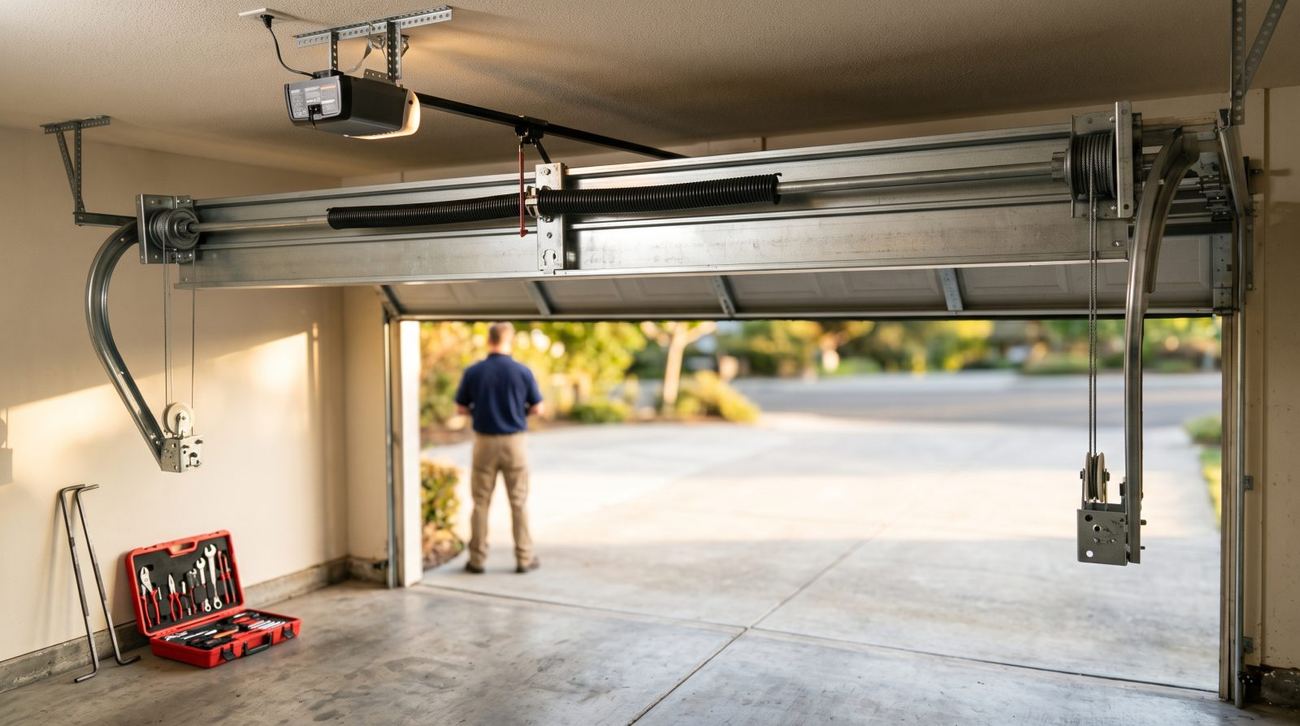
Behind the smooth, almost effortless motion of a healthy garage door is a tightly engineered balance system. Torsion springs mounted on a bar above the door, or extension springs running alongside the tracks, hold the door's weight so the opener (or your arm) only has to overcome friction, not the full hundred-plus pounds of the door. Steel cables transfer that spring force to the bottom of the door. When any of these parts wear out or break, the balance is lost and the door becomes unsafe to operate.
Springs are wear items with a finite life measured in cycles, where every open and close counts as one. That's why a spring can fail on an ordinary morning with no warning: it simply reached the end of its rated life. Cables fray over time, especially where moisture, road salt, or coastal humidity accelerate corrosion. An off-track door usually follows a cable break, a broken roller, or an impact, and it should never be forced back into the track by hand because the door can fall or pinch fingers.
Because springs and cables are paired systems, a technician will typically inspect and often replace them together to restore safe, balanced operation, rather than patching only the part that snapped. This is normal best practice, not upselling: a worn partner part frequently fails soon after if left in place.
- Torsion and extension springs are rated in cycles; high-use doors wear them out faster, so failure timing is about usage, not just age.
- Cables and springs work as a matched pair, so replacing both is common practice for safe, balanced operation.
- Off-track doors should be inspected before any attempt to move them; forcing them risks a fall or further bending of the tracks.
- Spring repair specifically requires proper winding bars and technique; it is one of the few home repairs widely considered unsafe to DIY.
When It's the Opener, Sensors, or Power (Not the Door Itself)
Not every garage door emergency is mechanical. Sometimes the door and its springs are perfectly fine and the problem is the opener, the safety sensors, or the power feeding them. These issues are worth ruling out because they're often quicker and less costly to resolve, and a few you can safely check yourself before calling for help.
Modern openers use photo-eye sensors near the floor on both sides of the door. If the door won't close, or it starts down and reverses, a blocked, dirty, or misaligned sensor is a very common culprit, the system is doing its job by refusing to close on a perceived obstruction. A blinking light on the motor unit or wall button frequently points straight to a sensor problem. Dead remote batteries, a tripped breaker, an unplugged opener, or an accidentally engaged vacation/lock mode can also masquerade as a 'broken' door.
If you've checked the simple things and the door still won't respond, or if you hear the motor straining, grinding, or running without the door moving, it's time for a professional look. Pushing a struggling opener can damage the gears and motor, turning a minor adjustment into a full opener replacement.
- Door reverses or won't close: check that nothing is blocking the photo-eye sensors and that both are aligned (a steady light usually means good, blinking means trouble).
- No response at all: test the wall button (not just the remote), check the breaker, and confirm the opener is plugged in.
- Remote-only failure: try fresh batteries and re-test before assuming a bigger problem.
- Motor runs but door doesn't move: stop using it, as this can indicate a stripped gear or a disconnected trolley and needs inspection.
How Climate and Region Affect Garage Doors Across the U.S.
Garage doors fail in different ways depending on where you live, and understanding your regional risks helps explain why problems cluster around certain seasons. As a nationwide resource, we see clear patterns: the same door behaves very differently in a humid coastal town, a freezing northern winter, or a hot, dry desert climate.
In colder regions, the first hard freeze of the season is a notorious time for spring breaks. Steel becomes more brittle in the cold, lubricant thickens, and the door may freeze to the ground, so when the opener strains against a stuck door, an already-aged spring lets go. In coastal and high-humidity areas, salt air and moisture accelerate rust on cables, springs, and hardware, shortening their life and increasing the odds of a snapped cable. Hot, sun-baked climates can degrade weather seals and stress the opener as it works harder against expanded, slightly warped panels.
None of this means a door in any region is destined to fail. Regular lubrication, keeping tracks clear, and addressing small noises early go a long way everywhere. But it does explain why an emergency can feel like it 'came out of nowhere': the underlying wear was building with the local climate until a cold snap or a humid season pushed a tired part over the edge.
- Cold climates: expect more spring breaks around the first freeze; never force a door that may be frozen to the ground.
- Coastal and humid regions: watch for rust on cables and springs, which raises the risk of snapped cables over time.
- Hot, dry climates: heat stresses openers and degrades weather seals, so doors may need more frequent seal and sensor attention.
- Everywhere: simple seasonal lubrication and clearing debris from tracks meaningfully extends component life and prevents surprise failures.
What Same-Day Garage Door Repair Looks Like
When you reach out for urgent help, the goal is to get your door safe and working again quickly, often the same day, without guesswork. A good repair starts with a hands-on safety inspection: releasing tension correctly, checking the springs and cables, testing the door's balance, examining the rollers and tracks, and verifying the opener and sensors. Only then can a technician tell you exactly what failed and what it will take to fix it.
Honest pricing depends on what's actually wrong: the door's size and weight, the spring type, the materials, and your region. Reputable repair is quoted after diagnosis, not promised as a single flat number sight unseen. As a general guide, common spring replacements and cable repairs tend to fall within typical industry ranges that vary by these factors; treat any figure you see online as an estimate, not a guaranteed quote. The right approach is a clear, written assessment of the problem and the cost before work begins.
If you're dealing with a stuck, off-track, or spring-broken door right now, the safest path is to leave it as it is and arrange fast service rather than risk a forced repair. When you're ready, request a free quote and describe what happened. The more detail about the noise, the symptom, and your door type, the faster you'll get an accurate diagnosis and a same-day path back to normal.
- Inspection first: balance, springs, cables, rollers, tracks, opener, and sensors are checked before any repair is quoted.
- Estimates, not guesses: real pricing reflects your door, spring type, materials, and region, so expect a range, not a one-size-fits-all number.
- Same-day focus: most common urgent failures (springs, cables, off-track doors, opener faults) can often be addressed quickly once a technician is on site.
- Clear next step: leave a failing door alone, then request a free quote with details of the symptom for the fastest accurate help.