What "Carriage House" Actually Means Today
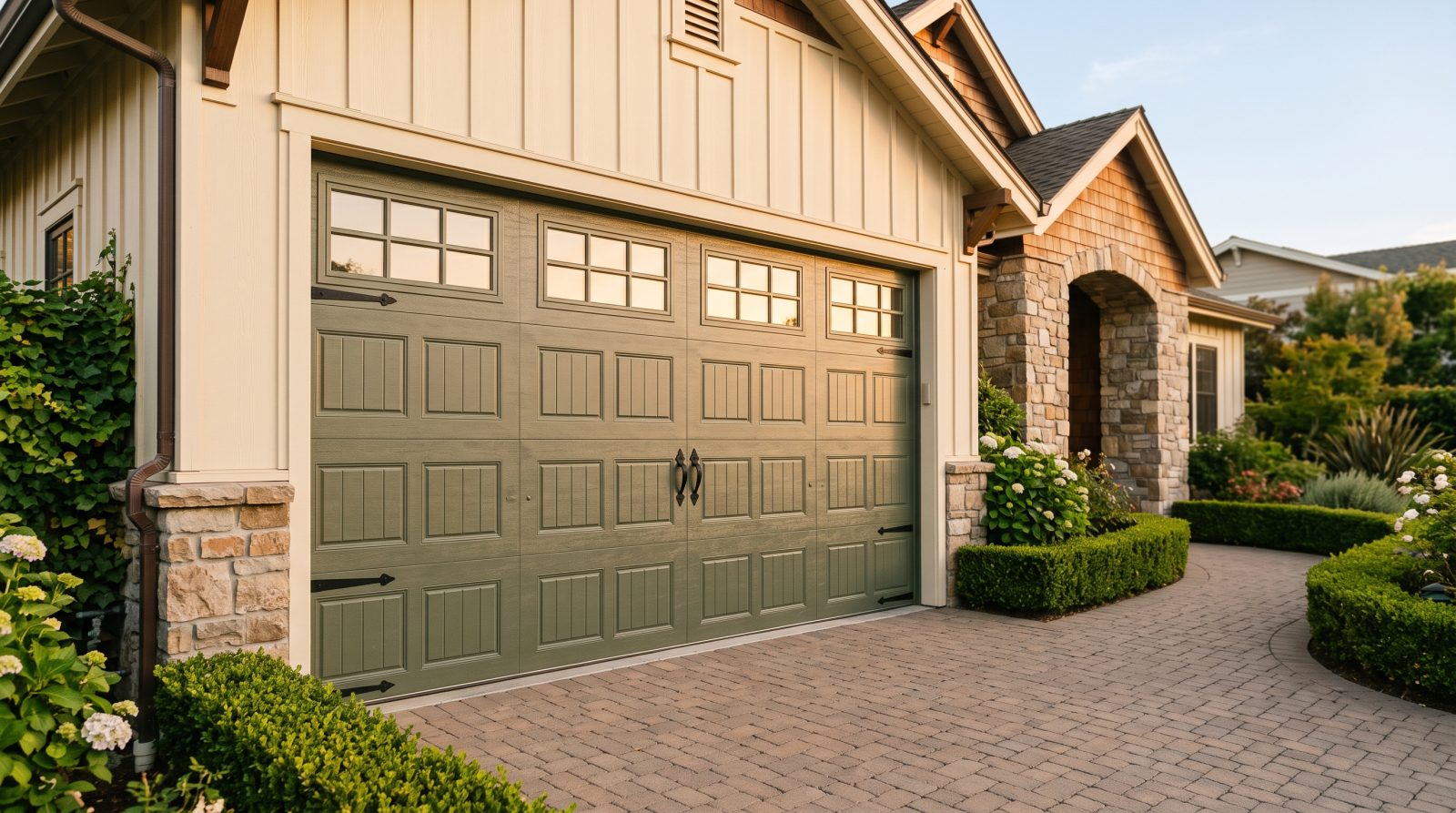
The term carriage house comes from the outbuildings that once stored horse-drawn carriages, with tall doors that swung open on side hinges. Almost no modern garage door actually swings; the carriage look is recreated on a standard sectional overhead door that rolls up on tracks. That distinction matters because it means you get the charm of the old style with none of the practical headaches of true swing doors, which need clearance to open outward, struggle in snow and wind, and are awkward to motorize.
There are two broad ways manufacturers achieve the look. The most common is a stamped or molded sectional door with decorative panels, faux hinges, and pull-style handles applied to the surface, giving the illusion of swing-out doors while functioning as an ordinary roll-up. The premium route is a true carriage-house build where each section is constructed with real overlay boards, recessed or raised panels, and substantial hardware, sometimes with the carriage motif carried across two doors that meet in the middle. Both open overhead; the difference is in depth, weight, and how convincing the detail looks up close.
Because the styling is decorative rather than structural, you can find carriage-house options in nearly every material and insulation grade. That flexibility is the style's biggest advantage: you are essentially choosing an aesthetic skin and a hardware package on top of a proven sectional-door mechanism.
- Carriage-house doors look like swing-out doors but almost always operate as overhead sectional doors.
- Two main tiers: applied-decoration stamped steel, and true overlay/recessed-panel construction.
- The carriage aesthetic can be applied to steel, wood, composite, and faux-wood doors.
- Faux hinges and handles are decorative hardware, not load-bearing parts.
Styles, Windows, and Design Choices That Drive Curb Appeal
Most of a carriage-house door's character comes from a handful of design decisions. The panel layout is the first: short, wide rows of recessed rectangles read as traditional, while longer vertical boards lean more rustic or farmhouse. The overlay pattern, meaning the raised trim boards laid over the face, is what most strongly signals the carriage style; common patterns include simple vertical planks, an X or arrow brace at the base, and framed squares across the top.
Windows are the second big lever. A top row of glass, often arched, divided into squares, or frosted for privacy, dramatically lightens the look and ties the garage to the home's other windows. For homes with limited natural light in the garage, these windows also help during a daytime outage when openers are useless. The third lever is hardware finish: matte black strap hinges and ring or spade pull handles are the classic touch, and they are usually the least expensive way to push a plain door toward the carriage look.
Color and finish coordinate the whole effect. Deep, saturated tones and wood-grain finishes tend to suit carriage styling better than flat builder-white, and a finish that picks up the front door or trim color makes the garage feel intentional rather than like an afterthought. The most successful carriage installations usually repeat one or two cues already present elsewhere on the house.
- Overlay/trim patterns (vertical plank, X-brace, framed squares) define the carriage character.
- Top-row windows add light and connect the garage to the home's window style.
- Strap hinges and pull handles in matte black are the signature finishing touch.
- Wood-grain and saturated colors generally read more authentic than flat white.
- Echoing the front door or trim color makes the door look designed, not generic.
Materials, Insulation, and How Climate Should Shape Your Choice
Steel is the most common carriage-house material because it is durable, lower maintenance, and available with strong insulation. Most quality steel carriage doors are built in layers, with insulation sandwiched between an outer and inner steel skin; this raises the door's R-value, stiffens it, and makes it quieter. In cold-winter regions, an insulated steel door helps keep an attached garage and the rooms above or beside it warmer, which is a meaningful consideration if the garage shares walls with living space.
Real wood carriage doors are the most authentic and the most beautiful, but they ask the most of you. Wood expands, contracts, and weathers, so it needs periodic refinishing, and that maintenance cycle is shorter in humid, coastal, or high-sun climates than in mild ones. Faux-wood composite and steel-with-wood-grain doors aim to capture the look while shrugging off rot and warping; in harsh or wet regions they are often the more practical choice. Coastal homes in particular should ask about corrosion-resistant hardware and finishes, because salt air is hard on springs, hinges, and fasteners.
Insulation also affects how the carriage style performs day to day. A heavier, well-built insulated door is more rigid, which helps the decorative sections stay flat and the door track smoothly; thin, single-layer doors are lighter and cheaper but can feel flimsy and dent more easily. In wind-prone and hurricane-exposed regions, wind-load-rated doors are sometimes required by code, and not every decorative door is reinforced for it, so it is worth confirming before you buy.
- Insulated steel: durable, low-maintenance, good for cold climates and shared garage walls.
- Real wood: most authentic, but needs refinishing on a climate-dependent schedule.
- Faux-wood composite/steel: the look of wood with far less upkeep, better for wet or sunny regions.
- Coastal homes should specify corrosion-resistant springs, hinges, and hardware.
- Wind-prone areas may require a wind-load-rated door; confirm the decorative model qualifies.
Typical Cost Ranges (Estimates That Vary)
Carriage-house doors generally cost more than plain flat-panel doors because of the extra material, decorative hardware, and in many cases heavier construction. The figures below are typical industry ranges offered for general planning only; they are not a quote and pricing is never guaranteed. Actual pricing varies widely by door size, material, insulation grade, window options, hardware, and your region's labor rates, and a true two-door or oversized build will sit at the higher end.
As a rough frame of reference, an entry-level stamped-steel carriage-look door installed often falls in the lower-to-mid range, a well-insulated steel or composite carriage door in the mid range, and a custom or real-wood carriage door at the premium end, sometimes well above a standard door. Installation labor, removal and disposal of the old door, a new opener if needed, and decorative hardware are commonly separate line items, so always ask what a written estimate includes.
When comparing estimates, look past the headline number to the build quality: insulation value, single versus double-layer construction, spring cycle rating, warranty terms, and whether the quote covers the hardware and windows you actually want. The cheapest carriage door is frequently a thin single-layer panel with applied plastic trim, which can look the part on day one but disappoint over time.
- All prices are typical industry estimate ranges, not quotes; your cost depends on door, scope, and region.
- Order of cost, low to high: stamped-steel look, insulated steel/composite, custom or real wood.
- Often billed separately: labor, old-door removal, new opener, decorative hardware, windows.
- Compare insulation, layer count, spring cycle rating, and warranty terms, not just the bottom line.
- A new opener may be needed if a heavier carriage door exceeds your current opener's capacity.
When a Carriage-Style Door Fails: What to Do Right Now
Carriage-house doors have the same core mechanism as any sectional door, plus extra weight and decorative hardware, so the urgent failures are the same ones every homeowner dreads: a broken spring, a door stuck open, a door stuck closed with the car trapped inside, an off-track section, or a snapped cable. The single most important rule is this: do not force it. A garage door, especially a heavier insulated or wood carriage door, stores a lot of energy in its springs and cables, and forcing a jammed or off-balance door can cause it to slam down or the hardware to fail violently.
If the door is stuck open, treat it as a security and safety issue, because an open garage exposes your home and anything stored inside. Keep people and pets clear of the opening, do not stand under a raised door that will not come down, and avoid repeatedly pressing the opener button, which can pile more strain on a failing part. If the door is stuck closed and your vehicle is trapped, resist the urge to crank it manually until you know why it stopped; a broken spring or cable means the door is no longer counterbalanced and is extremely heavy and unpredictable by hand.
If you see a clear hazard, such as a section hanging off the track, a cable dangling, or a coiled spring that looks separated, keep the door where it is and keep everyone away from it. These are not safe do-it-yourself repairs. The fastest path back to normal is to stop using the door and arrange professional same-day help rather than risk an injury or further damage to an expensive decorative door.
A few quick, genuinely safe checks can rule out the simplest causes before you call. If those do not resolve it, leave the mechanical parts alone.
- Never force a stuck, jammed, or off-balance carriage door; the stored spring energy can be dangerous.
- Stuck open is a security risk: keep people and pets clear and don't stand under a raised door.
- Stuck closed with a trapped car: don't hand-crank a door whose spring or cable may be broken.
- Safe to check: that the opener has power, that nothing blocks the photo-eye sensors near the floor, and that the manual lock isn't engaged.
- Not DIY: broken springs, snapped cables, off-track sections, and bent decorative hardware under load.
- Stop using the door and get fast, same-day professional help rather than risking injury or more damage.
Maintenance to Keep a Carriage Door Beautiful and Reliable
Carriage-house doors reward routine care because they have more visible surfaces and more hardware to keep looking right. A few times a year, wash the face with mild soap and water to protect the finish and keep the decorative overlays and hinges from collecting grime, and inspect the strap hinges and handles to make sure fasteners are snug. For wood and wood-grain doors, watch for finish wear and refinish on a schedule that fits your climate, sooner in strong sun, humidity, or salt air.
Mechanically, the smart move is periodic professional service rather than poking at the high-tension parts yourself. A technician can lubricate rollers and hinges, check and adjust spring balance, inspect cables for fraying, and confirm the door's safety reversal and photo-eye sensors work, all of which matter more on a heavier carriage door. Listening to your door helps too: new grinding, popping, or jerky movement, or a door that suddenly feels heavier, are early warnings worth acting on before they become a breakdown.
Seasonal awareness pays off as well. Cold snaps can stiffen lubricant and make springs more prone to breaking, heat and humidity can swell wood, and grit from winter roads or coastal sand accelerates wear on tracks and rollers. Building a light maintenance habit, and bringing in a professional for anything involving springs, cables, or balance, is what keeps a carriage-house door both stunning and dependable for the long run.
- Wash the face a few times a year and keep hinge and handle fasteners snug.
- Refinish wood and wood-grain doors on a climate-appropriate cycle.
- Leave springs, cables, and balance adjustments to a professional.
- New noises, jerky motion, or a suddenly heavier door are early warning signs.
- Adjust care for your season and region: cold, heat, humidity, road salt, and coastal sand all add wear.