First: What to Do Right Now (and What Not to Touch)
When a spring breaks, the safest move is to stop using the door immediately. A garage door spring stores an enormous amount of energy under tension, and a door with a failed spring is no longer balanced. Trying to muscle it open, or running the opener again and again to force it, is how a frustrating problem turns into a damaged door, a burned-out opener motor, or an injury. Treat the door as out of service until it has been looked at.
If your car is stuck inside, resist the urge to lift the door by hand on a torsion-spring system. With the spring broken, the door can weigh well over a hundred pounds and offers no counterbalance, so it can drop fast and unevenly. If you must get a vehicle out and the situation is urgent, that is exactly the kind of same-day call where it is safer to have help on the way than to improvise. If the door is stuck open, your home is exposed, which is a security concern worth treating as urgent, especially overnight.
Above all, do not disconnect or fiddle with the springs, cables, or the bottom-bracket bolts yourself. These are the parts under the most tension, and they are responsible for the majority of serious garage door injuries. Reading the situation correctly and calling for fast help is the right call here, not a DIY adjustment.
- Stop pressing the opener button: repeated attempts can strip gears or overheat the motor.
- Do not try to hand-lift a door with a broken torsion spring: it is heavier and far less predictable than it looks.
- If the door is stuck open, prioritize securing the home until repair help arrives.
- Never loosen spring, cable, or bottom-bracket hardware yourself: these are the high-tension parts.
- Pull the manual release cord only if you understand your system, and never on a door you suspect is off-balance.
Torsion vs. Extension Springs: Know What You Have
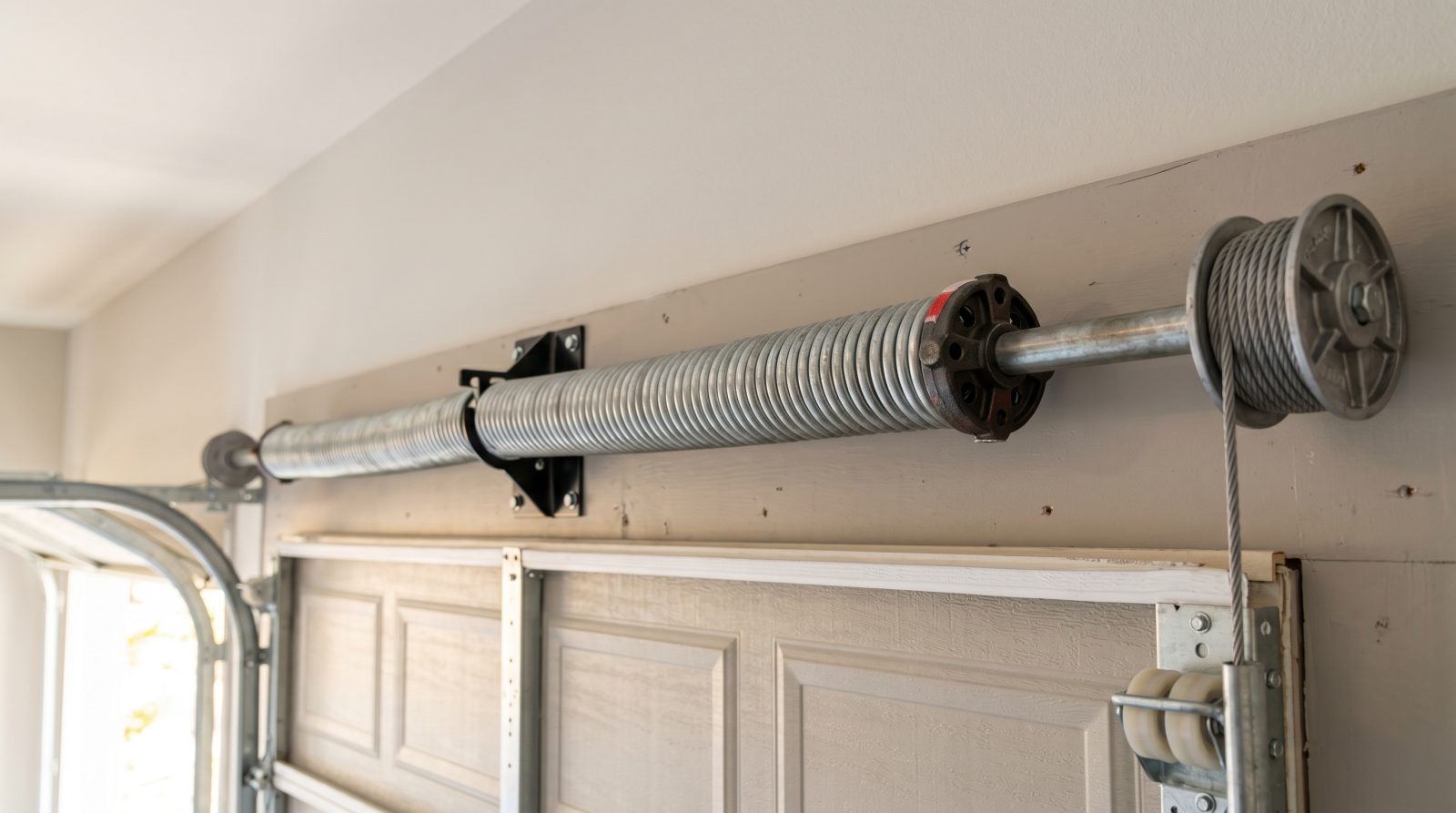
Garage doors use one of two spring systems, and knowing which you have helps you describe the problem and understand the repair. Torsion springs are the most common on modern doors. They sit on a metal shaft mounted horizontally above the door opening and wind up to lift the door. When a torsion spring breaks, you'll often see a clear gap in the coil, as if someone cut a section out of it, and the door becomes very hard or impossible to lift.
Extension springs are the long, lighter springs that run parallel to the horizontal tracks on either side of the door, stretching and contracting as the door moves. They are more common on older or lighter single-car doors. A failed extension spring may hang loose, look stretched out, or have visibly separated, and the door may sit crooked or open unevenly because one side has lost its support.
There is an important safety reason to identify the type: extension springs especially should run with a safety cable threaded through them, because a snapping extension spring can become a flying projectile. If your door uses extension springs and you don't see a safety cable, that is a meaningful safety upgrade to ask about during the repair. In both systems, springs are wear parts with a finite lifespan, not permanent components.
- Torsion springs: mounted on a shaft above the door, common on modern and heavier doors; a break shows as a visible gap in the coil.
- Extension springs: run along the side tracks, common on older or lighter doors; a break shows as a loose, stretched, or separated spring.
- Doors are usually balanced in pairs: if one spring of a matched set fails, the other is typically near the end of its life too.
- Safety cables are essential on extension-spring systems and a worthwhile add if yours lacks them.
Why Garage Door Springs Break
Springs do not fail randomly; they wear out from use. Garage door springs are rated by cycles, where one cycle is a single open-and-close. A common builder-grade spring is rated for roughly 10,000 cycles, which sounds like a lot until you count an active household opening the door several times a day, year after year. Homes that use the garage as the main entrance often reach that limit faster than they expect. Higher-cycle springs exist and last considerably longer, which is worth discussing if your door sees heavy daily use.
Climate plays a real and often underestimated role, and it varies widely across the country. In cold-winter regions, metal contracts and becomes more brittle, which is why so many springs let go on the first hard freeze of the season. In humid or coastal areas, moisture and salt air accelerate rust, and a rusted spring loses strength and binds as it coils, shortening its life. In hot, dry climates, the issue is more often simple high-cycle wear plus dust and grit working into the moving parts. None of these are flaws in your door; they are normal regional realities that affect how long a spring lasts.
Maintenance, or the lack of it, is the other big factor. Springs and the cables and rollers around them benefit from periodic lubrication and from keeping the door properly balanced. A door that is out of balance forces the opener and springs to work harder than designed, wearing everything out faster. Rust, missing lubrication, an unbalanced door, and an undersized spring for the door's actual weight are the usual suspects behind an early failure.
- Normal cycle wear: standard springs are often rated near 10,000 cycles; heavy daily use reaches that sooner.
- Cold climates: freezing temperatures make spring steel more brittle and prone to snapping in winter.
- Humid and coastal climates: rust and corrosion weaken springs and shorten their lifespan.
- Poor lubrication and an unbalanced door: make springs and openers work harder than intended.
- Wrong spring spec: a spring sized for a lighter door will fail early under a heavier one.
Why It's Dangerous to Force or DIY a Spring
Garage door springs are widely considered the most dangerous part of the whole system, and that reputation is earned. A torsion spring under full tension stores enough energy that a slip with the wrong tool, or a bolt loosened in the wrong order, can release that force violently. Winding bars can kick back, cables can whip, and parts can launch. This is the reason professionals treat spring work with so much respect, and why we strongly discourage homeowners from attempting it.
Beyond the spring itself, forcing a door with a failed spring causes collateral damage. The opener was never designed to lift a door without spring assistance; pushing it to do so can strip the drive gear, bend the door panels, pull the cables off their drums, or knock the door off its tracks, turning a single-spring repair into a much larger job. A door that is hand-lifted on a broken spring can also slam closed with no warning, which is a serious hazard for anyone, and especially for children and pets nearby.
There's also a correctness issue that matters for safety and longevity. Springs must be matched to the specific weight and dimensions of your door and wound to the right tension. An incorrectly sized or improperly wound spring may seem to work for a while, then fail again sooner or leave the door dangerously unbalanced. Getting the spec and the installation right the first time is part of what makes professional spring repair worth it, not just the muscle.
- Stored tension: a wound spring can release suddenly and forcefully, causing serious injury.
- Opener damage: lifting without spring support can strip gears and burn out the motor.
- Cascading failures: forcing the door can bend panels, snap cables, or throw it off track.
- Wrong-spec springs: fail early and can leave the door unbalanced and unsafe.
- Sudden drops: a hand-lifted door on a broken spring can slam shut without warning.
What Same-Day Spring Repair Involves
A proper spring repair starts with diagnosis, not just swapping a part. A technician confirms whether it's a spring, a cable, or another component, measures the door so the replacement spring matches its weight and size, and checks the cables, rollers, drums, and bearings that work alongside the spring. Because these parts wear together, it's common to find a cable fraying or a bearing wearing out at the same time, and addressing them together prevents a repeat callout days later.
When a door has a matched pair of springs and one has broken, the standard recommendation is to replace both. They have lived the same cycle count, so the second is usually close behind. Replacing the pair keeps the door balanced and saves you the cost and disruption of a second service call when the other lets go. After installation, the door should be balanced and tested so it opens smoothly and holds position partway up, which is the simple real-world check that the spring tension is correct.
On cost, expect typical industry ranges rather than a fixed number, because the right price depends on your door's size and weight, whether it uses torsion or extension springs, the spring's cycle rating, and how many parts need replacing. As a general guide, single-spring repairs tend to fall at the lower end and full torsion-pair replacements toward the higher end, with high-cycle upgrades costing more upfront but lasting longer. These are estimates that vary by door, materials, region, and scope, and a real figure should come only after the door is measured and assessed in person.
- Full diagnosis: confirm the failed part and measure the door so the new spring matches.
- Replace springs in pairs: a matched set that has shared the same cycles is best replaced together.
- Check the neighbors: cables, rollers, drums, and bearings wear alongside springs and are worth inspecting.
- Balance and test: a correctly repaired door opens smoothly and holds partway up on its own.
- Ask about high-cycle springs: a higher upfront cost can mean far fewer failures over the years.