When a New Opener Is an Upgrade vs. an Urgent Problem
Not every opener replacement is an emergency, and knowing which situation you are in changes how fast you should act. A planned upgrade looks like this: your opener still works, but it is loud, slow, lacks modern safety features, or you simply want quieter, smarter operation. You have time to compare drive types, research models, and schedule the work. An urgent situation is different. If your door is stuck open, your home and everything in the garage is exposed to weather and anyone walking by, which is a genuine security risk that should be addressed the same day. If the door is stuck closed, a vehicle may be trapped inside right when you need it.
The most important safety rule when an opener fails is to resist the urge to force the door. A residential garage door is one of the heaviest moving objects in a typical home, and it is held in balance by springs under enormous tension. The opener does not lift that weight by brute force; it guides a door that the springs are largely counterbalancing. When people yank on a partially open door or repeatedly hit the button on a struggling motor, they can pop the door off its track, snap a cable, or put a hand near a spring or pinch point at exactly the wrong moment. If your door is behaving unpredictably, the safer move is to stop, leave it where it is if possible, and get a professional eye on it.
It also helps to confirm the opener is truly the failed part before replacing it. A door that suddenly will not move can be a snapped spring, a broken cable, or an off-track door rather than a dead motor, and those are mechanical repairs, not opener swaps. If your remotes do nothing, the wall button is dead, and there is no motor hum at all, the opener or its power is the likely culprit. If the motor runs but the door does not move or reverses immediately, the problem is more often the door hardware, springs, or safety sensors. Diagnosing this correctly is the difference between a one-hour fix and replacing the wrong thing entirely.
- Plan ahead when: the opener works but is noisy, slow, or missing modern safety and security features.
- Treat as urgent when: the door is stuck open (security and weather exposure) or stuck closed with a vehicle trapped.
- Never force a struggling or partially open door, you risk an off-track door, snapped cable, or injury near the springs.
- Confirm the real failure first: dead motor and remotes point to the opener; motor runs but door won't move points to springs, cables, or sensors.
Chain vs. Belt vs. Screw-Drive: Choosing the Right Mechanism
Most residential openers fall into three classic drive types, and the right choice depends mostly on your noise tolerance, your door's weight, and where the garage sits relative to living space. A chain-drive opener uses a metal chain to push or pull a trolley along the rail. It is the workhorse of the category: durable, affordable, and strong enough for heavy doors, but it is also the loudest option because of metal-on-metal movement and vibration. If your garage is detached, or the rooms above and beside it are not bedrooms, the extra noise may not matter and the lower price is appealing.
A belt-drive opener swaps the chain for a reinforced rubber or polymer belt. Mechanically it works the same way, but it runs noticeably quieter and smoother because there is no chain rattle. Belt drives are the popular choice when there is a bedroom, office, or nursery directly above or beside the garage, or when anyone in the household keeps unusual hours and a loud opener would wake people. They typically cost a bit more than chain drives, and the belt is engineered to last for years of daily cycles, so the premium is mostly buying quiet, not buying fragility.
A screw-drive opener moves the trolley along a threaded steel rod rather than a chain or belt. It has fewer moving parts and can deliver strong, steady lifting power, which historically made it attractive for heavier doors. Its real-world quirk is temperature sensitivity: in regions with big seasonal swings, older screw-drive units could run rougher in extreme cold or heat, though many modern designs use low-maintenance lubricant and self-lubricating materials to reduce that effect. Climate matters more here than with the other two types, so screw drives tend to suit milder or more stable climates better than areas with harsh winters or scorching summers.
Beyond the drive itself, two specs deserve attention regardless of type. Horsepower (or the DC-motor equivalent) should be matched to your door: standard single doors are fine with a mid-range motor, while wide, double, or solid-wood doors need more lifting capacity to avoid straining the unit. And modern openers are designed with photo-eye safety sensors near the floor that reverse the door if something crosses the path, a feature that has been standard on residential openers in the U.S. since the early 1990s and is especially important in homes with kids or pets.
- Chain-drive: lowest cost, very durable, handles heavy doors, but the loudest, best for detached garages or away from bedrooms.
- Belt-drive: quiet and smooth, ideal when living space is above or beside the garage, modest price premium for the quiet.
- Screw-drive: fewer moving parts and strong lift, but more temperature-sensitive, better suited to milder, stable climates.
- Match motor power to the door: heavier double or solid-wood doors need more capacity than a standard single door.
- Insist on photo-eye safety sensors, they are standard on modern openers and reverse the door if anything is in the path.
Smart Openers and Modern Features Worth Paying For
Smart garage door openers connect to your home Wi-Fi and let you operate and monitor the door from a phone app, no extra remote required. The feature people end up valuing most is not flashy: it is the simple ability to check whether the door is open from anywhere, and to close it remotely. Anyone who has driven away wondering if they left the garage gaping knows how much peace of mind that delivers, and an open garage is one of the most common easy-access points for opportunistic theft. Real-time alerts that tell you when the door opens or closes turn the garage from a blind spot into something you can actually keep an eye on.
Beyond remote control, useful smart features include scheduled auto-close (so the door shuts itself if it is left open past a set time), temporary access codes you can grant to a dog walker, family member, or delivery service and then revoke, and integration with smart-home platforms and voice assistants. Battery backup is another modern feature worth prioritizing in any region prone to power outages, because an opener with backup power can still raise the door during a blackout, which matters a great deal if storms or grid issues are common where you live. In some areas, battery backup has also become a code expectation rather than a luxury.
Smart capability does not require buying an entirely new opener in every case. Many existing openers can be upgraded with an add-on smart controller that connects to the door's wiring and brings app control to a unit that is otherwise working fine. That can be a sensible middle path if your current opener is healthy and you mostly want the connected features. When the opener itself is aging, loud, or failing, though, replacing it with a modern smart belt-drive often makes more sense than bolting new technology onto a tired motor.
- Remote app control and open/closed status give real security value, an open garage is a common easy entry point.
- Look for scheduled auto-close, revocable guest access codes, and alerts when the door opens or closes.
- Prioritize battery backup in outage-prone regions so the door still works during a blackout; in some areas it is now code-expected.
- A healthy older opener can often be upgraded with an add-on smart controller instead of a full replacement.
- If the opener is already noisy or unreliable, a new smart unit usually beats adding tech to a failing motor.
What a Professional Opener Installation Involves
A proper installation is more than mounting a motor and plugging it in. It starts with checking the door itself, because an opener should never be asked to compensate for a poorly balanced door. A technician will typically test the door's balance by disconnecting the opener and lifting the door by hand: a well-balanced door stays roughly in place when raised halfway, while one that slams down or shoots up signals a spring or hardware issue that needs attention first. Installing a brand-new opener on a door with worn springs or binding rollers just transfers the strain to the new motor and shortens its life.
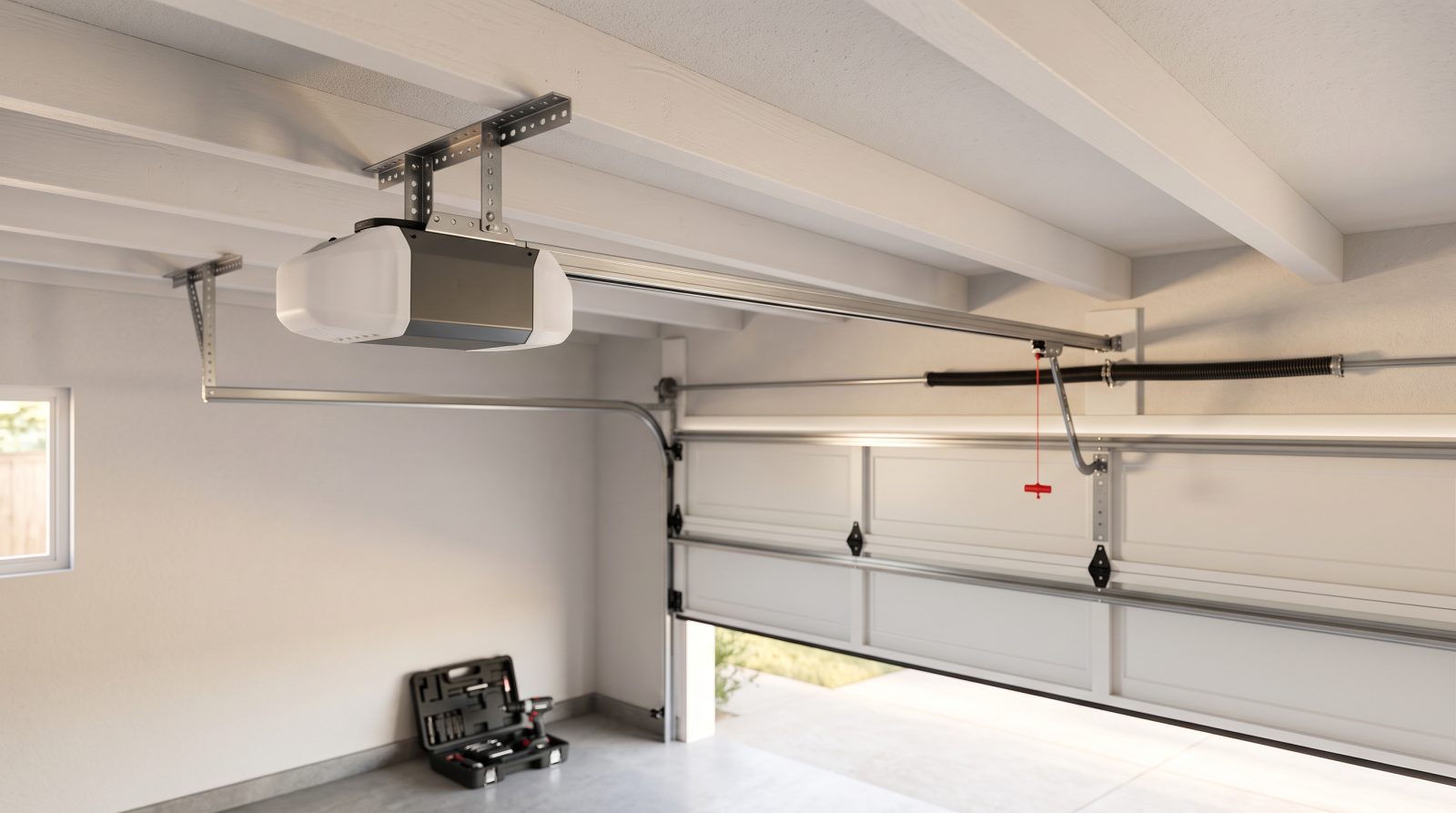
From there, the work includes securely mounting the motor unit to ceiling framing, assembling and aligning the rail, attaching the trolley and door arm, and wiring the wall control and the photo-eye safety sensors at the correct low height on each side of the opening. The safety sensors then have to be aligned and tested so the door reliably reverses when the beam is broken, and the door's auto-reverse force settings have to be adjusted so it backs off if it meets resistance. Remotes and any keypad or smart features are paired and tested, and the whole system is cycled multiple times to confirm smooth, quiet, fully reversing operation.
This is also where doing it right protects you long-term. Correctly set travel limits stop the door from crushing down too hard or leaving a gap at the bottom. Properly aligned sensors prevent the maddening problem of a door that refuses to close and flashes its lights for no obvious reason. And confirming the door's balance up front means the opener is doing the job it was designed for rather than fighting the door. While many handy homeowners can install a basic opener, the springs and high-tension components elsewhere in the system are genuinely dangerous to work on without training, which is why most people are better served having those parts handled professionally.
- Step one is checking door balance, an opener should guide a balanced door, not muscle a faulty one.
- Installation covers mounting, rail alignment, wiring the wall control, and placing the photo-eye sensors low on each side.
- Safety sensors and auto-reverse force must be tested so the door reliably backs off when it meets an obstruction.
- Correct travel limits prevent the door slamming, leaving a gap, or refusing to close.
- Spring and high-tension work is genuinely hazardous, leave those components to trained professionals.
Typical Cost Ranges and How to Make a Smart Decision
Opener pricing varies widely, and any figure should be treated as a typical industry range that shifts with your door, the drive type, the features you choose, and your region, not a fixed quote. As a rough guide, a basic chain-drive opener unit tends to sit at the lower end, belt-drive units in the middle, and feature-rich smart or heavy-duty models toward the higher end. Professional installation is usually an additional labor charge on top of the unit, and it can rise if old equipment has to be removed, if wiring needs updating, or if related door hardware needs attention. The honest takeaway is that the unit price is only part of the picture, the installed total is what matters.
When weighing options, resist focusing only on the sticker price of the motor. A quiet belt drive in a home with bedrooms over the garage, or battery backup in a storm-prone area, can be worth the extra outlay every single day you use the door. Likewise, matching motor power to a heavy door avoids premature wear that costs more in the long run. If your current opener is simply old and loud but mechanically fine, an add-on smart controller may get you most of the benefit for a fraction of a full replacement, while a genuinely failing opener is usually better replaced outright than repaired repeatedly.
If your situation is the urgent kind, a door stuck open and exposing your home, or stuck closed with a car trapped, the priority is getting it safely operable again the same day rather than agonizing over the perfect long-term unit in the moment. A good service approach handles the immediate safety and access problem first, then helps you choose the right permanent opener once the pressure is off. When you are ready to move forward, whether that is a planned quiet upgrade or a same-day fix for a dead opener, you can request a free quote and get clear, no-pressure guidance on the right unit for your door, your home, and your climate.
- Treat all prices as estimated ranges that vary by door, drive type, features, and region, never a fixed quote.
- Chain drives sit at the low end, belt drives mid-range, and smart or heavy-duty units toward the higher end, plus labor.
- Factor in removal of old equipment, wiring updates, and any door hardware that needs attention, the installed total is what counts.
- Spend where it pays off daily: quiet operation near bedrooms, battery backup in outage-prone areas, and motor power matched to door weight.
- For an urgent stuck door, get it safely operable the same day first, then choose the right permanent opener without pressure.