Lifespan at a Glance: Door, Opener, Springs, and Hardware
There is no single answer to "how long does a garage door last," because the door is really a system of parts that age independently. The steel, wood, or aluminum panels are usually the longest-lived component, while the springs, rollers, and cables are wear items engineered to be replaced one or more times over the life of the door. Understanding these separate clocks helps you budget, plan, and avoid the panic of a part failing at the worst possible moment.
The figures below are typical industry ranges drawn from how these components are built and how they're commonly rated. They are estimates, not guarantees: real lifespan varies enormously with cycle count (how many times the door opens and closes), climate, installation quality, and maintenance. A door at a busy household that opens eight times a day ages far faster than one used twice a day, even if they're identical models.
- Garage door (panels/section): roughly 15 to 30 years, longer for well-maintained steel and quality wood; coastal and harsh climates trend toward the lower end.
- Torsion or extension springs: commonly rated around 10,000 cycles (often cited as 7 to 12 years at average use), but heavy daily use can cut this to just a few years.
- Garage door opener (motor unit): typically 10 to 15 years, with belt-drive and modern units often outlasting older chain-drive models.
- Rollers: about 5 to 15 years depending on material (plastic rollers wear fastest; sealed nylon or steel bearing rollers last longest).
- Cables: often 8 to 15 years, but fraying from moisture, friction, or a spring failure can shorten this dramatically.
- Hinges, brackets, and tracks: often last the life of the door if kept clean, aligned, and lightly lubricated.
Springs: The Hardest-Working and Shortest-Lived Part
If any part of your garage door is going to fail and create an emergency, it's most often the springs. They counterbalance the entire weight of the door, which can be well over 100 pounds, so the opener only has to handle a fraction of that load. Because they store and release so much energy on every cycle, springs are deliberately designed as a consumable part with a finite life measured in cycles rather than years.
A spring rated for around 10,000 cycles will last roughly seven years for a household that opens the door four times a day, but barely three to four years for a busy family opening it ten or more times daily. Cold climates are especially hard on springs: metal becomes more brittle in freezing temperatures, which is why so many springs snap on the coldest mornings of the year. Coastal humidity and road salt accelerate corrosion, and any rust pitting becomes a stress point where the metal eventually breaks.
When a spring breaks, the door becomes dangerously heavy and unbalanced almost instantly. The opener may strain and fail to lift it, leaving your car trapped, or the door may slam down if it's open. This is not a do-it-yourself repair. Springs are under extreme tension, and releasing that tension incorrectly causes serious injuries every year. If you hear a loud bang from the garage, see a visible gap in the coiled spring above the door, or the door suddenly feels like it weighs a ton, stop using it and get professional help.
- Warning signs: a loud bang, a 1-to-2-inch gap in the torsion spring, the door feeling extremely heavy, or the opener struggling and reversing.
- Why they fail early: high cycle counts, freezing temperatures making metal brittle, rust from humidity or coastal salt air, and lack of lubrication.
- Lifespan tip: replacing both springs together (even if only one broke) keeps the door balanced and usually means the second won't fail weeks later.
- Upgrade option: high-cycle springs (rated 20,000+ cycles) cost more upfront but can roughly double service life for heavy-use homes.
Openers and Their Electronics: 10 to 15 Years, Sometimes More
The opener is the motorized unit on your ceiling, and as a whole it typically lasts 10 to 15 years. That said, it's rarely the motor that dies first. More often a small component fails: a worn drive gear, a stripped trolley, a failing circuit board, or a logic board damaged by a power surge or lightning. Many openers can be repaired rather than replaced, especially if the motor still runs strong.
Drive type matters for longevity and noise. Chain-drive openers are durable and inexpensive but louder and can stretch over time. Belt-drive units run quieter and often age more gracefully, which matters if there's a bedroom above the garage. Newer openers also add safety and convenience features that older units lack, and after enough years parts simply become hard to source, which can push a working-but-aging opener into replacement territory.
One safety note worth knowing nationwide: since the early 1990s, U.S. residential openers have been required to include photo-eye sensors that reverse the door if something crosses the beam. If your opener predates that, or the auto-reverse no longer works reliably, that's reason enough to replace it regardless of the motor's condition. A door that won't reverse is a genuine hazard to children and pets.
- Signs an opener is near end of life: intermittent operation, grinding gears, slow or jerky travel, frequent need to reset, or unresponsive remotes after fresh batteries.
- Often repairable: gears, trolleys, sprockets, and circuit boards can frequently be swapped without replacing the whole unit.
- Surge protection helps: lightning and power surges are a leading cause of premature board failure, so a surge protector is cheap insurance.
- Replace if: the door won't auto-reverse, parts are obsolete, or repair costs approach the price of a new unit.
Why Lifespans Vary So Much by Climate and Region
Two identical garage doors installed on the same day can age very differently depending on where they live. Climate is one of the biggest variables, and because this is a nationwide concern, it's worth understanding how your region works against (or for) your door's hardware. The same door that lasts 30 years in a mild, dry climate might need spring and cable work far sooner in a coastal or freeze-thaw environment.
In coastal areas, salt air is relentlessly corrosive. It attacks springs, cables, rollers, hinges, and any exposed steel, so homeowners near the ocean should expect more frequent hardware replacement and benefit most from galvanized or coated components. In cold northern climates, the freeze-thaw cycle and brittle-cold metal are the enemies: springs snap in deep cold, weatherstripping cracks, and doors can freeze to the slab. In hot, sunny regions, intense UV and heat fade and warp certain materials and degrade plastic parts and seals faster. Humid and rainy regions accelerate rust and can swell wood doors if they're not sealed.
Usage is the other half of the equation. A door that's also the family's main entrance, opening many times a day, will burn through spring cycles and wear rollers far faster than a door used occasionally. Installation quality matters too: a door that was set up out of balance, with the wrong spring rating, puts extra strain on the opener and every moving part, quietly shortening the life of the whole system.
- Coastal/salt air: faster corrosion of springs, cables, and rollers; favor galvanized or coated hardware and rinse off salt buildup.
- Cold/freeze-thaw climates: brittle springs snap in deep cold, seals crack, and doors can freeze to the floor; keep the bottom seal clear of ice.
- Hot/high-UV regions: heat and sun fade finishes, warp some panels, and shorten the life of plastic parts and seals.
- Humid/rainy areas: rust on metal parts and swelling of unsealed wood doors; keep hardware lubricated and wood properly finished.
- High-usage homes: more daily cycles means springs, rollers, and the opener all reach end of life sooner than the averages suggest.
How to Make the Whole System Last Longer
Most garage door components reach the upper end of their lifespan range only when they're maintained, and most fall short when they're neglected. The good news is that the maintenance that matters most takes only a few minutes a couple of times a year, costs almost nothing, and dramatically reduces the odds of a sudden failure. Think of it as catching small problems while they're still cheap and convenient instead of urgent and expensive.
The single most valuable habit is the balance test, which tells you whether the springs are doing their job. With the door fully closed, pull the manual release cord to disconnect the opener, then lift the door by hand to about waist height and let go. A well-balanced door should stay roughly in place. If it slams shut or flies up, the springs are out of adjustment or wearing out, and the opener is compensating with extra strain. Catching that early lets you schedule a repair instead of waking up to a trapped car. Reconnect the opener afterward and test that it runs normally.
Lubrication is the other big lever. A light application of a proper garage door lubricant on the rollers, hinges, springs, and bearings (not on the tracks, which only need to be wiped clean) keeps everything moving freely and reduces wear. Beyond that, a quick visual check goes a long way: look for frayed cable strands, rust, loose bolts, cracked rollers, and worn weatherstripping. If you ever spot a frayed cable, a gap in a spring, or a door that's become hard to move, treat it as urgent. Don't force a struggling door, because pushing through a hardware problem can turn a simple part replacement into a bent track, a snapped cable, or an injury.
- Test balance twice a year: disconnect the opener and lift the door by hand; if it won't stay put, the springs need attention.
- Lubricate moving metal: rollers, hinges, springs, and bearings with garage door lubricant; wipe tracks clean rather than greasing them.
- Tighten and inspect: snug up loose nuts and bolts and look for fraying cables, rust, and cracked plastic rollers.
- Protect the weatherseal: replace cracked bottom seals and weatherstripping to keep out water, pests, and drafts.
- Never force a stuck or heavy door: stop and have the hardware inspected before a small issue becomes a dangerous one.
When Repair Makes Sense vs. When to Replace
Because each part has its own clock, you'll rarely face an all-or-nothing decision. A broken spring on a 6-year-old door is a routine repair, not a reason to replace the door. A worn opener can often be fixed with a new gear or board. The door panels usually outlast everything else, so most homeowners replace springs once or twice and an opener once during the door's overall life.
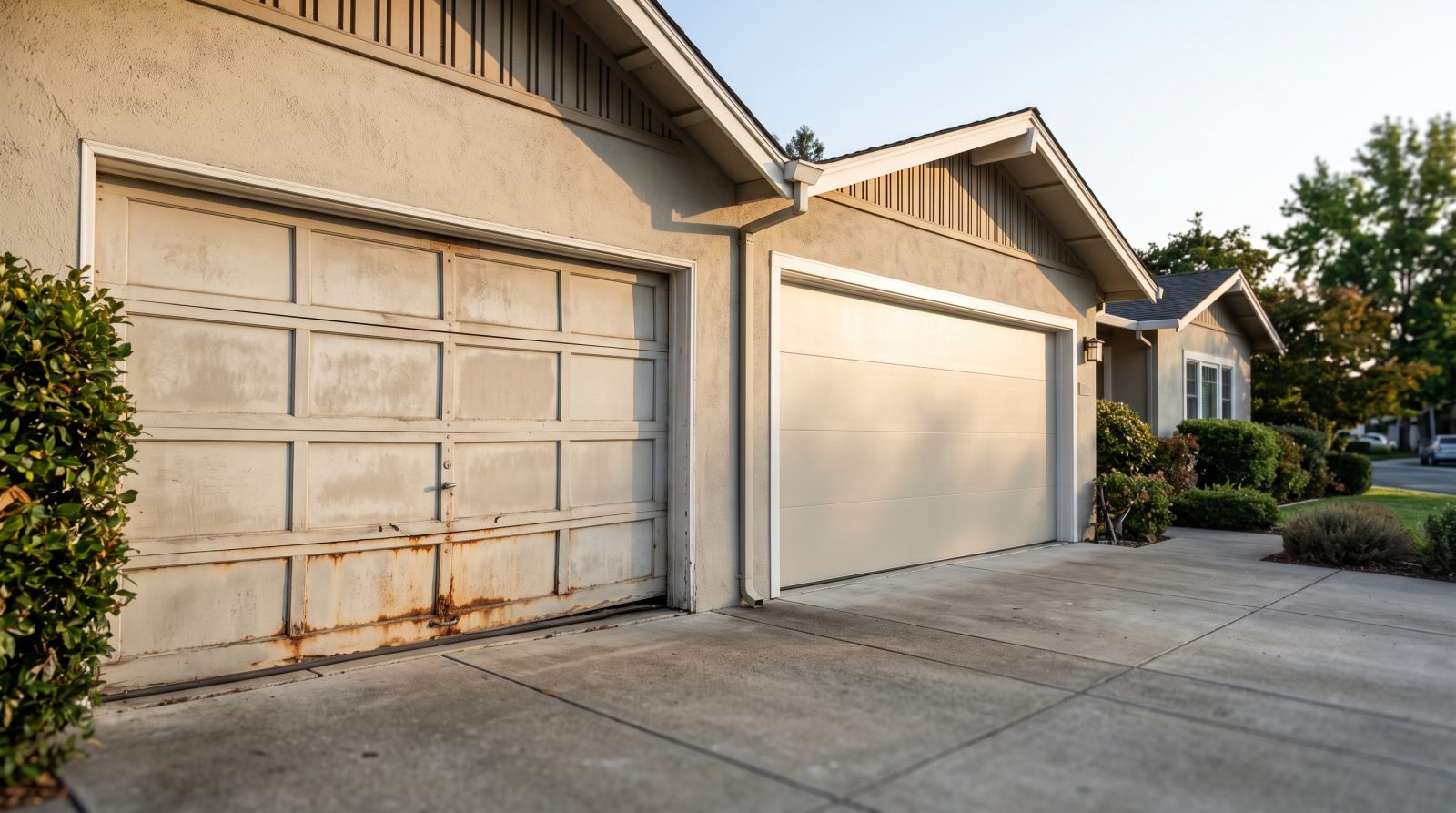
Replacement of the whole door starts to make sense when the panels themselves are the problem: sections that are dented, rotted, rusted through, or damaged in a collision, or a door so old that it lacks modern safety features and insulation. It can also make sense when several major components are failing around the same time, because at that point the combined repair cost is climbing toward the value of a new, more efficient door. Repair and replacement costs both vary widely by door size, material, spring type, opener model, region, and labor, so any figure is only a typical estimate, not a fixed quote for your specific door.
The most important rule is about safety and timing, not just dollars. Anything involving springs, cables, or a door that has become heavy or off-track should be handled by a professional and shouldn't wait, because these are the failures that trap your car, leave your home insecure, or cause injury. If your door is showing warning signs or has already failed, the safest move is to stop using it and get a same-day, fast inspection. Request a free quote and get an expert assessment before a stressed part fails completely.
- Usually repair: a broken spring, frayed cable, worn rollers, or an opener with a single failed component on an otherwise sound door.
- Consider replacement: dented, rotted, rusted, or collision-damaged panels, or a very old door without modern auto-reverse safety.
- Weigh it when failures cluster: multiple aging parts at once can make a new door the more sensible long-term value.
- Don't delay safety repairs: spring, cable, and off-track failures are urgent and unsafe to force; get fast professional help.