When a Commercial Door Goes Down, the Clock Is Already Running
A failed commercial garage door is an operational emergency in a way a home door never is. A rolling steel door stuck halfway up at a warehouse leaves inventory exposed and a wide-open entry into the building. A sectional dock door that won't close traps cold air, conditioned air, or refrigeration — and on a hot or freezing day that is money leaving the building every minute. A door jammed shut at a fire bay, parking structure, or service garage can block the one path vehicles and people need. The cost of waiting is almost never just the repair; it is the lost throughput, the security exposure, and the liability of a heavy door behaving unpredictably.
That urgency is why the single most important rule is also the simplest: do not force a commercial door that is fighting you. These assemblies store enormous mechanical energy in their springs and counterbalance systems, and a door that is binding, dropping, or hanging off its track is telling you something is already broken. Forcing it — running the opener again and again, prying a panel, or muscling a heavy curtain — is how a bad morning becomes an injury or a destroyed door. The right move is to stop, secure the area, and get a qualified technician on it the same day.
- Stuck open is a security and weather-loss problem — secure the opening and restrict access until it's repaired.
- Stuck closed can trap vehicles, block deliveries, or seal off an exit path — treat it as time-sensitive.
- Repeated opener attempts on a binding door can burn out the motor or worsen the underlying failure.
- A door that is visibly off-track, sagging, or leaning is under tension and unsafe to stand under or operate.
Rolling Steel vs. Sectional: Two Very Different Doors to Diagnose
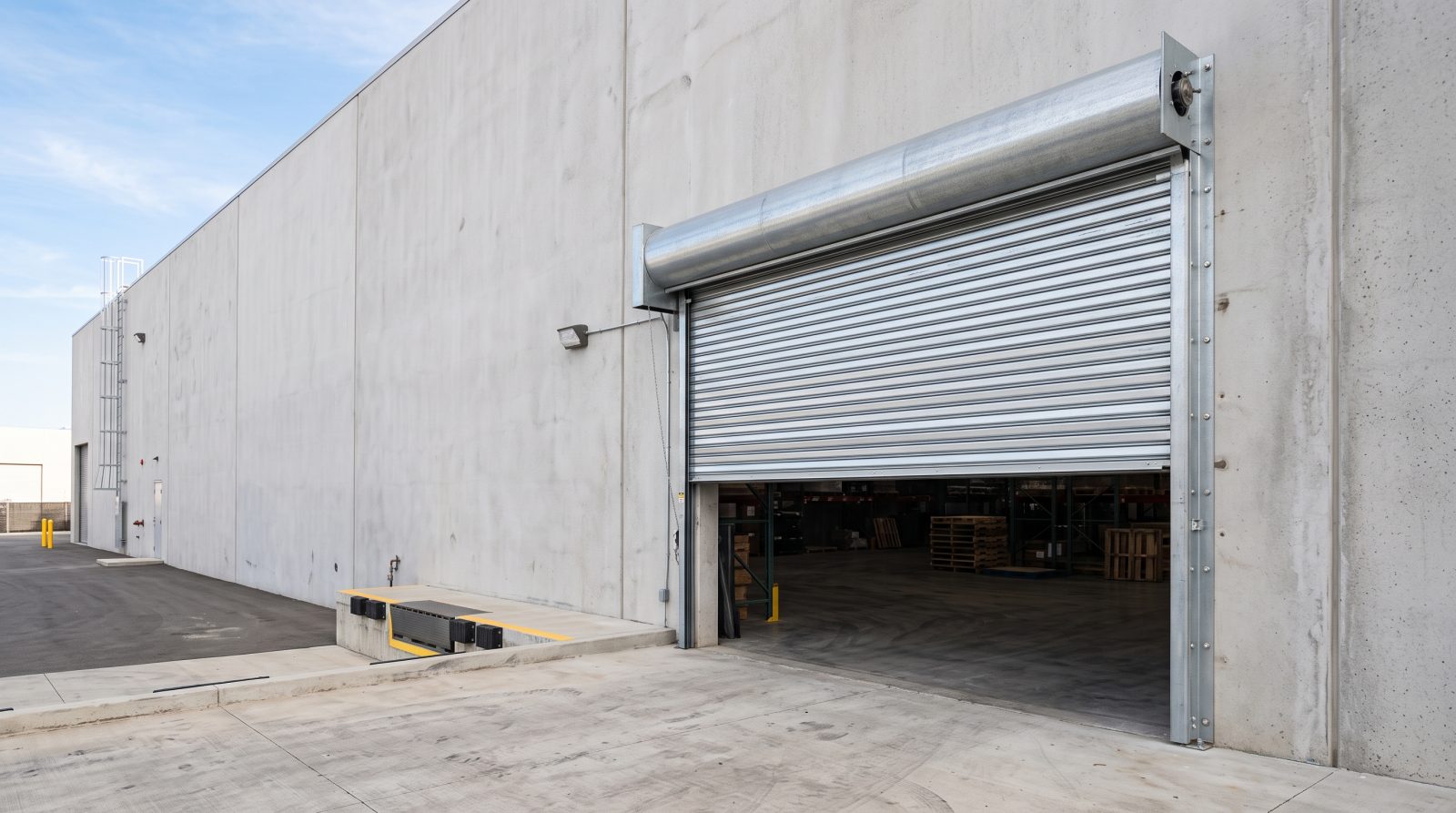
Commercial buildings run two broad families of overhead door, and they fail in different ways. Rolling steel doors (also called coiling doors) are made of interlocking horizontal slats that wind up into a barrel above the opening. They are the workhorses of storefronts, self-storage, warehouses, and fire-rated openings because they are compact, durable, and secure. When a rolling steel door fails, the usual culprits are a worn or broken spring inside the barrel, a curtain that has jammed in the guides, bent bottom bars, or slats that have come out of alignment after an impact. Because the tension lives inside the barrel, these are not doors to take apart casually.
Sectional commercial doors are built from hinged horizontal panels that ride up and over on tracks and rollers, much like a residential garage door but scaled up and built to higher cycle ratings. You'll find them on loading docks, fleet bays, auto shops, and warehouses. Their common failures are snapped torsion springs, frayed or broken lift cables, worn rollers and hinges, damaged track from forklift or vehicle contact, and bottom panels crushed by a dock collision. Sectional doors also pair with commercial operators (jackshaft, trolley, or hoist styles) that have their own failure points.
Diagnosing which system you have — and what failed within it — is the first real step, because the safe repair path is completely different for a coiling barrel versus a torsion-spring sectional. A technician who knows commercial doors will identify the door type, the spring and cable system, the operator, and the safety devices before touching anything under tension.
- Rolling steel: interlocking slats coil into an overhead barrel; failures often involve barrel springs, jammed guides, and bent slats or bottom bars.
- Sectional: hinged panels ride on tracks and rollers; failures often involve torsion springs, lift cables, rollers, and impact-damaged tracks or panels.
- Both rely on a counterbalance system that holds tremendous tension — never the place for improvised fixes.
- Operator type (jackshaft, trolley, hoist) changes both the diagnosis and the repair on either door family.
The Urgent Failures We See Most — and What to Do Right Now
Most emergency commercial calls trace back to a handful of failures, and knowing what you're looking at helps you make the right immediate decision while help is on the way. A broken spring is the most common and the most dangerous-feeling: the door suddenly becomes extremely heavy, the opener strains or won't lift it, and you may have heard a loud bang when the spring let go. Snapped cables show up as a door that drops on one side, hangs crooked, or refuses to move evenly. An off-track door — panels or a curtain that have jumped their guides — looks visibly misaligned and can be partially open, which is both a security gap and a falling hazard.
Then there are the doors that simply won't respond: an operator that hums but doesn't move, a door that reverses immediately, or a control that does nothing at all. These can be electrical, a tripped safety device, a stripped operator component, or a mechanical bind that the motor refuses to fight. The temptation is to keep hitting the button — but a door that won't move usually has a reason, and overriding it can turn a part swap into a full rebuild.
In every one of these cases, the safest immediate steps are the same: clear people and vehicles out from under and around the door, stop trying to cycle it, and avoid pulling manual release chains or disengaging the operator unless you genuinely understand the counterbalance state — releasing a door with a broken spring can let it fall. Then get same-day service on it.
- Broken spring: door is suddenly very heavy, opener strains or stalls — stop operating it and keep the area clear.
- Snapped cable: door hangs crooked or drops on one side — do not try to level it by hand.
- Off-track door or curtain: visible misalignment, often partly open — treat as a falling and security hazard.
- Won't open or close at all: stop cycling the opener; repeated attempts can damage the motor or worsen a bind.
- Never disengage the manual release on a door you suspect has a broken spring or cable — it can drop.
Why Commercial Doors Fail Faster — and How Region and Climate Play a Role
Commercial doors live a harder life than residential ones, and that shapes both how often they fail and what fails first. The biggest factor is cycle count. A home door might open and close a few times a day; a busy loading dock or self-storage gate can cycle dozens or hundreds of times daily. Springs are rated in cycles, so a high-traffic door simply reaches the end of its spring life far sooner. This is why cycle-rated, heavy-duty springs and routine maintenance matter so much in a commercial setting — and why a sudden spring failure on a hard-working door is rarely a surprise to anyone tracking it.
Environment is the second factor, and it varies meaningfully across the country. In coastal and high-humidity regions, salt air and moisture accelerate corrosion on tracks, springs, cables, and slats — rolling steel doors near the coast often need more attention to rust and lubrication. In cold-climate and northern states, freezing temperatures stiffen grease, contract metal, and can freeze a bottom seal to the slab, so doors that ran fine in summer start binding in winter; weather seals and cold-rated lubricants make a real difference. In hot, dusty, or desert regions, grit works into rollers and guides and bakes out lubrication, and thermal expansion stresses panels and hardware. Humid Gulf and Southeast climates combine moisture and heat, which is hard on both metal and electronics.
The practical takeaway is that there is no single national maintenance schedule — a dock door in Minnesota and a storefront coil door in Florida wear differently and need different care. What stays constant everywhere is that small issues (a fraying cable strand, a roller starting to bind, a spring losing tension) are cheap to catch and expensive to ignore once they cascade into an emergency.
- High cycle counts shorten spring life dramatically — heavy-use doors benefit from cycle-rated hardware and regular checks.
- Coastal and humid regions: corrosion on tracks, cables, and springs is the leading enemy — rust control and lubrication matter.
- Cold-climate states: freezing stiffens grease, contracts metal, and can freeze seals to the slab, causing winter binding.
- Hot, dusty, and desert regions: grit and thermal expansion wear rollers, guides, and panels faster.
- Catching a fraying cable or weakening spring early is far cheaper than an emergency replacement after it fails.
What Commercial Door Service Typically Costs (Honest Ranges, Not Quotes)
Commercial door pricing is genuinely hard to pin down in advance because the variables are large: door type (rolling steel vs. sectional), door size and weight, the gauge and material of the curtain or panels, spring and cable rating, operator style, the height and access of the opening, and how much damage cascaded from the original failure. A small storefront coil door is a different job from a 14-foot insulated dock door with a damaged operator. For that reason, treat any figures here as typical industry estimate ranges that vary by door, materials, region, and scope — never a fixed quote or a guarantee.
As broad orientation only: a service call or diagnostic visit is usually a modest base fee that often applies toward the repair. Common emergency repairs — replacing a broken spring, swapping snapped cables, resetting an off-track door, or replacing worn rollers — commonly land in a few-hundred-dollar range per repair, with heavier doors, higher cycle-rated springs, and harder access pushing higher. Commercial torsion springs cost more than residential because they are bigger and built for far more cycles. Operator repairs range widely depending on whether it's a control board, a worn component, or a full operator replacement. A full commercial door replacement is a substantially larger project, driven by size, insulation, material, and whether the opening and tracks need rework.
The honest way to budget is to expect a same-day diagnosis that identifies exactly what failed, then a clear scope before any work proceeds — including whether a repair makes sense versus a planned replacement on a door that is near the end of its service life. A good technician will explain the reasoning behind the number rather than hand you a figure with no context.
- Costs vary by door type, size, weight, material, spring rating, operator, opening height, and access — there is no one-size price.
- Diagnostic/service-call fees are typically modest and often credited toward the repair.
- Spring, cable, roller, and off-track repairs commonly run in a per-repair range that rises with door size and cycle rating.
- Commercial springs cost more than residential because they're larger and rated for many more cycles.
- All figures here are typical estimate ranges that vary by region and scope — never a fixed quote or guarantee.
Repair, Replace, or Maintain: Keeping Your Door Out of the Emergency Cycle
The best commercial door service is the one you don't need at 6 a.m. before a shift. Once your immediate failure is handled, the real win is breaking the emergency cycle — and that comes down to an honest repair-vs-replace decision plus a maintenance rhythm matched to how hard the door works. A door that fails repeatedly, has rusted-through slats, a bent or worn barrel, cracked panels, or a spring system that has simply outlived its cycle rating is often a candidate for planned replacement rather than another patch. Replacing on your schedule is always cheaper and less disruptive than replacing because the door died mid-operation.
For doors with life left in them, preventive maintenance is the highest-leverage thing you can do. That means periodic inspection of springs and cables for wear, lubrication appropriate to your climate, checking and adjusting track alignment, testing the operator and its safety reversing features, and tightening hardware loosened by constant cycling. On high-traffic doors, this is not a luxury — it is the difference between a planned 20-minute tune-up and an unplanned shutdown. Many businesses with multiple doors set up a recurring schedule so failures get caught as wear, not as emergencies.
Whichever path fits, the goal is the same: a door that opens and closes reliably, stays secure when it should, and never becomes the reason your business stops. If you're dealing with a door that's down right now, get same-day help on it; if you're thinking ahead, a maintenance plan is the cheapest insurance you can buy. Either way, you can request a free quote and we'll lay out the options clearly so you can decide with full information.
- Repeated failures, rust-through, bent barrels or cracked panels, and end-of-cycle springs often favor planned replacement.
- Replacing on your schedule beats an emergency replacement on the door's schedule — every time.
- Preventive maintenance (springs, cables, lubrication, track alignment, operator safety checks) catches wear before it becomes a shutdown.
- High-traffic doors benefit most from a recurring maintenance schedule, especially across multiple openings.
- Down right now? Get same-day service. Planning ahead? Request a free quote and review your options.