How garage door springs actually work (and why they're under so much tension)
A garage door spring isn't there to power the door — it's there to counterbalance its weight. Modern motors are surprisingly weak; the opener mostly just guides the door up and down. The springs do the heavy lifting by storing mechanical energy when the door is closed and releasing it as the door rises. A correctly balanced door should feel nearly weightless when you lift it by hand, hovering roughly halfway open without slamming down or flying up. That balance is the spring's entire job.
Because they offset hundreds of pounds, springs are wound or stretched to extreme tension. A typical torsion spring on a two-car door can store energy equivalent to lifting an adult off the ground — which is exactly why a sudden failure is violent and why winding one by hand is genuinely hazardous. This stored force is also what wears the spring out: every open-and-close cycle flexes the steel a little, and over thousands of cycles metal fatigue eventually wins.
Understanding this helps explain almost every spring symptom you'll read about below. A door that's heavy, crooked, won't stay open, or strains the motor isn't usually an opener problem — it's a counterbalance problem. The opener is just the messenger telling you the springs can no longer carry the load.
- Springs counterbalance the door's weight; the motor mostly guides, not lifts.
- A balanced door feels light by hand and holds steady about halfway open.
- Stored tension is enormous — enough to cause serious injury if released suddenly.
- Every cycle (one open + one close) adds wear; springs are rated in cycles, not years.
Torsion springs: the workhorse mounted above the door
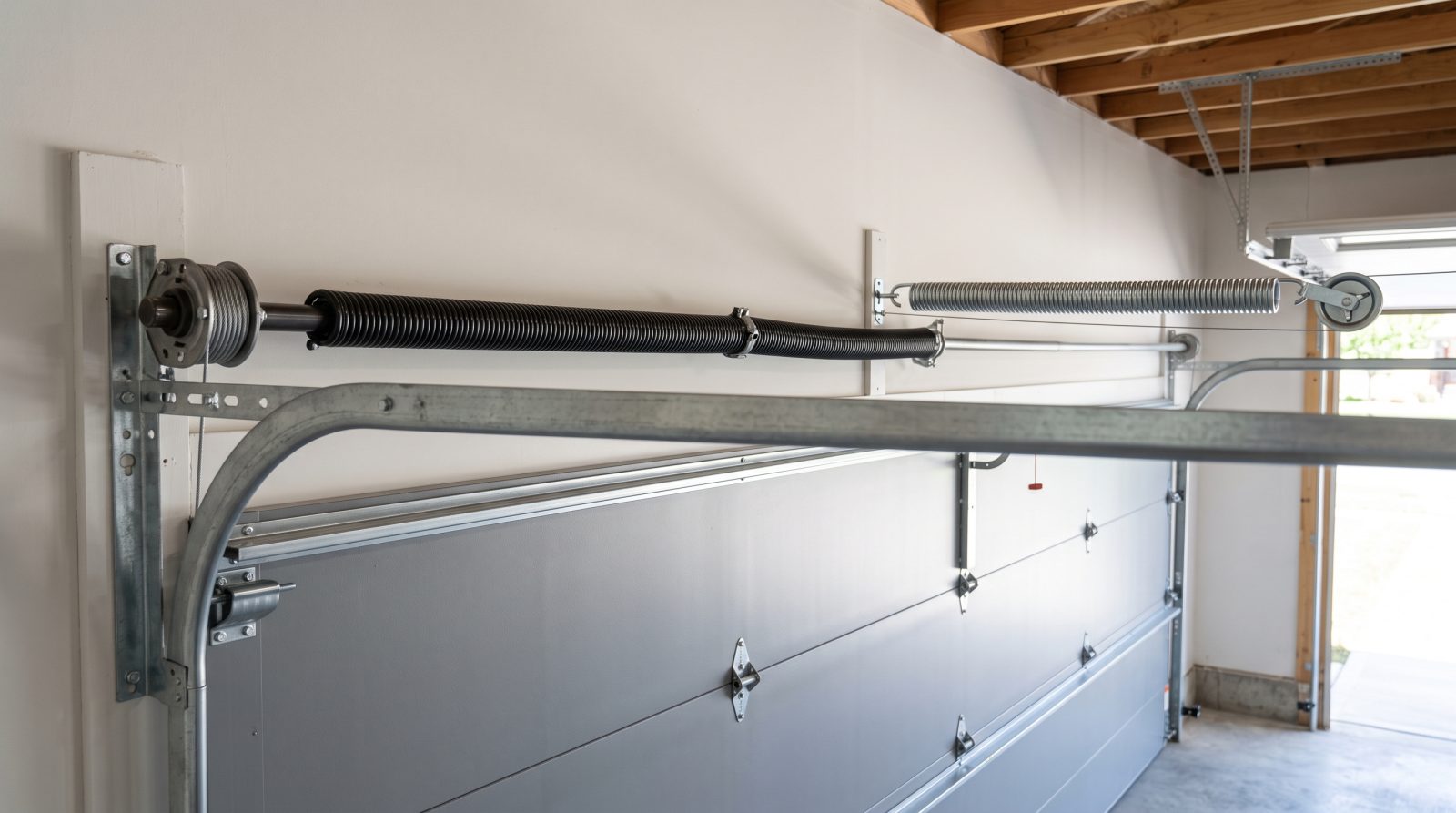
Torsion springs are the tightly wound steel coils mounted horizontally on a metal shaft above the door opening, usually centered over the header. Instead of stretching, they twist (torque) to store energy. As the door closes, cables wind drums on the shaft and load the spring; as the door opens, the spring unwinds and turns the shaft, lifting the door via those cables. This twisting action delivers smooth, controlled, well-balanced movement, which is why torsion systems are the modern standard on most newer and heavier doors.
The advantages are real: torsion springs generally last longer, run quieter, and balance the door more precisely than the older extension style. Because the system is centered and contained on a shaft, a torsion door tends to travel evenly with less side-to-side wobble. The trade-off is that the components — shaft, drums, bearings, and the precisely sized spring itself — are more involved, and adjusting or replacing them safely requires winding bars and proper technique. This is not a parts-store-and-a-weekend job.
Climate matters here more than most homeowners expect. In cold regions, steel becomes more brittle and torsion springs disproportionately fail on the first frigid morning of the season, when an already-fatigued coil meets a sudden temperature drop. In humid coastal or southern areas, corrosion is the bigger enemy, slowly weakening the steel from the surface in. Neither changes how the spring works — but both shorten its life and explain seasonal spikes in sudden breaks.
- Mounted on a horizontal shaft above the door; stores energy by twisting.
- Smoother, quieter, and better-balanced than extension springs — the modern standard.
- Typically longer-lived but more complex to service safely.
- Cold snaps and coastal humidity both accelerate failure; expect seasonal break spikes.
Extension springs: the stretch-and-pull system along the tracks
Extension springs are the long, lighter-gauge springs mounted on either side of the door, running parallel to and above the horizontal tracks. They work by stretching: when the door closes, the springs extend and store energy; when it opens, they contract and pull the door up through a system of pulleys and cables. You'll often find one spring per side, working as a pair. They're common on older homes and lighter, single-car doors, partly because they're less expensive to manufacture and install.
The main thing to know about extension springs is safety. Because they stretch and contract along an open track, a snapped extension spring can launch across the garage with dangerous force. For this reason, building codes and good practice call for a safety containment cable — a steel cable threaded through the center of each spring — so that if the spring breaks, the pieces stay captured on the cable instead of becoming a projectile. If your door has exposed extension springs without containment cables, that's a serious safety gap worth addressing regardless of whether anything is currently wrong.
Extension systems also tend to balance the door slightly less evenly than torsion, since the pulling force comes from the sides rather than a centered shaft. They can be a perfectly reasonable choice for the right door, but they demand respect: the combination of open stretch, paired springs, and cables under load means a failure is both more likely to be sudden and more likely to scatter parts.
- Mounted along the side tracks; stretch to store energy and contract to lift.
- Common on older and lighter single-car doors; lower upfront cost.
- Must have safety containment cables — without them, a break can become a projectile.
- Balance the door a bit less evenly than centered torsion systems.
Warning signs a spring is failing — and what to do right now
Spring failure is sometimes sudden and sometimes telegraphed days in advance. The most unmistakable sign is a loud bang from the garage — often mistaken for a gunshot or something falling — followed by a door that suddenly won't open or feels far heavier than usual. With a torsion spring you may see a clear gap in the coil where it snapped. With extension springs you might find one spring obviously longer, stretched out, or hanging loose compared to its partner.
Earlier, subtler signs are worth catching because they let you fix the problem on your schedule instead of in a crisis. Watch for a door that opens a few inches and stops, jerks or moves crookedly, slams down faster than it should, or strains and groans the motor. A door that no longer holds position halfway when you lift it by hand is a classic sign the counterbalance is going. Squealing, grinding, or loose, slack cables can also point to a spring or related hardware on its way out.
If you suspect a broken spring, the safest move is to stop using the door entirely. Do not repeatedly hit the opener button — forcing a motor to lift a door with a dead spring can burn out the opener, snap a cable, or pull the door off its tracks, turning one repair into several. If a vehicle is trapped inside and you must use the manual release, do it carefully and never with anyone or anything beneath the door, because a poorly balanced door can drop hard. When in doubt, leave it where it is and get expert help the same day.
- Loud bang, then a heavy door that won't open — the classic break signature.
- Visible gap in a torsion coil, or an extension spring that's stretched or hanging.
- Early warnings: door stops short, moves crookedly, slams shut, or won't hold halfway.
- Do NOT keep pressing the opener — you risk the motor, cables, and tracks.
- Never stand or park under a suspect door; it can drop without warning.
Why spring repair is a same-day, professional job — not a DIY fix
Garage door springs are consistently ranked among the most dangerous home-repair items, and the reason is simple physics: you're working directly with hundreds of pounds of stored tension. Winding a torsion spring with improper bars or technique, or releasing an extension spring's load incorrectly, can cause a winding bar to kick back, a spring to whip loose, or the door to crash down. Serious hand, head, and eye injuries from DIY spring attempts are well documented. This is the rare repair where the gap between a pro and a confident DIYer isn't just quality — it's safety.
There's a balance issue too. Springs are sized precisely to the door's weight, height, and material; a spring that's even slightly mismatched leaves the door unbalanced, overworks the opener, and wears out the new spring early. On most doors springs are installed in matched pairs, and when one breaks, the other is usually the same age and close behind — which is why replacing both at once is standard practice and often saves a second service call within months. A trained technician measures the door, selects correctly rated springs, sets the tension, and then tests the balance so the door travels smoothly and safely.
Because a broken spring routinely traps a car, leaves a home exposed, or renders the main entry unusable, it genuinely warrants fast, same-day attention rather than waiting. The good news is that a competent technician can typically diagnose and replace springs efficiently, restore balance, and confirm the door is safe in a single visit. If you're dealing with a snapped spring or any of the warning signs above, the smartest next step is to stop using the door and request a free quote so a professional can handle the tension safely and get you back to normal.
- Stored tension makes spring work genuinely hazardous without the right tools and training.
- Springs must be matched to the door's exact weight and size for proper balance.
- Replacing both springs together is common practice and often avoids a fast repeat failure.
- A pro restores balance and tests safety in one visit; you avoid injury and added damage.
- Pricing varies by door, spring type, cycle rating, and region, so ask for a clear quote up front.