First, Make It Safe: What to Do Right Now
When a garage door fails suddenly, your instinct is to fix it fast — but the safest first move is almost always to stop and assess. Garage doors are heavy, and they're held in balance by springs and cables under extreme tension. When something breaks, that balance is gone, and the door can move in unexpected, forceful ways. Resist the urge to repeatedly press the opener button or to muscle the door up or down. If the motor is straining or grinding, unplug the opener so it can't try to move a jammed or off-track door and cause more damage.
Clear the area underneath and keep children and pets well away from the door until it's resolved. If the door is stuck partway open and feels loose, wobbly, or unsupported, do not walk under it or park beneath it — treat it as something that could come down. If it's a security concern because the door is stuck open, you can usually still protect the house: lock the interior door between the garage and your home, and move valuables out of easy reach until the overhead door is repaired.
Once everyone is safe and the opener is off, you can do a calm visual check from a safe distance. You're not trying to repair anything yet — you're trying to identify what failed so you can describe it accurately and get the right help quickly. The sections below cover the most common emergencies and how to recognize each one.
- Stop pressing the opener and stop forcing the door — repeated attempts turn a small failure into a big one.
- Unplug the opener if the motor is straining, grinding, or trying to move a stuck door.
- Never stand or park under a door that's stuck partway open or visibly hanging unevenly.
- If the door is stuck open, secure the interior door to your home and keep the area clear.
- Take a quick photo of the broken part from a safe distance — it helps a technician arrive prepared.
Broken Garage Door Springs — The Most Common (and Most Dangerous) Failure
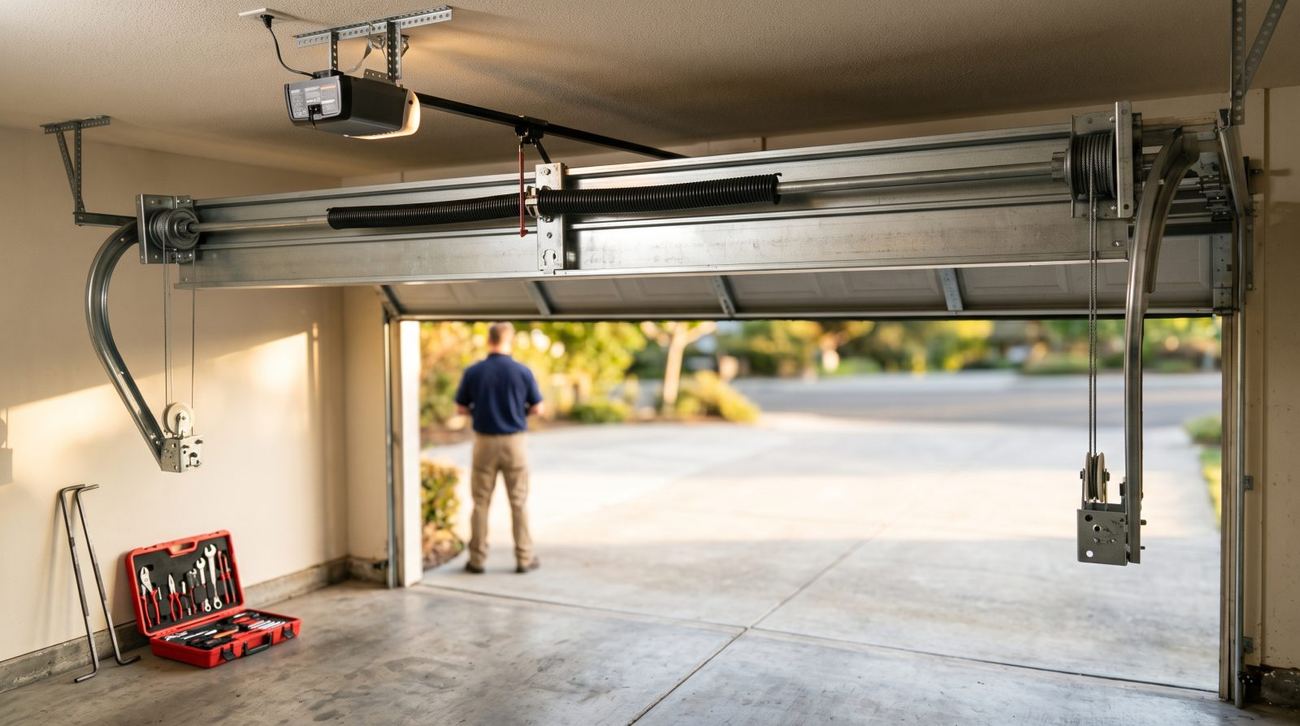
Springs are the hardest-working part of your garage door and one of the most common emergencies homeowners face. They counterbalance the weight of the door — often 150 pounds or more — so the opener (or your arm) only has to do a fraction of the lifting. When a spring breaks, that help disappears instantly. The telltale signs are a loud bang like a firecracker (often heard from inside the house), a door that suddenly feels impossibly heavy, a door that won't open more than a few inches, or a visible gap in a coil of the spring mounted above the door.
There are two main systems. Torsion springs mount horizontally on a metal bar above the door opening and are the most common on modern doors. Extension springs run along the horizontal tracks on either side. Both store enormous energy when wound or stretched. This is the one repair we consistently urge homeowners not to attempt: a slip during spring replacement can cause severe injury, and it requires winding bars, correctly rated springs, and proper technique. A broken spring is a same-day repair worth handing to an experienced technician.
Spring lifespan is usually measured in cycles (one open-and-close equals one cycle), and standard springs are often rated around 10,000 cycles — roughly seven to twelve years for an average household, but far less for a busy family or a door used as the main entrance. Climate plays a real role: in colder regions, repeated freezing and the added strain of frozen-down doors tend to shorten spring life, while coastal and humid areas see more corrosion that can weaken coils early. If one spring breaks on a two-spring door, it's standard practice to replace both, since the second is usually near the end of its life too.
- Loud bang, then a door that's suddenly very heavy or won't lift = almost certainly a broken spring.
- Look for a visible gap or separation in the coiled spring above the door — a clear giveaway.
- Do not try to open the door with the opener; without the spring, the motor can be damaged or the door can drop.
- Spring replacement is not a DIY job — the stored tension makes it genuinely hazardous.
- Expect both springs to be replaced together on a two-spring door for balanced, longer-lasting results.
Stuck Open or Stuck Closed: Security Risks and Trapped Cars
A door stuck in the wrong position creates two different emergencies. Stuck open is a security and weather problem: your garage and everything in it — often including a path into your home — is exposed, and an open door is an open invitation. Stuck closed is usually an access problem: your car is trapped, and you may be late for work, school, or an appointment. Both feel urgent, and both have a handful of common causes worth ruling out before help arrives.
If the door won't respond at all, start with the basics that solve a surprising number of calls: confirm the opener has power (check the outlet and breaker), make sure the wall control isn't set to a 'lock' or 'vacation' mode, and replace the remote battery. If the door starts to close and then reverses every time, the photo-eye safety sensors near the floor are likely blocked or misaligned — wipe the lenses and check that they point straight at each other. These are safe checks any homeowner can make. If the opener runs but the door doesn't move, the trolley may have disconnected from the carriage, or there may be a spring or cable problem behind it.
If you need to get a trapped car out, most openers have a red emergency-release cord hanging from the trolley along the ceiling rail. Pulling it disconnects the door from the opener so you can lift it by hand — but only do this if the door is otherwise sound and you're confident the springs are intact. If the door is heavy, hangs unevenly, or you suspect a broken spring or cable, leave it alone; releasing it can let it drop. When the simple checks don't restore normal operation, that points to the harder mechanical parts and is the right moment for same-day professional help.
- Stuck open = secure your home first (lock the interior door, clear the area), then get fast repair.
- Stuck closed = check power, lock mode, remote battery, and the floor-level safety sensors before anything else.
- Door closes then reverses every time: clean and realign the photo-eye sensors near the floor.
- The red release cord lets you lift the door by hand — only if the springs and cables are sound.
- Opener runs but the door stays put? Suspect a disconnected trolley, spring, or cable — get help.
Off-Track Doors and Snapped Cables — Why You Shouldn't Force It
An off-track door is one of the most visually alarming failures: a roller has jumped out of the metal track, leaving a panel hanging out of line, bowed, or wedged at an angle. It often happens after something bumps the door, after a cable lets go, or when a roller or hinge finally wears out. It can look like a quick nudge would pop it back — but forcing an off-track door is one of the fastest ways to bend panels, damage the track, or cause the whole door to come down. The safe move is to stop using the door entirely until it's properly reset.
Cables work hand-in-hand with the springs to control the door's movement and keep tension balanced. When a cable frays or snaps, you might see it dangling, notice the door looks crooked, or find it suddenly riding rough or jamming on one side. Like springs, lift cables are under significant tension, and a door with a failed cable can be unstable. Snapped cables and off-track doors are closely related — a cable failure frequently throws a door off its track, and vice versa — so they're best diagnosed and corrected together.
These are not the repairs to improvise with pliers and a ladder. Resetting a door correctly means relieving tension safely, realigning rollers in the track, checking the springs and cables that may have caused (or been damaged by) the event, and confirming the door is balanced before it's put back into service. Attempting it without the right approach risks injury and usually turns a same-day fix into a panel-replacement job. Keep the door closed and unused, and get an experienced technician out the same day.
- A panel hanging out of line or a roller out of the track = off-track; stop using the door immediately.
- A dangling, frayed, or snapped cable makes the door unstable — don't try to operate it.
- Off-track doors and cable failures usually go together and should be diagnosed as a pair.
- Forcing an off-track door bends panels and tracks, turning a repair into a replacement.
- Resetting a door safely requires releasing tension correctly — leave it to a trained tech.
When It's Truly an Emergency vs. When It Can Wait
Not every garage door hiccup is an emergency, and knowing the difference saves you stress and money. A true emergency is anything that leaves your home insecure, traps your vehicle when you need it, or involves a door that's unsafe to operate — a broken spring, an off-track or hanging door, a snapped cable, or a door stuck open overnight. These deserve same-day attention because the situation can worsen or expose your home if it's left unresolved.
Other issues are real but rarely urgent: a remote that's getting flaky, a door that's gotten noisy, slightly slow operation, or a single worn roller. These are maintenance items you can schedule at your convenience, and addressing them early often prevents the emergency version later. A noisy, jerky door is frequently the warning sign before a roller, hinge, or spring gives out — so a calm tune-up now beats a trapped car next week.
When you do reach out for urgent help, a clear description gets you the right fix faster. Note what you heard (a bang? grinding? silence?), what you see (a gap in the spring, a panel out of the track, a dangling cable, sensors blinking), and whether the door is stuck open or closed. A quick photo of the failed part, taken from a safe distance, lets a technician show up with the correct springs, cables, or rollers rather than making a second trip. When you're ready, request a free quote and describe the situation — getting accurate, same-day help is far safer and usually cheaper than a forced DIY attempt that goes wrong.
- Same-day emergencies: broken spring, off-track or hanging door, snapped cable, door stuck open.
- Can wait (but don't ignore): flaky remote, noisy operation, slow movement, one worn roller.
- A noisy, jerky door is often the warning before a real failure — fix it before it becomes urgent.
- Describe the sound, the visible damage, and whether the door is stuck open or closed when you reach out.
- Repair pricing varies widely by door, spring type, materials, and region — ask for an estimate, not a guess.