What Photo-Eye Safety Sensors Are and How They Work
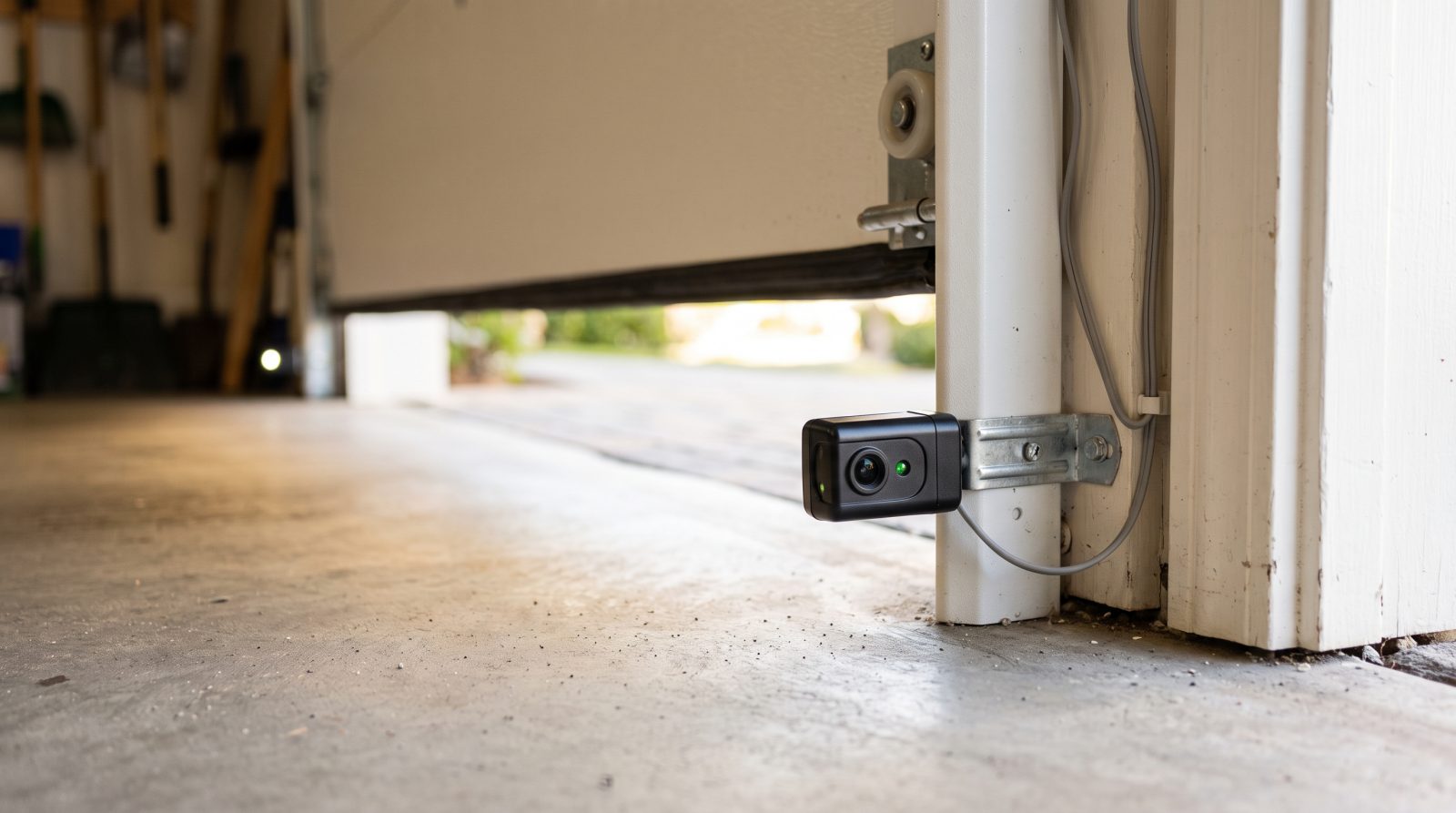
Every residential garage door opener manufactured in the United States since 1993 is required to include an external entrapment-protection device. In practice, that almost always means a pair of photoelectric sensors — commonly called photo-eyes — mounted on the vertical tracks roughly four to six inches above the floor on each side of the opening. One unit sends an invisible infrared beam straight across the doorway; the other receives it. As long as that beam travels uninterrupted from sender to receiver, the opener knows the path is clear and allows the door to close.
The moment something breaks the beam — a child, a pet, a trash can, a bicycle, even a stray broom handle — the receiving sensor loses the signal and instantly tells the opener to stop and reverse. This is the feature that prevents a heavy door, which can weigh well over a hundred pounds, from closing on a person, vehicle, or object. It is genuinely life-safety equipment, which is why a door that won't close because of the sensors is the system protecting you, not malfunctioning at random.
Most sensors communicate their status with small indicator LEDs. Conventions vary by brand, but a typical setup uses a steady light on the sending eye and a steady light on the receiving eye when the beam is properly aligned and unobstructed. When the receiving eye's light is off, flickering, or blinking, the opener is being told the path is not clear — and it will refuse to close, no matter how many times you press the button.
- Two units per door: a sending eye (emitter) and a receiving eye (detector), one on each track
- Mounted low — usually 4 to 6 inches off the floor — because that's where a child or pet would be
- An unbroken infrared beam means 'clear to close'; a broken or lost beam means 'stop and reverse'
- Indicator LEDs tell you the status at a glance once you learn your opener's light pattern
- Required by federal safety standards on openers built since 1993 — not an optional add-on
Why a Misaligned or Blocked Sensor Stops Your Door From Closing
When a garage door starts to close and immediately reverses — often with the opener's overhead light flashing a set number of times — the system is almost always reporting a sensor problem. The opener interprets a lost beam exactly the same way whether the cause is a real obstruction or a sensor that has simply drifted out of line. From the motor's point of view, 'I can't see the beam' and 'something is in the way' are the same message, and it always errs on the side of safety by refusing to close.
Misalignment is the most frequent cause. The brackets that hold the eyes are thin and easily bumped by a car door, a leaning ladder, a snow shovel, or a curious kid. A nudge of even a few degrees can be enough to send the beam past the receiver instead of into it. Vibration over months and years can slowly walk a bracket out of position, which is why a door that has closed reliably for years can suddenly start reversing for no obvious reason.
Obstruction and dirt are the next most common causes. A cobweb, a film of dust, road salt, or condensation on the lens can scatter the beam enough to break the signal — a frequent issue in humid coastal regions and in cold-climate garages where snowmelt and grit accumulate near the floor. Direct, low-angle sunlight in the morning or evening can also overwhelm some older sensors and cause intermittent reversing that seems to come and go with the time of day. Finally, the small wires running from the eyes back to the opener can corrode, get pinched, chewed by rodents, or pulled loose, cutting the signal entirely.
There's an important safety reason not to fight this. Many openers let you force the door closed by holding the wall-button down continuously, which overrides the sensors. Doing this routinely is dangerous: it disables the exact protection meant to stop the door from crushing whatever is below it. Use a manual override only briefly to secure an open garage, and never as a permanent workaround.
- Door starts down then reverses + flashing opener light = classic sensor fault
- A bump of a few degrees can send the beam past the receiver and trigger constant reversing
- Dust, cobwebs, salt, and condensation on the lens scatter the beam — common in humid and snowy regions
- Low-angle morning or evening sun can wash out older sensors and cause intermittent failures
- Corroded, pinched, or rodent-damaged wiring cuts the signal completely
- Holding the wall button to force the door shut overrides safety — use only briefly, never as a habit
How to Safely Check and Realign Your Sensors
Before assuming the worst, a few minutes of inspection resolves a large share of sensor faults. Start by clearing the doorway and looking at both eyes. Wipe each lens gently with a clean, dry, soft cloth — never a solvent or abrasive, which can cloud the plastic. Check that nothing small (a leaf, a spider's web, a stored item) is sitting in the beam path near the floor.
Next, read the lights. With the door open, look at the indicator LED on each sensor. If the sending eye is lit but the receiving eye is dark or flickering, the beam isn't reaching home. Sight along the line between the two eyes — they should point directly at each other at the same height. If one is visibly tilted or sagging, the bracket has likely shifted. Gently loosen the wing nut or screw on the bracket, nudge the eye until the receiver's light becomes steady, then snug it back down. Move slowly; the alignment 'sweet spot' can be small.
Inspect the wiring where you can see it. Look for staples driven through the insulation, sections gnawed by pests, green corrosion at the terminals, or wires hanging loose. Visible wiring damage is a reasonable reason to stop and call a professional rather than risk a poor splice. Likewise, if the lights stay correct and steady but the door still won't close, the problem may have moved upstream to the opener's logic board or the door's own balance and hardware — territory where forcing the issue can turn a small repair into a larger one.
Keep your expectations realistic about what's a DIY fix and what isn't. Cleaning and realigning sensors is well within reach for most homeowners. Replacing a damaged sensor pair, rewiring, or diagnosing an opener that misreads a perfectly good beam is best handled by a technician who can test the system end to end and confirm the door is safe to operate again.
- Clear the doorway and gently wipe each lens with a dry, soft cloth — no solvents
- Compare the LEDs: sender lit but receiver dark or flickering points to misalignment
- Loosen the bracket, aim the eye until the receiver light is steady, then retighten
- Look for stapled, corroded, chewed, or loose wiring — visible damage means call a pro
- If lights are steady but the door still won't close, the fault is likely the opener or door hardware
- Cleaning and realigning is DIY-friendly; rewiring and sensor replacement usually aren't
When Sensor Trouble Is Actually an Urgent Garage Door Problem
Most sensor faults are a nuisance, not an emergency — but a few situations deserve faster attention. A garage door stuck in the open position is a real security concern: it leaves your home, vehicles, and belongings exposed, and in many homes the garage is a direct entry point into the house. If your door won't close and you can't quickly restore the sensors, your first priority is to secure the opening, not to walk away from it.
If you must leave a door open while waiting for help, you can usually close it manually. Pull the emergency release cord (the red handle hanging from the opener trolley) to disengage the door from the motor, then lower the door by hand and, if your door has a manual lock, engage it. Only do this if the door is properly balanced and feels controllable; a door that slams down or won't stay put when released may have a spring or cable problem, which is a separate and more hazardous issue. Never stand under a moving door, and keep hands clear of the tracks and hinges.
Treat sensor symptoms as a warning, not just an inconvenience. A door that intermittently reverses, makes new grinding or popping sounds, hangs crooked, or feels heavy when moved by hand may be signaling a spring, cable, or track problem that the sensor fault is only partly masking. Forcing a door in that condition — especially by overriding the safety eyes — is how a manageable repair becomes a snapped cable, a broken spring, or a door off its track. When in doubt, stop operating it and get a same-day inspection rather than risk a sudden failure.
- A door stuck open is a security risk — securing the opening comes first
- Use the red emergency-release cord to lower a balanced door by hand, then lock it if you can
- If the door slams, won't stay down, or feels heavy, suspect a spring or cable problem — stop and call
- New grinding, popping, crooked hanging, or heaviness alongside sensor faults points to bigger hardware issues
- Never stand under a moving door and never override the eyes to force a door you don't trust
Keeping Your Safety Sensors Reliable Year-Round
A little routine care keeps the photo-eyes doing their job and spares you the morning surprise of a door that won't close. Roughly every few months, wipe the lenses, glance at the indicator lights, and make sure nothing is stored in the beam path. Garages collect clutter near the floor, and a misplaced bin is one of the most common reasons a door suddenly starts reversing.
Climate matters more than most homeowners realize. In humid and coastal areas, condensation and corrosion are the usual enemies, so check terminals and lenses more often and keep an eye on moisture near the floor. In cold-climate garages, road salt, grit, and snowmelt build up exactly where the sensors live, and freezing temperatures can make brittle brackets and aging wiring more fragile. In hot, dusty, or high-sun regions, fine dust films and intense low-angle sunlight are the more likely troublemakers. Tailoring your quick checks to your local conditions goes a long way.
Finally, fold the sensors into a broader safety habit. Once or twice a year, test the reversal feature: with the door open, place a sturdy object in the beam path and try to close the door — it should refuse — and separately test the door's contact reversal by placing a solid object flat on the floor in the door's path. A door that fails either test should not be used until it's repaired. These small habits are what stand between a routine garage and an avoidable injury. If your checks turn up a misaligned, damaged, or unreliable sensor — or any sign of a spring, cable, or track problem behind it — request a free quote and get it looked at promptly rather than living with a door you can't fully trust.
- Wipe lenses, check the lights, and clear the beam path every few months
- Humid and coastal homes: watch for corrosion and condensation at the lenses and terminals
- Cold climates: clear salt, grit, and snowmelt and expect brittle brackets and wiring in winter
- Hot, dusty, high-sun regions: dust films and low-angle sunlight are the usual culprits
- Test the reversal feature a couple of times a year and stop using a door that fails
- Catch sensor and hardware issues early to avoid a stuck or unsafe door later